Lab-grown
Gryrigns lab ruby, emerald cut, 20 x 15 mm
about $35
- Synthetic red corundum
- 29.83 ct, 20 x 15 mm
The best value on the list: roughly a dollar a carat for a stone you could not buy mined at any sane price.
See it on AmazonLab-grown ruby and sapphire are real , and corundum is cheap to grow, so a 30 carat lab ruby costs about $35 on Amazon. The catch is that red glass looks the same in a photo. Every stone below passed three checks: the listing says lab-grown, created or synthetic and names the mineral; the carat weight matches the size for that mineral; and the seller has a record. Then use the home tests when it arrives.
Loose stones first, then jewellery you can wear. Gryrigns stones (sold by Ms. Ring) are the value pick for size: every listing says synthetic red corundum and gives both millimetres and carats, and the carats match corundum. CHINALUSTER (sold by Onedia) is the pick for smaller stones in many cuts.
Lab-grown
about $35
The best value on the list: roughly a dollar a carat for a stone you could not buy mined at any sane price.
See it on AmazonLab-grown
about $30
The oval version of the same size. An oval is shallower than an emerald cut, so it weighs less for the same face.
See it on AmazonLab-grown
about $40
A stone the size of a large coat button.
See it on AmazonLab-grown
about $55
The biggest faceted ruby on the list, and a showpiece for a desk or display case.
See it on AmazonLab-grown
about $20
Smaller stones for setting in jewellery. We have bought from this seller before and liked the stones.
See it on AmazonLab-grown
about $25
A teardrop for a pendant or a pair of drop earrings.
See it on AmazonLab-grown
about $18
The cheapest lab ruby necklace we trust: small stones in a flower setting, sold by Amazon itself.
See it on AmazonLab-grown
about $22
Leverbacks close like a latch, so they do not fall out.
See it on AmazonLab-grown
about $70
Real gold posts at a gift price.
See it on AmazonLab-grown
about $50
Big pear-shaped drops: lab ruby makes this size affordable.
See it on AmazonLab-grown
about $110
From a seller that sells only lab-grown stones.
See it on AmazonLab-grown
about $250
PEORA is a lab gem specialist; this is their solid-gold line.
See it on AmazonLab-grown
about $75
A plain silver bar with one small ruby: a lab ruby a man can wear every day.
See it on AmazonSold as natural
about $25
Green zoisite with red ruby spots. There are no real lab ruby beads on Amazon; this is the honest way to string ruby.
See it on AmazonSold as natural
about $65
Natural bead-grade ruby: pinkish and cloudy, nothing like a cut gem, but real corundum.
See it on AmazonLab-grown
about $18
Real lab corundum balls, sold mostly as hot-glass accessories. No hole, so not for stringing as they are; a beautiful way to own a handful of perfect lab ruby.
See it on AmazonLab-grown
about $25
A mixed bag of sizes for a display dish or resin work.
See it on AmazonLab-grown
about $10
The cheapest way to hold lab ruby.
See it on AmazonLab-grown
about $15
Same material from another seller.
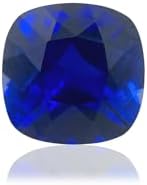
See it on AmazonLoose stones first, then jewellery for women and men. Blue sapphire is the same mineral as ruby (corundum) with iron and titanium instead of chromium, so the same weight check works. Here it is in every common cut, from an 8 mm square to a 29 carat emerald cut, biggest first.
Lab-grown
about $75
The biggest blue on the list. Sapphire costs more to grow in this colour than ruby, and the price shows it. Still a few dollars a carat.
See it on AmazonLab-grown
about $55
The same face as the emerald cut above, but an oval is shallower, so it weighs less and costs less.
See it on AmazonLab-grown
about $60
The classic emerald-cut size for a statement ring or pendant: long step facets that show the inside like a window.
See it on AmazonLab-grown
about $50
A large ring or pendant stone.
See it on AmazonLab-grown
about $35
A big oval at about three dollars a carat.
See it on AmazonLab-grown
about $25
A teardrop for a pendant. Pears are cut to keep the most weight from a tapering piece of rough.
See it on AmazonLab-grown
about $25
The lighter Kashmir-style blue in a bigger radiant: cropped corners with brilliant facets, so it sparkles more than an emerald cut.
See it on AmazonLab-grown
about $20
A lighter, softer blue than royal blue, the colour of the famous Kashmir stones.
See it on AmazonLab-grown
about $25
A round brilliant for a classic solitaire setting.
See it on AmazonLab-grown
about $20
A pillow-shaped square with soft corners, the cut of the Logan and many antique sapphires.
See it on AmazonLab-grown
about $20
A sharp-cornered square brilliant. Set it with corner prongs, because points chip.
See it on AmazonLab-grown
about $195
Several times the price of the Gryrigns ovals. You pay for a lab report and finer cutting, not a different mineral: both are corundum.
See it on AmazonLab-grown
about $35
Cut the old-fashioned way and honest about inclusions, so it looks more like a mined stone than a flawless cut. Ships on lead time.
See it on AmazonLab-grown
about $25 for the largest
One listing with every size, so you can match a setting.
See it on AmazonLab-grown
about $25
Hundreds of ratings. Simple round studs that go with everything.
See it on AmazonLab-grown
about $30
A bigger oval for more colour.
See it on AmazonLab-grown
about $30
Sold by Amazon itself, with hundreds of ratings.
See it on AmazonLab-grown
about $25
A halo-style ring with hundreds of ratings, at the price of the stone alone.
See it on AmazonLab-grown
about $70
A full ring of small sapphires, made to stack.
See it on AmazonLab-grown
about $330
Solid gold and square stones: the classic look for less than one natural sapphire of this size.
See it on AmazonLab-grown
about $280
The matching pendant.
See it on AmazonLab-grown
about $130
A heavy, plain mens ring with one big sapphire. The best mens lab gem ring we found.
See it on AmazonLab-grown
about $150
A square-cut sapphire in a classic mens setting.
See it on AmazonLab-grown
about $17
Lab blue sapphire, polished into perfect balls. No hole: for display, resin or wire-wrapped cages.
See it on AmazonLoose stones, then jewellery. We found no mens lab emerald jewellery we could trust. Lab emerald is lab-grown , made slowly by the flux or hydrothermal method, and it costs tens of dollars a carat, not cents. A huge "lab emerald" for a few dollars is glass. Only the listings below passed, from a thousand-dollar showpiece down to a ring stone.
 Lab-grown About $1,070 11 to 15 ct, 18 x 13 mm, emerald cut on Amazon →
 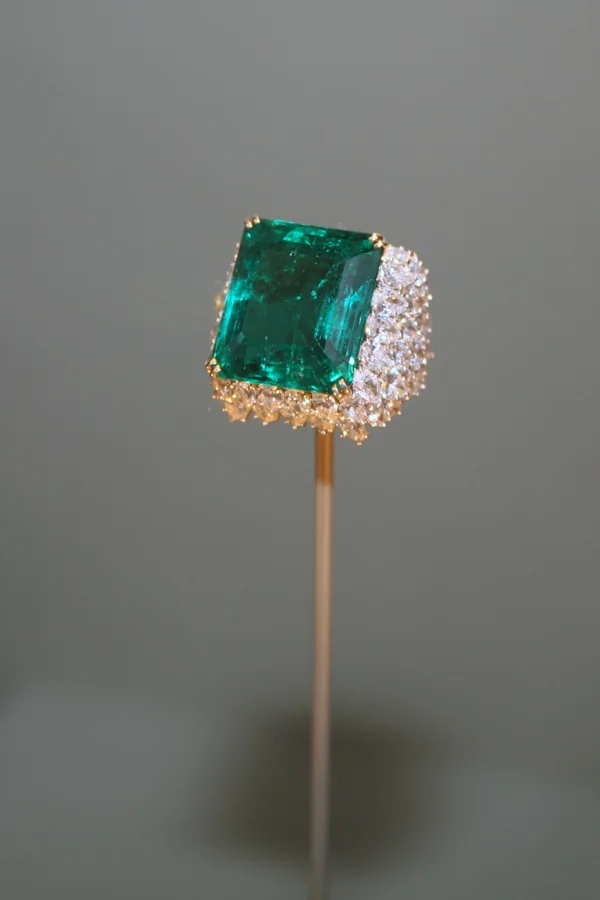 Natural About $580,000 to $750,000 14 to 15 ct Colombian, emerald cut, with a Swiss lab report
 There is no natural counterpart on Amazon we trust. Search for one and you will find 11 carat natural Colombian emeralds for under $50; at that price they are glass, dyed quartz or cloudy low-grade beryl.
So we checked a major dealer instead. In October 2026 LEIBISH listed natural Colombian emeralds in the emerald cut at 14.33 ct, with a GRS report, for about $752,000, and at 14.90 ct, with a Gübelin report, for about $579,000. The cheapest natural Colombian stone it listed between 10 and 16 ct, an 11.9 ct pear, was about $35,000.
The lab emerald beside it costs about $1,070: roughly one six-hundredth of the price, for the same mineral.
Source: LEIBISH, natural Colombian emeralds (asking prices), checked October 11, 2026. Photo: the Chalk Emerald (natural, Colombia), Cliff, CC BY 2.0.
Lab emerald grows two ways. Hydrothermal emerald grows as flat slabs on a inside a pressure vessel; flux emerald grows as clusters of six-sided crystals in a molten salt. We searched Amazon for real lab emerald rough and found no listing we could trust: every cheap "lab emerald rough" is glass, at a few cents a carat, for a material that costs dollars a carat to grow. So here are museum photos instead.
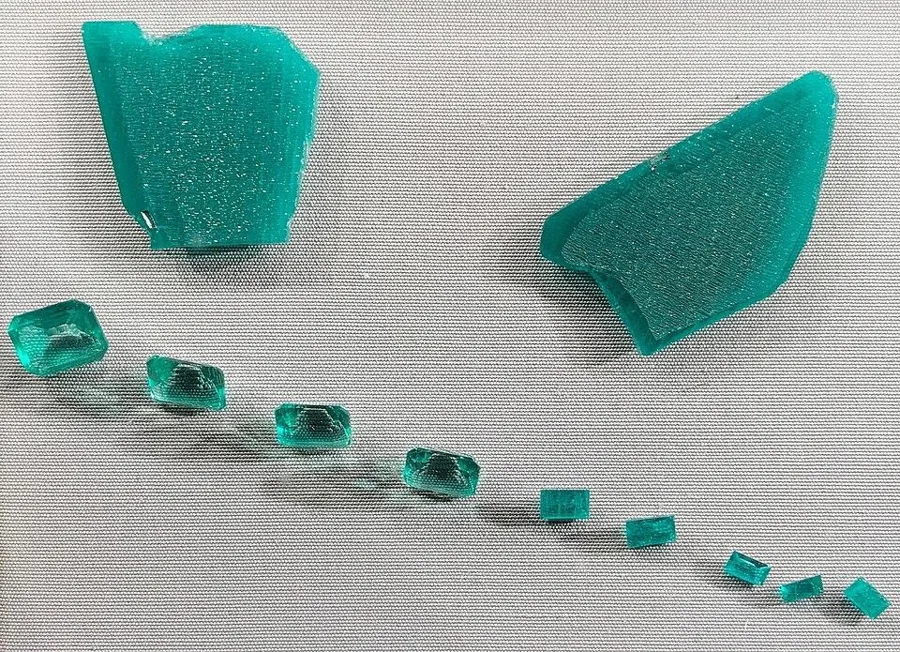
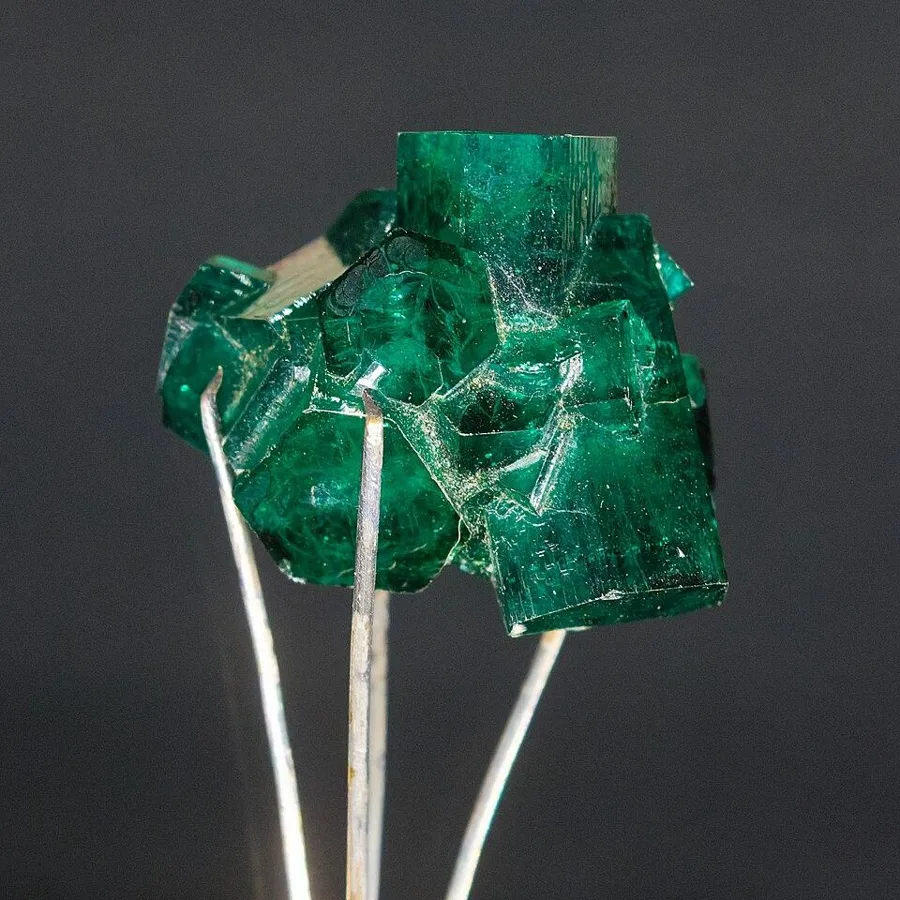
No listing on Amazon. Cut lab emeralds are in the grid below.
Lab-grown
about $1,070
The big one, and the most honest price tag on this page. A lab ruby this size costs about $35; a lab emerald costs a thousand dollars, because it grows for months in a flux or an and most of the crystal is lost in cutting. Any big lab emerald for a few dollars is glass, and this listing is how you know.
See it on AmazonLab-grown
about $300
A softer cushion shape, for a centre stone.
See it on AmazonLab-grown
about $230
The middle step: a real ring centre at about a fifth of the big stone price.
See it on AmazonLab-grown
about $170
Price climbs steeply with size, which is exactly what real lab emerald does.
See it on AmazonLab-grown
about $95
A three-sided cut, flat and wide, so it looks bigger than its weight.
See it on AmazonLab-grown
about $75
The entry size from a long-running lab gem seller.
See it on AmazonLab-grown
about $75
Pick the Colombia or Zambia colour only. The same listing also sells YAG, which is a different crystal and not emerald.
See it on AmazonLab-grown
about $90
The listing names the growth method and admits inclusions, both signs of an honest seller. Ships on lead time.
See it on AmazonLab-grown
about $38
The matching earrings.
See it on AmazonLab-grown
about $170
From a seller that sells only lab-grown stones.
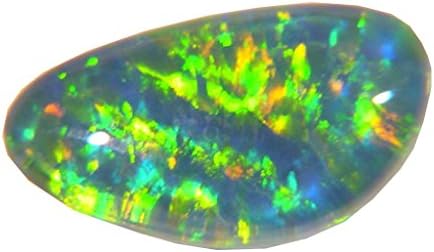
See it on AmazonLab gems with an optical trick: a six-rayed star that glides across the dome, and opal that shows real play of colour.
Lab-grown
from about $15
Lab star corundum (the old Linde type). Hold it under one bright light and the star moves as you tilt it.
See it on AmazonLab-grown
from about $15
The same effect in blue.
See it on AmazonLab-grown
about $13
Pierre Gilson brought lab-grown opal to market in the 1970s. Old lapidary stock with no reviews yet, so treat it as a curiosity.
See it on AmazonNot lab gems, but the pieces people are most surprised they can buy. Meteorites are sold as genuine with a certificate; the minerals are sold as natural.
Meteorite
about $25
Iron from a meteorite shower that fell on Argentina some 4,000 to 5,000 years ago. The iron itself is about 4.5 billion years old.
See it on AmazonMeteorite
about $15
The cheapest way to hold a piece of space. A good gift for a child.
See it on AmazonMeteorite
about $100
Etched Muonionalusta shows the Widmanstatten pattern, a crystal lattice that only forms in metal cooling over millions of years inside an asteroid.
See it on AmazonMeteorite
about $50
The same Swedish meteorite set into a coin.
See it on AmazonLab-grown
about $20
Grown from molten bismuth into stepped "staircase" crystals. The rainbow is a thin oxide layer, not paint.
See it on AmazonSold as natural
about $25
Pink inside, green outside, grown as one crystal while the chemistry of the fluid changed.
See it on AmazonSold as natural
about $25
Turn it in the light and a blue and gold flash appears, then vanishes. Light scattering between thin layers inside the stone does it.
See it on AmazonSold as natural
about $30
Natural opal with rainbow fire, from the Welo deposits found in 2008.
See it on AmazonSold as natural
about $30
Gold needles of rutile frozen inside clear quartz.
See it on AmazonSold as natural
about $75
Fossil ammonite shell turned iridescent over about 70 million years; gem ammolite comes from Alberta. New listing with no reviews, so check what arrives.
See it on AmazonUse the buttons to see jewellery for women, for men, or beads. Jade is two different stones: jadeite (rarer, mostly from Myanmar) and nephrite (from Canada, China and New Zealand). Neither is grown in labs. Most cheap jade on Amazon is dyed quartzite, serpentine or glass, so every listing here names jadeite or nephrite.
Sold as natural
about $385
Hetian is the jade Chinese emperors prized for 2,000 years. A bangle is cut from one solid block and most of the stone becomes waste, which is why it costs what it does.
See it on AmazonSold as natural
about $130
The same material at a lower grade, with a certificate in the box.
See it on AmazonSold as natural
about $235
A Maori-style hei tiki in greenstone. A big, heavy carving, made to be worn for life.
See it on AmazonSold as natural
about $95
The roimata, a teardrop shape from Maori carving. Smaller and simpler than the tiki.
See it on AmazonSold as natural
about $130
A detailed carving. Nephrite is extraordinarily tough, which is why it holds fine undercut work like this.
See it on AmazonSold as natural
about $80
Jadeite, the rarer of the two jades. Grade A means untreated: no bleach, no polymer, no dye.
See it on AmazonSold as natural
about $120
Carved jadeite on a solid gold bail. A gift that is real all the way through.
See it on AmazonSold as natural
about $35
The magatama, a comma shape worn in Japan for more than 2,000 years, in jadeite.
See it on AmazonSold as natural
about $45
British Columbia is one of the biggest nephrite sources on earth. Deep spinach green, the classic Canadian colour.
See it on AmazonSold as natural
about $20
Canadian nephrite from a well-reviewed bead seller.
See it on AmazonUse the buttons to switch between jewellery, loose stones, beads and raw pieces. A warning: one big seller lists "created lapis" earrings; lapis is not grown in labs, so "created" there means imitation. Lapis is a rock, not a single crystal: blue lazurite with gold pyrite and white calcite. It is not grown in labs, and the fakes are dyed howlite and glass. The finest still comes from the Kokcha valley in Afghanistan, mined for more than 6,000 years.
Sold as natural
about $45
A whole ball of lapis shows how it really looks: deep blue, gold pyrite sparks and white calcite veins all the way through.
See it on AmazonSold as natural
about $30
The same size from the same seller at a lower price; the pattern varies piece by piece.
See it on AmazonSold as natural
about $45
A single certified stone, ready for a ring or pendant, in the deep blue of the Tutankhamun treasures.
See it on AmazonSold as natural
about $60
A finer-grade bracelet, with a more even blue than the bargain strands.
See it on AmazonSold as natural
about $17
The classic source of lapis for 6,000 years. More than a thousand reviews.
See it on AmazonSold as natural
about $20
A pile of polished stones for jewellery making, or to see how much one rock varies.
See it on AmazonSold as natural
about $20
Flat backs for gluing into bezels and wire wraps.
See it on AmazonSold as natural
about $13
Tumbled pieces, the cheapest way to hold real Afghan lapis.
See it on AmazonSold as natural
about $20
Rough for tumbling or cabbing.
See it on AmazonSold as natural
under $10
Tumbled raw chips with grey and white matrix: lapis the way it comes out of the ground, for the price of a coffee.
See it on AmazonSold as natural
about $30
Handmade, with hundreds of ratings.
See it on AmazonSold as natural
about $58
A big oval of blue with gold pyrite flecks.
See it on AmazonSold as natural
about $50
Old-style silver lace around the stone.
See it on AmazonSold as natural
about $23
More than a thousand ratings.
See it on AmazonSold as natural
about $50
Flat round that show the blue.
See it on AmazonSold as natural
about $95
Flat square beads on a braided cord: the most masculine lapis piece we found.
See it on AmazonSold as natural
about $18
A simple unisex bead bracelet with hundreds of ratings.
See it on AmazonCarnelian is orange chalcedony, a fine-grained quartz coloured by iron. It is not grown in labs; much of it is gently heat-treated to deepen the red, which is normal and stable. Hold it up to a light: real carnelian glows through.
Sold as natural
about $40
A polished ball shows the banding and the glow from every side.
See it on AmazonSold as natural
about $70
A handmade band from a small maker, with an oval carnelian set in patterned silver.
See it on AmazonSold as natural
about $30
Calibrated so they drop straight into standard settings.
See it on AmazonSold as natural
about $20
Big ovals showing the cloudy orange-to-red variation of natural stone.
See it on AmazonSold as natural
about $20
A deeper red, typical of heat-treated carnelian.
See it on AmazonSold as natural
about $12
Faceted beads catch light the way a cut gem does, unlike smooth rounds.
See it on AmazonSold as natural
about $10
The easiest everyday way to wear it.
See it on AmazonSold as natural
about $20
From a long-running lapidary supplier. Mixed carnelian and agate for cabbing or tumbling.
See it on AmazonSold as natural
about $15
A natural mix of orange, red, grey and white pieces. That variety is what untreated material really looks like.
See it on AmazonSold as natural
about $30
Handmade, with hundreds of ratings.
See it on AmazonSold as natural
about $80
NOVICA sells work from artisans around the world.
See it on AmazonSold as natural
about $45
A smooth drop of carnelian on a cord, for men or women.
See it on AmazonSold as natural
about $12
Big holes take thick cord or leather, perfect for the tie-on bracelet below.
See it on AmazonTurquoise is not grown in labs, and it is the most faked stone on Amazon: most cheap turquoise beads are white howlite or magnesite dyed blue. We found no turquoise beads on Amazon we could trust, so this section is jewellery from sellers who name the real stone.
Sold as natural
about $90
A big slab of turquoise with dark matrix lines. Sized for men or women.
See it on AmazonSold as natural
about $100
Turquoise inlaid into a silver turtle.
See it on AmazonSold as natural
about $100
Teardrops in matching sizes.
See it on AmazonSold as natural
about $30
Sleeping Beauty is a famous Arizona mine known for even sky blue.
See it on AmazonSold as natural
about $60
From the same maker as the lapis bracelet.
See it on AmazonTigers eye is quartz that replaced blue asbestos fibres, keeping their shape; that is what makes the band of light. It is cheap, natural and rarely faked.
Sold as natural
about $100
A heavy carved silver ring with a big golden cabochon. Hundreds of ratings.
See it on AmazonSold as natural
about $30
The same maker as the lapis and carnelian rings.
See it on AmazonSold as natural
about $14
Thousands of ratings for a plain bead bracelet.
See it on AmazonSold as natural
about $15
Made in the USA, sized for wrists.
See it on AmazonSold as natural
about $12
The blue form, coloured by the same crocidolite fibres before they turned golden.
See it on AmazonSold as natural
about $8
Tigers eye is cheap and rarely faked, which makes it a good first strand.
See it on AmazonSold as natural
about $20
Turn one under a lamp and watch the gold band roll across it.
See it on AmazonReal gem beads are the cheapest way to own lapis, ruby, jade, carnelian and tigers eye, and to start a collection you can wear. Every strand below is the real stone; the cords are what you string them on.
Be honest about the knot: this is a makeshift bracelet. The knot stays tied until you untie it or cut it, and stretch cord wears out in time. When you want jewellery that opens and closes, the next step costs a little more: beading wire, crimp beads and a clasp (below the grid).
Sold as natural
about $25
Green zoisite with red ruby spots. There are no real lab ruby beads on Amazon; this is the honest way to string ruby.
See it on AmazonSold as natural
about $65
Natural bead-grade ruby: pinkish and cloudy, nothing like a cut gem, but real corundum.
See it on AmazonLab-grown
about $18
Real lab corundum balls, sold mostly as hot-glass accessories. No hole, so not for stringing as they are; a beautiful way to own a handful of perfect lab ruby.
See it on AmazonLab-grown
about $25
A mixed bag of sizes for a display dish or resin work.
See it on AmazonLab-grown
about $10
The cheapest way to hold lab ruby.
See it on AmazonLab-grown
about $15
Same material from another seller.
See it on AmazonLab-grown
about $17
Lab blue sapphire, polished into perfect balls. No hole: for display, resin or wire-wrapped cages.
See it on AmazonSold as natural
about $20
Canadian nephrite from a well-reviewed bead seller.
See it on AmazonSold as natural
about $17
The classic source of lapis for 6,000 years. More than a thousand reviews.
See it on AmazonSold as natural
about $12
Faceted beads catch light the way a cut gem does, unlike smooth rounds.
See it on AmazonSold as natural
about $12
Big holes take thick cord or leather, perfect for the tie-on bracelet below.
See it on AmazonSold as natural
about $12
The blue form, coloured by the same crocidolite fibres before they turned golden.
See it on AmazonSold as natural
about $8
Tigers eye is cheap and rarely faked, which makes it a good first strand.
See it on AmazonBead supplies
about $8
Thread a few large-hole beads, wrap it round your wrist, tie a knot. More than a thousand ratings.
See it on AmazonBead supplies
about $12
The classic stretch bracelet cord: slips over the hand, no clasp needed.
See it on AmazonBead supplies
about $7
A huge spool for the price, a little thicker for bigger beads.
See it on Amazon Beadalon 49-strand beading wire, 0.46 mm, 10 ftThe wire jewellers use for strung necklaces: strong, flexible, and it hangs like thread.about $10 on Amazon →
  Acejoz crimp bead and clasp kit, 2,165 piecesCrimp beads squeeze shut on the wire to hold a clasp, so the piece opens and closes like store-bought jewellery.about $15 on Amazon →
 We found no lab ruby beads and no turquoise beads we could trust on Amazon: lab corundum is not drilled into beads at bead prices, and almost every cheap turquoise strand is dyed howlite or magnesite. The ruby strands above are natural ruby.
Every cut stone above started as a lump like these. This is what comes out of the furnace or the press, before a cutter touches it, and you can buy it: cutters facet it, collectors keep it as it is, and it is the clearest way to see that a lab gem is a grown crystal, not moulded glass. Glass is poured into a mould; a boule is one continuous crystal built drop by drop. After the ruby, sapphire and diamond rough come three other crystals labs grow, from the colourless sapphire in phone cameras to the furnace rock that moissanite comes from. More on each method in how lab gems are grown.
Flame fusion (Verneuil)
This is what a lab ruby looks like the moment it comes off the furnace: one single crystal shaped like a fat crayon, called a boule. Powdered alumina with a pinch of chromium falls through a hydrogen and oxygen flame hotter than 2,000 C, melts, and lands drop by drop on a slowly sinking ceramic rod. The crystal grows upward in a matter of hours, and the flame leaves the outside slightly rippled and dull. It is dark because you are looking through a thick block; cutting thin faceted stones from it lets the light back out as red.
Gryrigns lab ruby rough, 600 ct, about $85
Flame fusion (Verneuil)
A boule cools fast and is full of internal strain, so it is usually split lengthwise, often with nothing more than a tap. One side is the rounded outer skin from the furnace; the other is the bright, glassy break face. Cutters orient their stones from that flat face. Inside, the crystal has like the layers of an onion, which is how a gemologist later knows a cut stone grew in a flame.
Gryrigns lab ruby rough, 250 ct, about $40
Flame fusion (Verneuil)
The same story at a larger size: a half boule with a long, clean split face. A cutter keeps only part of the weight, because most of a rough piece ends up as dust on the lap, so a 350 carat boule becomes a handful of finished stones.
Gryrigns lab ruby rough, 350 ct, about $55
Flame fusion (Verneuil)
Sapphire is grown the same way, with iron and titanium in the powder instead of chromium. Look at the rounded end: that dome is the growing surface, where the molten drops landed last. It looks almost black because blue sapphire absorbs so strongly through a thick piece; thin cut stones show the royal blue.
Gryrigns lab sapphire rough, 150 ct, about $65
HPHT (high pressure, high temperature)
Lab diamond does not come from a flame. Carbon dissolved in molten metal is squeezed in a press at around 5 to 6 gigapascals, the pressure 150 kilometres down, at 1,300 to 1,600 C, and diamond crystallises out over hours to days. It grows cube and octahedron faces at the same time, which gives these blocky, many-sided crystals. The yellow is nitrogen, from the air and the raw materials, trapped in the lattice; crystals like these are made by the tonne for cutting tools and abrasives. Colourless gem diamonds need the nitrogen kept out.
Lab-grown yellow diamond rough, single crystal, about 0.26 ct, about $35
Kyropoulos and other industrial methods
Most lab sapphire on earth is never a gem. It is grown colourless, in crystals weighing tens of kilograms, then sawn into windows, phone camera covers, watch crystals and LED substrates. This little disc is the same aluminium oxide as a royal blue sapphire, minus the iron and titanium. Scratch it with steel and nothing happens: only diamond and moissanite are harder.
Optical sapphire window, 10 mm, 1 mm thick, about $30
Czochralski pulling
The Czochralski method dips a seed into a molten bath and pulls a crystal up out of it, rotating slowly. Some lab ruby, sapphire and alexandrite are grown this way, but its real job is silicon: almost every computer chip starts as a pulled silicon crystal the size of a person. These glassy grey shards are broken offcuts of that kind of crystal, sold as monocrystalline. They show the shell-like fracture of a single crystal, with no grain boundaries.
Monocrystalline silicon chunks, 100 g, about $15
Acheson furnace (sold as natural, but it is not)
These spiky rainbow clusters are often listed as natural carborundum. They are not: natural (moissanite) exists only as microscopic grains, first found in a meteorite crater in Arizona. These grow in an industrial furnace, invented by Edward Acheson in 1891, where sand and carbon are baked at about 2,500 C to make abrasive grit. It is the same compound as moissanite, the gem, which is grown far more slowly and cleanly. The rainbow is a thin surface layer, like the colours on bismuth. A lab crystal people buy as a natural mineral, and a lesson in reading listings.
Justinstones rainbow carborundum with stand, about $13
Short answer: no. Lab ruby rough costs about 15 cents a carat from sellers with reviews (a 600 carat boule is about $85; about 44 cents for blue sapphire), so the stone itself is almost free. What costs money is the cutting. A cutter keeps only about 20 to 35 percent of the rough weight; the rest is ground to dust. So a 5 carat finished ruby needs 15 to 20 carats of rough, about $3 worth, and a 30 carat stone needs about 100 carats, about $15 worth.
| Route | 5 ct stone | 30 ct stone | How the price works |
|---|---|---|---|
| Buy it already cut | about $25 | about $35 | A CHINALUSTER 5 ct pear, or the Gryrigns 29.83 ct emerald cut. Machine-cut, ready to set. |
| Raw rough + a commercial cutting house | about $35 to $65 | about $200 to $250 | About $6 per finished carat, or a per-stone fee; often overseas. |
| Raw rough + a US custom cutter | about $325 | about $1,400 | $85 a stone plus $35 a carat, plus 25 percent because corundum is hard. |
| Raw rough + a precision cutter | about $500 to $650 | $3,000 or more | $99 to $129 per finished carat, or $299 an hour. |
| Raw rough + cut it yourself | about $3 of rough | about $15 of rough | Plus a starter machine, about $260 to $500 once, and your time. |
Buying a lab stone already cut wins by a wide margin, because the factories that grow corundum also cut it by machine in huge batches, for very little per stone. Paying a person to cut one stone by hand costs 10 to 100 times what the stone is worth. Raw lab rough makes sense for three things:
 VEVOR gem faceting machine with angle manipulatorThe entry-level faceting machine: a variable-speed lap plus an arm that holds the stone at an exact angle.about $265 on Amazon →
  Mxmoonant gem faceting machine, 96 index wheelA step up, with a 96-tooth index wheel for more facet positions.about $400 on Amazon →
  HARFINGTON diamond lap set, 120 to 3000 grit, 6 inchNine laps from coarse cutting to fine pre-polish. Corundum is hard, so diamond laps do the work.about $40 on Amazon →
  JuxLux lapidary dop wax, 140 gHolds the stone on the dop stick while you cut.about $10 on Amazon →
  GemOro 10x triplet loupeCheck every facet meeting point as you go.about $17 on Amazon →
 The two lab ruby rough listings that look cheapest per carat are copies of the Gryrigns titles from new sellers with no reviews (about 10 cents a carat), and the huge 450 to 2,250 carat "lab created" lots come from a seller that also sells 2,000 carat "lab emerald" for under 2 cents a carat, which cannot be real beryl. We stick to sellers with a record. Cutting prices come from published price lists, some a few years old, so ask any cutter for a written quote first: Lambert, Gem Mountain, The Gemstone Artist, International Gem Society on yield.
Real lab emerald rough is not sold cheaply on Amazon: the 200 to 800 carat "lab emerald rough" listings for about $20 are glass. Hydrothermal emerald grows as a flat slab on a seed plate over weeks, and costs dollars per carat.
Labs keep pushing size. These are the largest lab-grown stones and crystals on record that we could source, and beside each one, a small piece of the same thing you can own.
75.33 ct
A square emerald cut grown by CVD in India by Ethereal Green Diamond, graded by IGI and shown at the JCK show in Las Vegas in 2024. The rough weighed about 190 carats and took about 270 days to grow, then about 30 days to cut. The record before it, the 50.25 ct "Shiphra", lasted a year.
Source: IGI · See the stone in IGI’s photos.
150.42 ct
The record for HPHT, the high-pressure method. CVD reactors grow bigger rough, like the 190 ct slab the diamond above was cut from, but HPHT grows a true chunky crystal, and this is the largest: a blue crystal about 28 mm across, grown in a press by Alkor-D, part of Meylor Global, in Ukraine, and examined by IGI in 2022. A 141.58 ct grey crystal came out of the same work.
Source: JCK.
720 kg
About 3.6 million carats of colourless sapphire, grown in China by a modified Kyropoulos method and reported in 2021, then sliced into windows 640 mm across. Russia’s Monocrystal has grown 350 kg crystals.
Source: Journal of Synthetic Crystals.
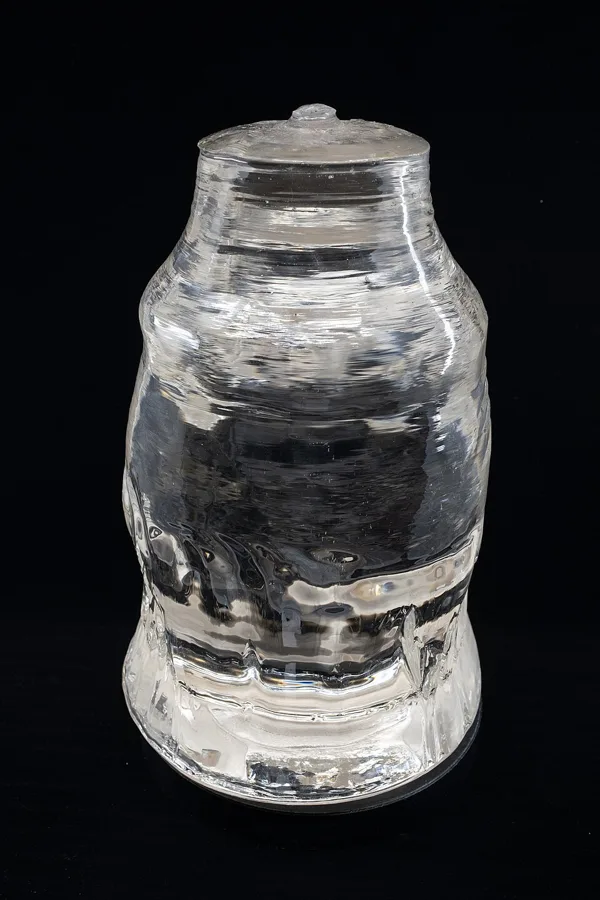
4,759 ct
A polished star ruby sphere about 77 mm across, close to the size of a baseball, examined by GIA in Tokyo in 2019 along with a 467 ct lab star sapphire. GIA called them among the largest lab star stones it had seen, and judged the ruby too big for flame fusion: most likely pulled from a melt.
Source: GIA, Gems & Gemology.
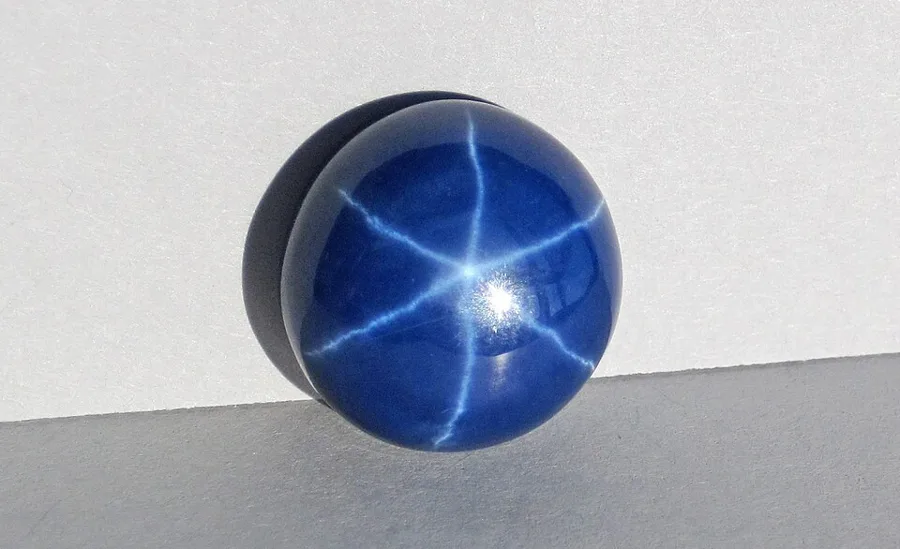
437 ct
A Gilson flux-grown emerald crystal about 60 by 40 mm. Lab emerald grows a few millimetres a month, so a crystal this size took far longer than any diamond or sapphire on this list.
Source: International Gem Society.
15 ct → 600 ct
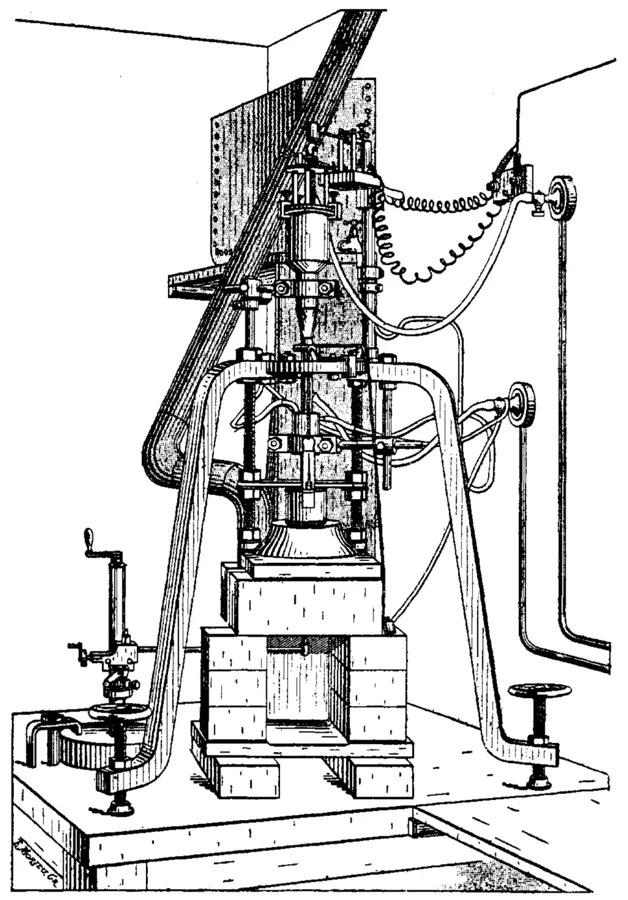
Auguste Verneuil’s first boules in 1902 weighed 12 to 15 carats after about two hours in the flame. Today a 600 carat ruby boule from the same process is an ordinary listing.
Source: Chemistry World.
None of these needs a gem lab. Run them inside the return window.
A carat scale (a few dollars) and digital calipers. Measure length, width and depth in millimetres, weigh in carats, and put the numbers in the checker below. Corundum lands near 4.0; glass near 2.5; cubic zirconia near 6.
A 365 nm UV torch makes lab ruby glow a strong red, from the chromium that colours it. Most red glass stays dark. A strong glow is a good sign; no glow at all on a "ruby" is a red flag.
Rub a cotton bud with nail polish remover on a hidden spot. Blue on the swab means dyed stone, often howlite or jasper sold as "Swiss lapis". Real lapis also shows gold flecks of pyrite and a little white calcite.
Shine a torch through it. Dye collects in cracks and along bands, so the colour looks like veins. Natural colour sits evenly through the stone. Real jade also resists a steel knife.
An estimate: cutting proportions vary, so allow about 15 percent either way.
| Material | Density | Note |
|---|---|---|
| Ordinary glass | 2.4 to 2.6 | The most common fake |
| Quartz | 2.65 | |
| Beryl (emerald) | 2.7 | Almost the same as glass, so weight cannot catch fake emerald |
| Diamond | 3.52 | |
| Spinel | 3.6 | Sometimes sold as "ruby" |
| Corundum (ruby, sapphire) | 4.0 | Lab and mined alike |
| YAG | 4.6 | Sold as "lab emerald" or "lab diamond"; it is neither |
| Cubic zirconia | 5.6 to 6.0 | Too heavy |
These turned up while building the list. We do not link them, and you should read their listings carefully if you meet them.
It is real ruby if the listing says lab-grown, created or synthetic corundum, and the weight matches the size. Ruby is corundum coloured by chromium, and corundum has been grown in labs since 1902, so big clean stones are cheap. It is not a mined ruby, which at that size would cost a fortune.
Weigh it and measure it. Corundum is much denser than glass, so a ruby of a given size weighs about 60 percent more than a glass copy. A UV flashlight helps too: lab ruby glows bright red under it, while most red glass stays dark.
Emerald is beryl, and beryl grows slowly by the flux or hydrothermal method over weeks or months. Ruby grows by flame fusion in hours. So a real lab emerald costs tens of dollars a carat, and a huge cheap "lab emerald" is glass.
Amazon links are affiliate links (tag thegemtray-20): buying through them costs you nothing extra and supports the site. As an Amazon Associate we earn from qualifying purchases.