Are lab rubies real rubies?
Yes. A lab ruby is corundum, aluminium oxide coloured red by chromium, exactly what a mined ruby is, with the same hardness (Mohs 9) and the same optics. The difference is origin and price: a lab ruby is grown in weeks instead of millions of years, so a large, clean one is inexpensive. It must be sold as lab-created, created or synthetic ruby, and honest listings say so.
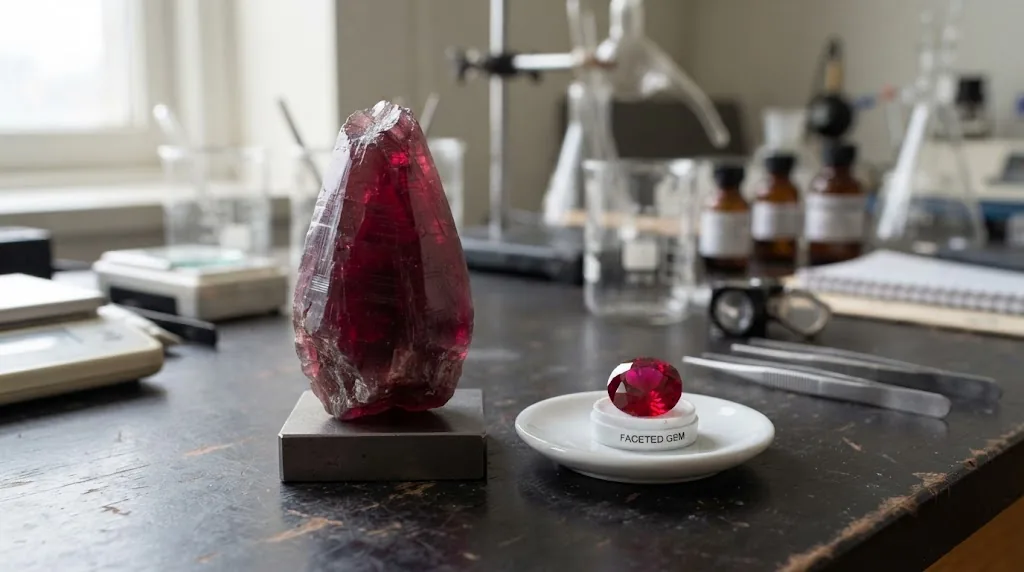
How lab rubies are made
Most inexpensive lab rubies are grown by flame fusion, the method Auguste Verneuil perfected around 1902: powdered aluminium oxide with a little chromium is dropped through a hydrogen-oxygen flame and builds up a pear-shaped crystal called a boule, which is then sawn and cut. Slower methods (flux growth and hydrothermal growth) make lab rubies that look more like mined stones and cost more. Our guide to how lab gems are grown covers all three.
Lab ruby vs mined ruby
Chemically and physically they are the same mineral. A gem laboratory tells them apart by their inclusions and growth features: flame-fusion rubies often show curved growth lines and gas bubbles under magnification, while mined rubies show natural crystals and fingerprints. Lab rubies are usually much cleaner and more evenly coloured than mined rubies at any affordable price.
What the names mean
"Lab-created", "lab-grown", "created" and "synthetic" ruby all mean real ruby made in a lab. "Simulated" or "imitation" ruby means something that only looks like ruby, usually glass. A "composite" ruby is low-grade natural material filled with lead glass, which is fragile and must be disclosed.
Frequently Asked Questions
Do lab rubies test as real ruby?
Yes. On a refractometer, a hardness test or a UV lamp, a lab ruby behaves as ruby. Telling lab from mined takes magnification and, for certainty, a gem laboratory.
Are lab rubies worth anything?
They are worth wearing, not reselling: the stone is inexpensive to make, so its resale value is low. The value of a piece is mostly in the metal and the workmanship.
Keep reading
Amazon links are affiliate links (tag thegemtray-20): buying through them costs you nothing extra and supports the site. As an Amazon Associate we earn from qualifying purchases.