How gems are cut
A rough crystal becomes a faceted gem in six steps: the cutter reads the rough, saws away the flaws, grinds a preform, cuts the lower half (pavilion) facet by facet at exact angles, flips the stone and cuts the top (crown), then polishes every facet to a mirror. The angles decide how much light comes back out, and the cutter usually keeps only 20 to 35 percent of the rough's weight.
Part of the gem world, laid out.
Rough to finished stone, step by step
- Read the rough. The cutter studies the crystal under light and magnification: where the colour is strongest, where the cracks and are, and which way the crystal axis runs. Many gems show different colours along different directions (), so the orientation decides the colour of the finished stone.
- Saw or cleave. Cracked or included parts are cut away with a diamond saw, and large rough is divided into pieces that will each become a stone.
- Preform. The piece is ground to the rough outline of the finished shape on a coarse wheel. This is where most of the weight goes.
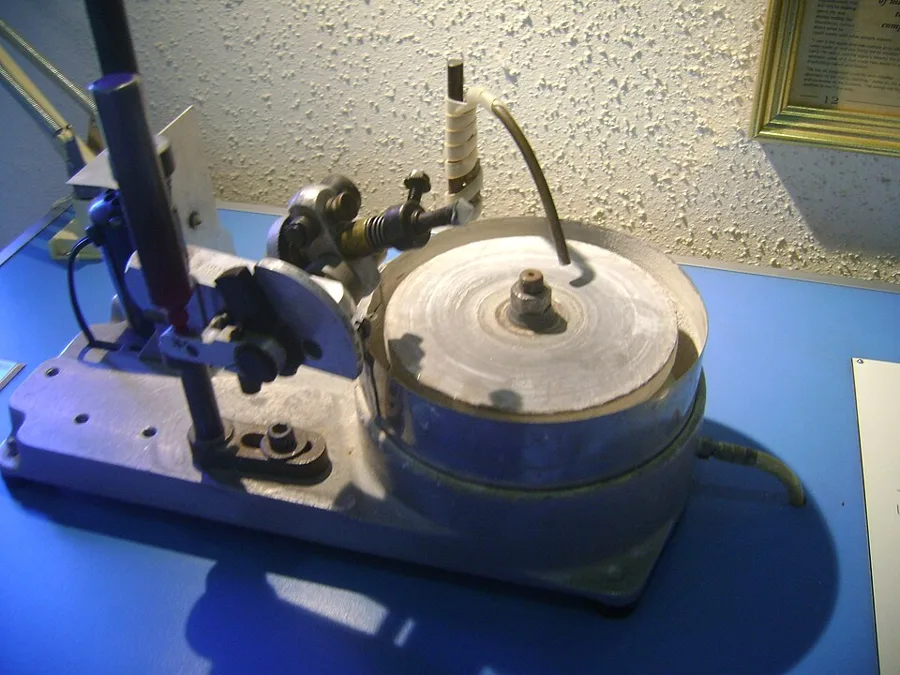
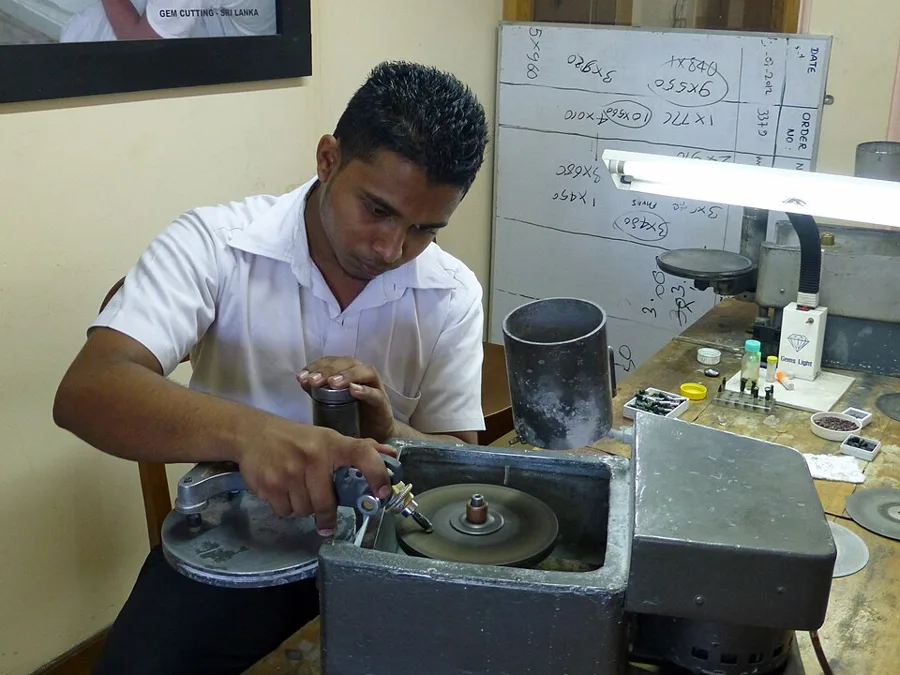
- Cut the pavilion. The stone is glued to a metal rod (a dop) and held in a faceting machine that sets each facet at an exact angle and index. The cutter grinds the lower half, the pavilion, facet by facet on a flat spinning lap.
- Transfer and cut the crown. The stone is flipped onto a second dop, perfectly aligned, and the upper half, the crown and the flat top (the table), is cut.
- Polish. Every facet is polished on a finer lap with diamond or oxide powder until it reflects like a mirror. A poor polish leaves a stone dull even if the angles are right.
What the rough looks like before any of this, from mines and from furnaces, is on raw from the lab. The history of how cutters learned to do it, from polished crystal points to the modern brilliant, is on the history of gem faceting.
Why the angles matter
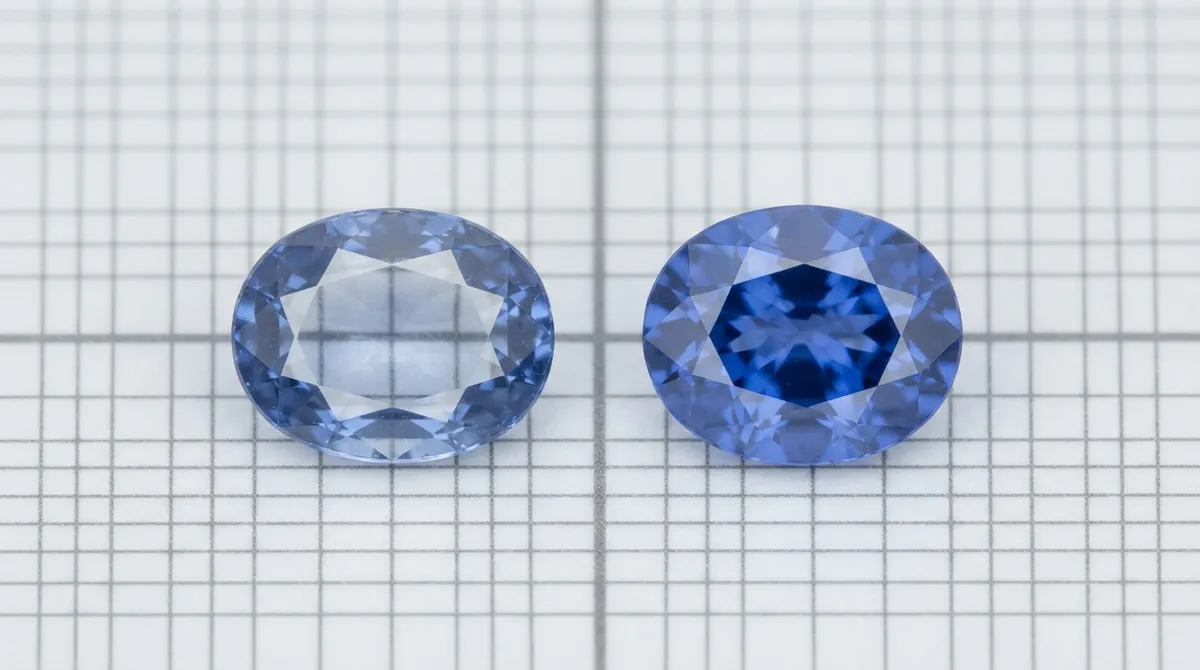
A faceted gem works like a set of mirrors. Light enters through the top, bounces off the pavilion facets and comes back out to your eye. If the pavilion is too shallow, light leaks out the back and the centre looks washed out, a "window". If it is too deep, the centre goes dark, called extinction. Each gem bends light by a different amount (its ), so the ideal angles are different for diamond, sapphire and quartz. This is why two stones of the same material and size can look completely different.
Cut styles
| Style | What it looks like | Common in |
|---|---|---|
| Brilliant | Triangular and kite-shaped facets radiating from the centre; made for sparkle | Round diamonds, moissanite, most round coloured stones |
| Step cut | Long rectangular facets in rows, like stairs; shows colour and clarity, hides little | Emerald cut, Asscher, baguette |
| Mixed cut | A brilliant crown with a step-cut pavilion, or the reverse | Most ovals, cushions and pears in coloured stones |
| Cabochon | A smooth dome with no facets | Opaque stones, opal, star ruby and sapphire, cat's-eye |
| Rose and briolette | Old styles covered in triangular facets, flat-backed (rose) or all round (briolette) | Antique and boho jewellery, drops |
| Checkerboard | A crown of square facets like a chessboard | Quartz, topaz, lab stones in modern jewellery |
Cuts from easiest to hardest (and cheapest to most expensive)
Cutting cost follows two things: how much skill and time the cut takes, and how hard the stone is. A harder stone takes longer to grind and polish; one US cutter adds 25 percent for ruby and sapphire. Here is the ladder from the simplest finish to the most demanding.
| Cut | Skill | Time per stone | Cost | Why |
|---|---|---|---|---|
| Tumbled | None | Days in a rotating barrel, but no hands-on time | Cents a stone | Rough rattles in grit until smooth. Machines do it by the tonne. |
| Beads | Low (machine) | Seconds each in a factory | Cents to dollars a strand | Shaped and drilled by machine; the drilling is the hard part. |
| Cabochon | Low to moderate | Minutes to an hour | Cheapest of the cut stones | A smooth dome: no angles to hit, and little weight lost. Usually far cheaper than a faceted stone of the same material. |
| Lathe-turned carving (bowls, vases) | Moderate | An hour or more | Low in soft stone | Fast in soft onyx marble; slow and costly in hard stone like jade or quartz. |
| Machine-cut faceted (rounds, ovals) | Low per stone (automated) | Minutes each | Cheap | Calibrated sizes, standard angles. Nearly all lab stones and cheap gems. |
| Hand-cut brilliant, oval or cushion | High | A few hours | Tens to hundreds of dollars | Dozens of facets that must meet at exact points; angles set for the material. |
| Hand-cut step cut (emerald, Asscher) | High | A few hours | Similar to a brilliant | Fewer facets, but long flat ones that show every flaw, scratch and misalignment. |
| Checkerboard and briolette | High | Hours | Higher | Many small facets; a briolette is faceted all the way round and hard to hold. |
| Concave | Very high | Up to many times a standard cut | Premium | Curved facets ground with special laps, partly freehand. |
| Fantasy cut, carving and intaglio | Highest | Days | The most expensive | Sculpted, grooved or engraved by hand; artist-signed pieces. Intaglio seals in carnelian are the ancient version. |
Two things push any cut up the ladder: waste, because fantasy and concave cuts grind away more of the rough, which is why they are mostly done in affordable quartz, topaz and tourmaline; and the stone itself, because diamond and take far longer to polish than quartz. A machine-cut lab ruby and a hand-cut precision ruby can be the same material, yet the second costs ten to a hundred times more to make.
Three kinds of cut quality
- Native or commercial cut. Cut to keep weight, because rough and finished stones are priced by the carat. Expect a deep belly, uneven facets and sometimes a window. Most mined coloured stones under a few hundred dollars are cut this way.
- Machine cut. Automated machines cut calibrated sizes (6 mm, 8 x 6 mm and so on) by the thousand. Symmetry is good, angles are standard. Nearly all cheap lab stones are machine cut, which is why they fit standard settings.
- Precision cut. A skilled cutter, often in the US, Europe or Australia, cuts one stone at a time to angles designed for that material, sometimes recutting a native-cut stone. The result returns the most light, and costs the most to make.
Where the world cuts its gems
- India. Surat, in Gujarat, is the world's diamond-cutting centre; GIA reports that roughly 90 percent of the world's diamonds are cut and polished in India. Jaipur is India's leading coloured-stone city and one of the world's main emerald cutting and trading centres.
- Thailand. Bangkok and Chanthaburi are the hub for ruby and sapphire: cutting, heat treatment and trading.
- Sri Lanka cuts much of its own sapphire, and Hong Kong is a major trading centre.
- Wuzhou, China is the capital of lab and imitation stones. Chinese state media put its share at about 70 percent of the world's synthetic gem production, mostly CZ, lab corundum and spinel, cut by the billion.
Should you cut your own, or buy it cut?
What it costs to cut lab rough, and is it cheaper than buying the stone cut?
Short answer: no. Lab ruby rough costs about 15 cents a carat from sellers with reviews (a 600 carat boule is about $85; about 44 cents for blue sapphire), so the stone itself is almost free. What costs money is the cutting. A cutter keeps only about 20 to 35 percent of the rough weight; the rest is ground to dust. So a 5 carat finished ruby needs 15 to 20 carats of rough, about $3 worth, and a 30 carat stone needs about 100 carats, about $15 worth.
| Route | 5 ct stone | 30 ct stone | How the price works |
|---|---|---|---|
| Buy it already cut | about $25 | about $35 | A CHINALUSTER 5 ct pear, or the Gryrigns 29.83 ct emerald cut. Machine-cut, ready to set. |
| Raw rough + a commercial cutting house | about $35 to $65 | about $200 to $250 | About $6 per finished carat, or a per-stone fee; often overseas. |
| Raw rough + a US custom cutter | about $325 | about $1,400 | $85 a stone plus $35 a carat, plus 25 percent because corundum is hard. |
| Raw rough + a precision cutter | about $500 to $650 | $3,000 or more | $99 to $129 per finished carat, or $299 an hour. |
| Raw rough + cut it yourself | about $3 of rough | about $15 of rough | Plus a starter machine, about $260 to $500 once, and your time. |
Buying a lab stone already cut wins by a wide margin, because the factories that grow corundum also cut it by machine in huge batches, for very little per stone. Paying a person to cut one stone by hand costs 10 to 100 times what the stone is worth. Raw lab rough makes sense for three things:
- Learning to facet. A mistake costs cents, which is why hobby cutters practise on lab corundum before touching anything mined. A starter machine pays for itself against a custom cutter after one or two stones, though never against buying cut.
- A one-off design you cannot buy ready-made: an unusual shape, a precision cut with more facets and better light return than a machine cut, or a stone sized to an heirloom setting.
- Keeping it raw. A is a beautiful specimen as it is, and the cheapest way to own a large single crystal.
If you want to cut it yourself: the starter kit
 VEVOR gem faceting machine with angle manipulatorThe entry-level faceting machine: a variable-speed lap plus an arm that holds the stone at an exact angle.about $265 on Amazon →
  Mxmoonant gem faceting machine, 96 index wheelA step up, with a 96-tooth index wheel for more facet positions.about $400 on Amazon →
  HARFINGTON diamond lap set, 120 to 3000 grit, 6 inchNine laps from coarse cutting to fine pre-polish. Corundum is hard, so diamond laps do the work.about $40 on Amazon →
  JuxLux lapidary dop wax, 140 gHolds the stone on the dop stick while you cut.about $10 on Amazon →
  GemOro 10x triplet loupeCheck every facet meeting point as you go.about $17 on Amazon →
 The two lab ruby rough listings that look cheapest per carat are copies of the Gryrigns titles from new sellers with no reviews (about 10 cents a carat), and the huge 450 to 2,250 carat "lab created" lots come from a seller that also sells 2,000 carat "lab emerald" for under 2 cents a carat, which cannot be real . We stick to sellers with a record. Cutting prices come from published price lists, some a few years old, so ask any cutter for a written quote first: Lambert, Gem Mountain, The Gemstone Artist, International Gem Society on yield.
Keep going
Frequently Asked Questions
How much weight is lost when a gem is cut?
Usually most of it. Cutters typically keep about 20 to 35 percent of well-shaped rough for a faceted stone; the rest is ground to dust. Mined rough is often cut to keep weight rather than for the best light, because price is set per carat.
What is a native cut?
A stone cut at the mine or in a local workshop to save as much weight as possible, often with a deep belly, uneven facets or a window (a see-through patch in the middle). Many mined coloured stones are native cut and later recut by precision cutters.
Are lab gems cut by hand?
Mostly by machine. Factories that grow lab corundum, CZ and spinel also cut them on automated machines in calibrated sizes, which is why a cut lab stone costs little more than its rough. Precision cutters hand-cut lab stones for special designs.
Sources
- GIA, "Jaipur, India: The Global Gem and Jewelry Power of the Pink City" (field report): gia.edu
- Jewellery Business, inside the world of fantasy gems: jewellerybusiness.com
- Sustainable Gemstones, cutting and polishing in the supply chain: sustainablegemstones.org
- China Daily, Wuzhou synthetic gem industry (June 2023): chinadailyhk.com
- International Gem Society, figuring rough cost and yield: gemsociety.org