Are lab emeralds real emeralds?
Yes. A lab-created emerald is beryl coloured green by chromium or vanadium, the same mineral as a mined emerald, with hardness 7.5 to 8. The practical differences: mined emerald is almost always heavily included, and well over 90 percent of emeralds sold are oiled or resin-filled to hide fractures, while lab emerald is typically much cleaner at the same price. Both are softer and more brittle than sapphire. In the US, "lab-created emerald" must be real beryl; "simulated emerald" is an imitation such as glass, and "emerald green" only describes a colour.
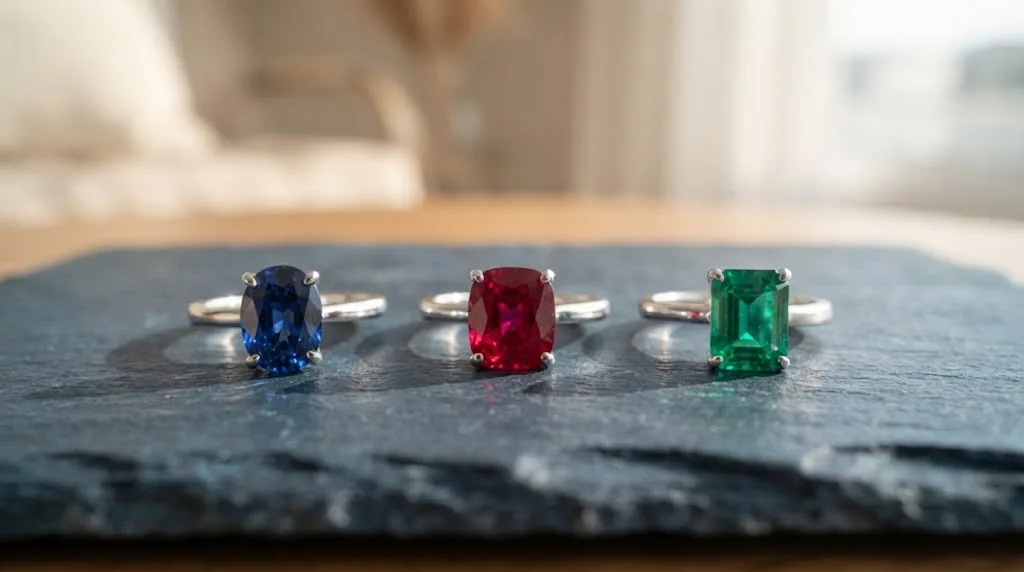
Same mineral, different origin
Emerald is beryl, Be3Al2Si6O18. Lab emerald is grown from a solution by flux or hydrothermal methods and has emerald's hardness and colour; a gemologist tells it apart by growth features and infrared spectroscopy, not by a simple test.
Clarity and oiling
Natural emerald's inclusions are called the jardin, the garden, and most mined emeralds are treated with oil or resin. Lab emerald is usually cleaner, which is often the first thing a jeweler notices.
Durability
At 7.5 to 8 on the hardness scale and brittle, emerald, lab or mined, chips more easily than ruby or sapphire (9). In rings and tennis bracelets, bezel or protective settings are the safer choice.
Reading the listing
Under 16 CFR 23.25, an unqualified "emerald" must be mined; "laboratory-created" or "[maker]-created emerald" must be real beryl with the same properties; anything that only looks like emerald must be called imitation or simulated. "Emerald colour" or "emerald green" claims nothing about what the stone is.
Frequently Asked Questions
Do lab emeralds have inclusions?
Some, but different ones: flux fingerprints and platinum platelets in flux stones, chevron zoning and nail-head spicules in hydrothermal stones. They are usually cleaner than mined emeralds of the same price.
Is green glass sold as lab emerald?
It happens. Glass and synthetic spinel show gas bubbles and read far from beryl on a refractometer. A listing should say "lab-created emerald"; "simulated" means imitation.
Keep reading
Amazon links are affiliate links (tag thegemtray-20): buying through them costs you nothing extra and supports the site. As an Amazon Associate we earn from qualifying purchases.