
Our first pick
Amazing Gemstone raw malachite, 1 piece
about $10
Natural rough with its growth texture, at a beginner price.
See it on AmazonCopper carbonate · Cu₂CO₃(OH)₂ · 3.5 to 4
Malachite is a green copper carbonate that forms in the weathered upper parts of copper deposits. It usually grows as rounded, bubbly masses built up layer by layer, which is why cut malachite shows its famous light and dark green bands and rings. It is soft and heavy, cut into , beads, boxes and carvings rather than faceted, and was ground for green eye paint in ancient Egypt. It is not grown in labs; imitations are printed or dyed resin and reconstituted powder.
The same stone at four moments. Tap a photo of a listing to see it on Amazon.
01 In the ground (step 1 of 4)
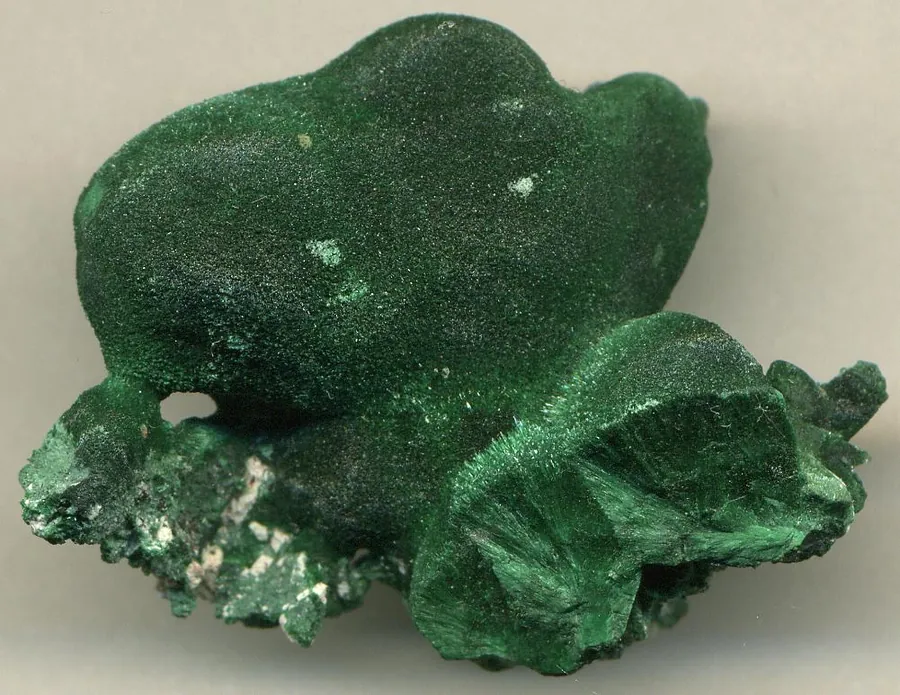
Botryoidal (bubbly) malachite from Milpillas, Sonora, Mexico: the way malachite grows, layer on layer.
Real specimen. Photo: James St. John, CC BY 2.0.
02 Rough (step 2 of 4)
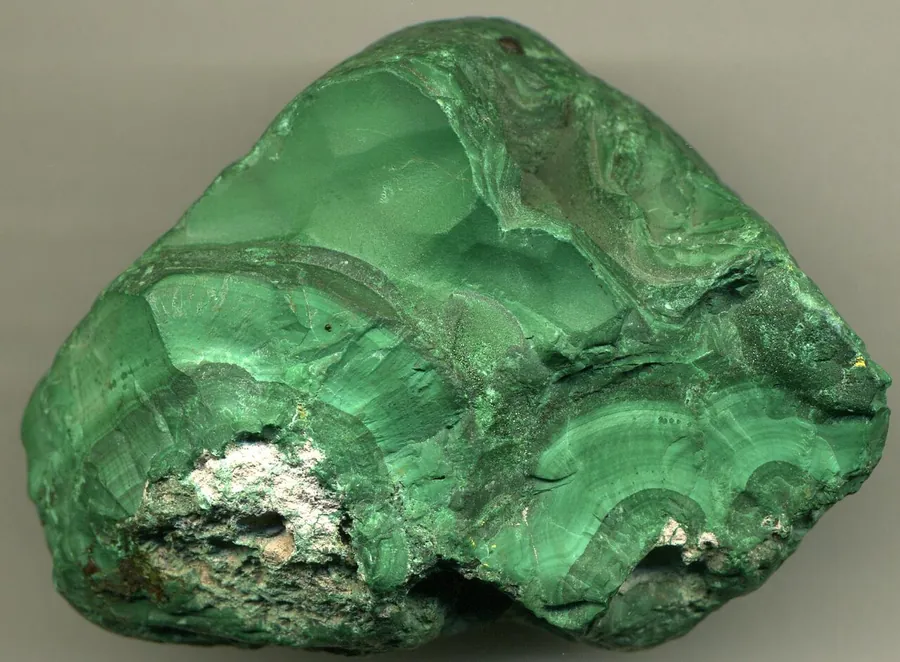
A malachite mass from Katanga, DR Congo, the world's main source, showing the green bands inside.
Real specimen. Photo: James St. John, CC BY 2.0.
03 Cut (step 3 of 4)

A polished malachite stone, about 2.4 inches, cut to show its rings and bands.
Amazon listing photo. See it on Amazon
04 Set (step 4 of 4)

A malachite drop pendant set in 925 sterling silver.
Amazon listing photo. See it on Amazon
| Real malachite | Reconstituted malachite | |
|---|---|---|
| What it is | Natural copper carbonate, cut from the solid stone | Malachite powder bound in resin and pressed |
| Bands | Irregular rings and stripes that follow the growth layers; no two pieces alike | Bands look smeared or blotchy |
| Weight and feel | Heavy and cold | Lighter |
| Surface | Takes a glassy polish | Slightly waxy |
| Price | Low to moderate; large polished pieces cost more | Low |
Real malachite is heavy and cold, and its bands are irregular rings that follow the way the stone grew, with no two beads alike. A strand of identical beads with repeating stripes, or a bead that feels light and warm, is resin. Look in drill holes: real malachite stays green and banded right through.
Treatments. Malachite is often stabilised with wax or resin to improve its polish and fill tiny pores, and much cheap malachite jewellery is reconstituted from powder. Keep it away from heat, acids, ammonia and perfume, which dull it. It is a copper mineral: cutters work it wet because the dust should not be breathed, and it should not be soaked in drinking water. Clean it with a soft dry cloth. All gem treatments explained.
Pins mark mining districts, not exact mines. Drag to move, pinch or scroll to zoom, tap a pin to read about it. Map data © OpenStreetMap contributors.
Lab malachite is mostly machine-cut in calibrated sizes, which is why a cut lab stone costs little more than its rough. Fine mined stones are often native-cut to keep weight, then recut by precision cutters. See cuts from easiest to hardest and whether cutting your own is cheaper than buying cut.
Checked in stock on October 10, 2026. Photos are the listings' own; prices are rounded.
Our first pick
about $10
Natural rough with its growth texture, at a beginner price.
See it on AmazonAlso good
about $20
Real banded malachite beads on an adjustable cord.
See it on AmazonAlso good
about $28
A real malachite drop in sterling silver, a better setting for a soft stone than a ring.
See it on AmazonFive tools that let you check what you bought (a loupe, a UV torch, locking tweezers, a gem box and a pocket scale), plus a turntable that spins your stone under the light the way jewellers show one. The full collector's kit.
 LookGemOro 10x triplet loupeunder $20
 LookDARKBEAM filtered 365 nm UV flashlightabout $10
 HandleHonoson locking tweezers, 3 packabout $10
 StoreTeensery gem display boxes with clear lids, 10 packabout $9
 ShowComXim motorized turntable, adjustable speed and directionabout $15
 MeasureGemOro Platinum XP500 pocket scale, 0.01 gabout $40
In short
Malachite grows over millions of years in the earth, or in hours to months in a lab. Both are real malachite; the mined stone is rare and priced for rarity, the lab stone is priced for the cost of growing it. Buy lab to wear and enjoy, check the listing names the mineral, and test it when it arrives.
See our first pick: Amazing Gemstone raw malachite, 1 pieceReal malachite is heavy and cold, and its bands are irregular rings and stripes that are different on every piece. Fakes are lighter, feel warm like plastic, and often have repeating or printed-looking bands.
Wearing polished malachite is fine. The risk is the dust: cutters grind it wet and avoid breathing it. Do not put malachite in drinking water or make elixirs with it.
It grows in layers inside cavities in copper ore, building rounded, bubbly masses. Each layer is a slightly different shade of green, so cutting through the mass shows rings and stripes.
A hall in the Winter Palace in St Petersburg, now part of the Hermitage, decorated in the 1830s with columns and vases veneered in Russian malachite from the Urals.
Amazon links are affiliate links (tag thegemtray-20): buying through them costs you nothing extra and supports the site. As an Amazon Associate we earn from qualifying purchases.
