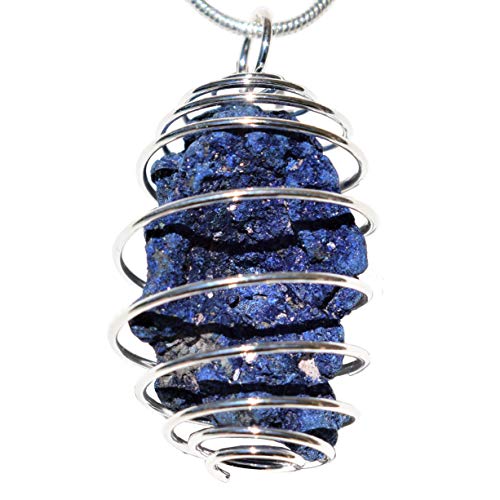
Our first pick
HQRP rich blue azurite rough, about 85 g
about $23
A good-sized natural piece with real crystal texture, enough to see why azurite is prized.
See it on AmazonCopper carbonate · Cu₃(CO₃)₂(OH)₂ · 3.5 to 4
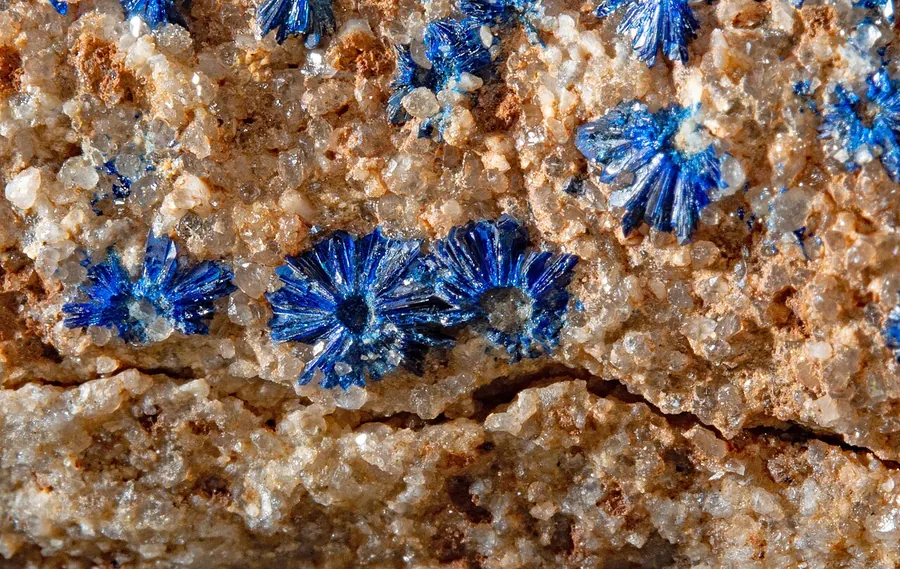
Azurite is a deep blue copper carbonate that forms where air and water break down copper ore near the surface. It grows as glassy royal-blue crystals, velvety balls and radiating sprays, very often next to green malachite, and over long periods azurite can slowly turn into malachite. It is soft, so it is collected as specimens and cut into and beads rather than set in everyday rings. Ground azurite was the main blue paint of medieval and Renaissance Europe. It is not grown in labs; the fakes are dyed stones and resin.
The same stone at four moments. Tap a photo of a listing to see it on Amazon.
01 In the ground (step 1 of 4)
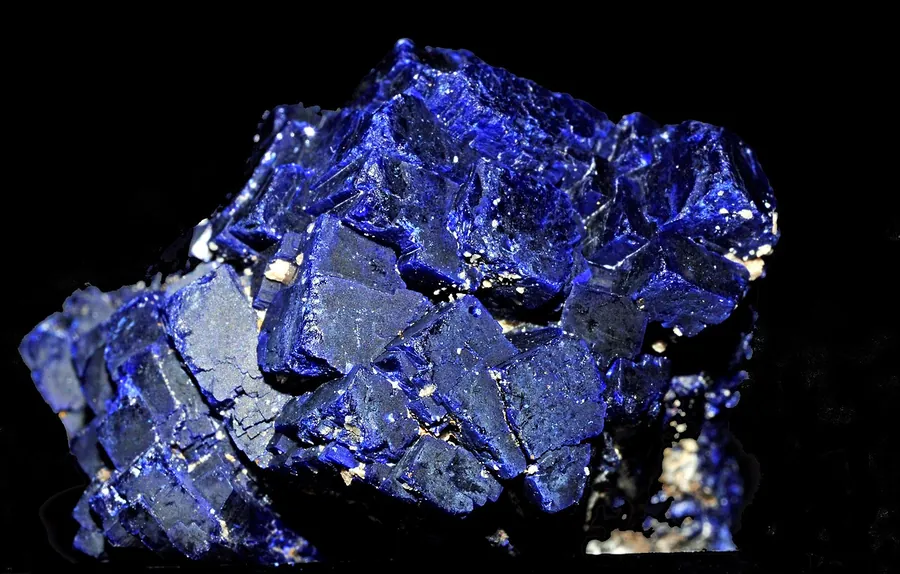
Crystallised azurite from China: deep blue crystals that grew where water broke down copper ore near the surface.
Real specimen. Photo: Parent Géry, Public domain.
02 Rough (step 2 of 4)

A raw azurite piece of about 85 g, as sold to collectors.
Amazon listing photo. See it on Amazon
03 Cut (step 3 of 4)

Azurite-malachite cabochons: azurite is cut as smooth domes because it is too soft to facet for wear.
Amazon listing photo. See it on Amazon
04 Set (step 4 of 4)

Raw azurite-malachite bars hung as a pendant.
Amazon listing photo. See it on Amazon
| Azurite | Azurite-malachite | |
|---|---|---|
| What it is | Copper carbonate, deep blue | Azurite and malachite grown together, blue beside green |
| Colour | Deep azure to inky blue: glassy crystals, grains or velvety balls | Blue patches next to green bands |
| Weight in the hand | Heavy for its size (it is a copper mineral) | Heavy |
| Price | Low for small pieces; fine crystal groups cost far more | Low |
| How it is listed | "Azurite specimen", often with a mine or region | "Azurite malachite" |
Real azurite feels heavy because it is a copper mineral, and its blue sits in crystals, grains or velvety balls rather than one flat even coat. Dyed howlite shows white or pale grey where it is chipped or drilled, and a cotton bud with acetone on a hidden spot picks up blue dye. Much cheap azurite jewellery is reconstituted: azurite powder bound in resin, which looks very uniform and feels light.
Treatments. Azurite is often stabilised with resin so soft pieces hold together for cutting, and some is reconstituted from powder. Keep it away from heat, which can darken it, and from acids and household cleaners. It is a copper mineral: do not grind or sand it dry, and do not soak it in drinking water. Wipe it with a soft dry cloth. All gem treatments explained.
Pins mark mining districts, not exact mines. Drag to move, pinch or scroll to zoom, tap a pin to read about it. Map data © OpenStreetMap contributors.
Lab azurite is mostly machine-cut in calibrated sizes, which is why a cut lab stone costs little more than its rough. Fine mined stones are often native-cut to keep weight, then recut by precision cutters. See cuts from easiest to hardest and whether cutting your own is cheaper than buying cut.
Checked in stock on October 10, 2026. Photos are the listings' own; prices are rounded.
Our first pick
about $23
A good-sized natural piece with real crystal texture, enough to see why azurite is prized.
See it on AmazonAlso good
about $8
A cheap way to own both copper minerals in one small piece.
See it on AmazonAlso good
about $20
Rough stone worn as a pendant, where its softness matters least.
See it on AmazonThe most striking natural azurite we found on Amazon: glittering crystal plates straight from the mine, a 10 lb polished azurite-malachite freeform, carved skulls crowned with raw azurite, and sterling silver jewellery. Every piece is sold as natural azurite or azurite-malachite, checked in stock on October 16, 2026. Photos are the listings’ own; prices are rounded. Azurite is soft, so pendants and earrings wear better than rings.
Five tools that let you check what you bought (a loupe, a UV torch, locking tweezers, a gem box and a pocket scale), plus a turntable that spins your stone under the light the way jewellers show one. The full collector's kit.
 LookGemOro 10x triplet loupeunder $20
 LookDARKBEAM filtered 365 nm UV flashlightabout $10
 HandleHonoson locking tweezers, 3 packabout $10
 StoreTeensery gem display boxes with clear lids, 10 packabout $9
 ShowComXim motorized turntable, adjustable speed and directionabout $15
 MeasureGemOro Platinum XP500 pocket scale, 0.01 gabout $40
In short
Azurite grows over millions of years in the earth, or in hours to months in a lab. Both are real azurite; the mined stone is rare and priced for rarity, the lab stone is priced for the cost of growing it. Buy lab to wear and enjoy, check the listing names the mineral, and test it when it arrives.
See our first pick: HQRP rich blue azurite rough, about 85 gIt can. Where there is plenty of water, azurite is less stable than malachite, so over very long periods it alters to green malachite, sometimes keeping the shape of the original blue crystals. That is why the two are so often found together.
Not for daily wear. At 3.5 to 4 on the Mohs scale it scratches and chips easily. It is better as a pendant, earrings or a specimen on a shelf.
Ground azurite was the main blue pigment in European painting in the Middle Ages and the Renaissance, far cheaper than ultramarine made from lapis lazuli. The coarser the grains, the deeper the blue.
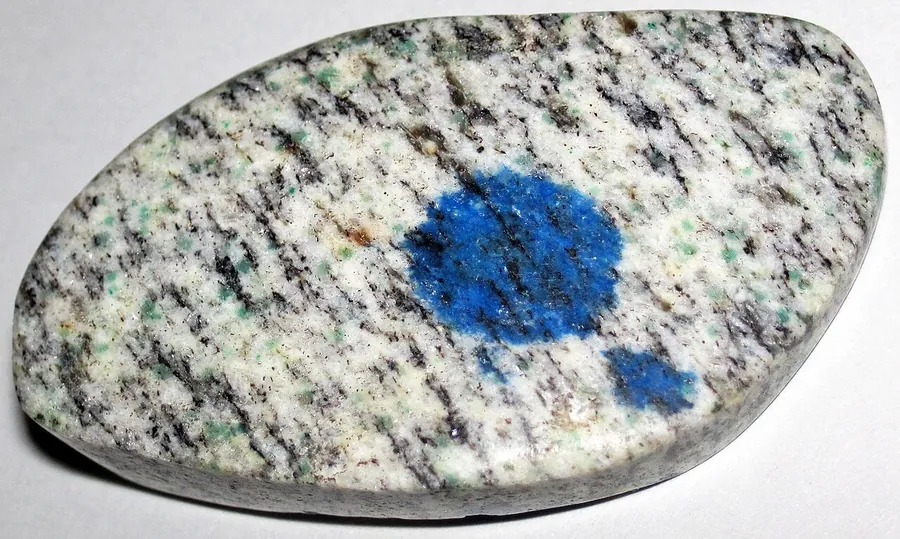
White granite dotted with round spots of blue azurite, sold as "K2 stone" or "K2 jasper". It comes from the mountains of northern Pakistan and is named after K2.
Amazon links are affiliate links (tag thegemtray-20): buying through them costs you nothing extra and supports the site. As an Amazon Associate we earn from qualifying purchases.