The history of gemstone faceting
For most of history gems were polished smooth, not faceted. Faceting began with diamond in 14th-century Europe: first the point cut, which just polished the natural crystal, then the table cut, then the flat-backed rose cut of the 1500s. The 1600s added more facets and the beginnings of the brilliant, which became the cushion-shaped old mine cut and, once a bruting machine could shape a true circle in 1874, the round old European cut. In 1919 Marcel Tolkowsky worked out the angles that give the most brightness and fire, and the modern round brilliant is his design, refined. Coloured stones follow different rules because they bend light less than diamond does. Every stone on our tray is cut on the same principles, in modern workshops, for a fraction of what cutting once cost.
Before facets: polished, carved and engraved
For thousands of years the way to finish a gem was to polish it smooth. Coloured stones were tumbled, shaped into rounded domes called cabochons, drilled as beads or engraved as seals and cameos. Roman and medieval jewelry is full of polished sapphires, garnets and emeralds that have no flat facets at all. The reason was partly taste, since a cabochon shows colour well, and partly tools: a flat, true facet needs a hard abrasive on a flat, spinning lap, and the gem trade did not have one in routine use.
Diamond was a harder problem. It is the hardest natural material, so the only thing that grinds it is diamond itself. Until the discovery of diamonds in Brazil in the 1720s, essentially all diamonds came from India, and Indian cutters worked them with diamond powder, usually polishing an existing crystal face or grinding away flaws while keeping as much weight as possible. That approach survives in the so-called Mughal cut: many irregular facets on a flattish stone, chosen to keep carats rather than to make light behave. The Koh-i-Noor arrived in Britain in 1850 cut this way.
The point cut and the table cut: 1300s and 1400s
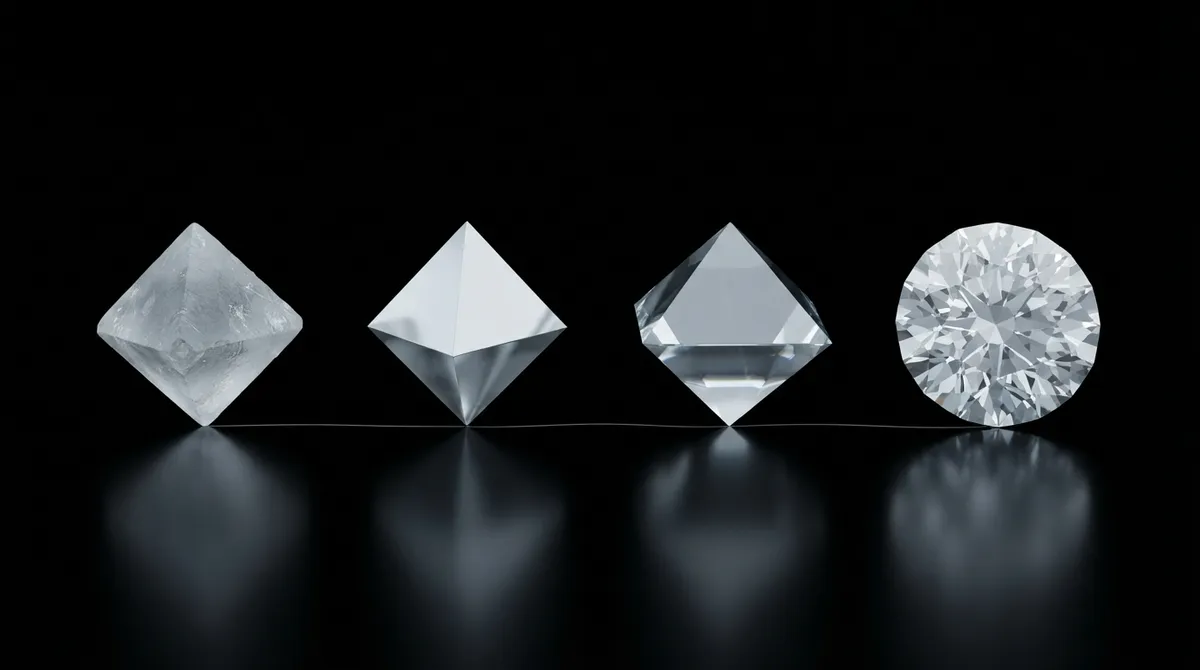
Rough diamond often grows as an octahedron, two four-sided pyramids joined at the base. The first European cut, the point cut, did little more than polish those eight natural faces flat and even. It was in use by the mid-1300s, and by 1375 there was a guild of diamond polishers in Nuremberg. Venice, which controlled much of the trade from India, and later Bruges, Paris and Antwerp became the cutting centres. A point-cut diamond looks dark and glassy to a modern eye: it reflects light from its surfaces but returns little from inside.
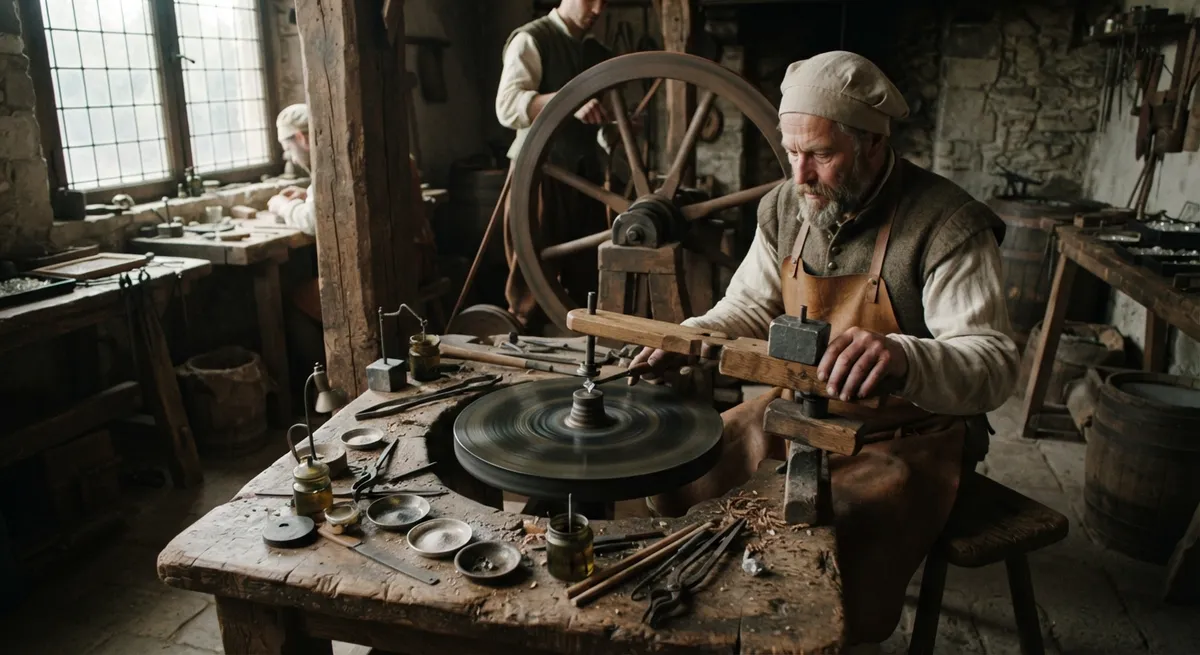
By the middle of the 1400s cutters were grinding off the top point of the octahedron to leave a flat square face, the table, and often a small flat at the bottom, the culet. The table cut is the ancestor of the step-cut shapes still sold today, the emerald cut and the Asscher. It needed a better polishing tool, the scaife: a horizontal cast-iron wheel charged with olive oil and diamond dust, spinning against a stone held in a clamp. Tradition credits Lodewyk (Louis) van Berquem of Bruges with introducing the scaife and symmetrical faceting around the 1470s. The story is worth knowing and worth doubting: it was first printed in the 1660s by a writer who claimed to be his descendant, and no document from van Berquem's own lifetime confirms it.
The rose cut: 1500s
Around the middle of the 1500s, cutters in Antwerp and elsewhere began making the rose cut: a dome of triangular facets rising to a point, on a completely flat base. A rose cut is, in effect, a crown with no pavilion underneath. It suited flat pieces of rough that would waste too much weight as a deep stone, and in candlelight its facets throw broad, soft flashes. Roses came in many patterns, the Dutch rose with 24 facets among the best known, and they were cut in coloured stones as well as diamond; GIA has documented baroque-era rose-cut garnets, sapphires and other gems. The rose cut stayed popular for three centuries and is back in fashion now, often in lab-grown material.
Toward the brilliant: 1600s to 1800s
The 1600s added facets in rings around the table and under the girdle. The double-cut brilliant, with 17 facets on the crown, carries the name of Cardinal Mazarin, who collected great diamonds; the triple-cut, with 58 facets, carries the name of a Venetian polisher, Vincenzo Peruzzi, around 1700. Both names are traditional labels rather than documented inventions. What matters is the direction: more facets arranged around a central table, and a deeper pavilion underneath that begins to send light back out of the top of the stone instead of out of the bottom.
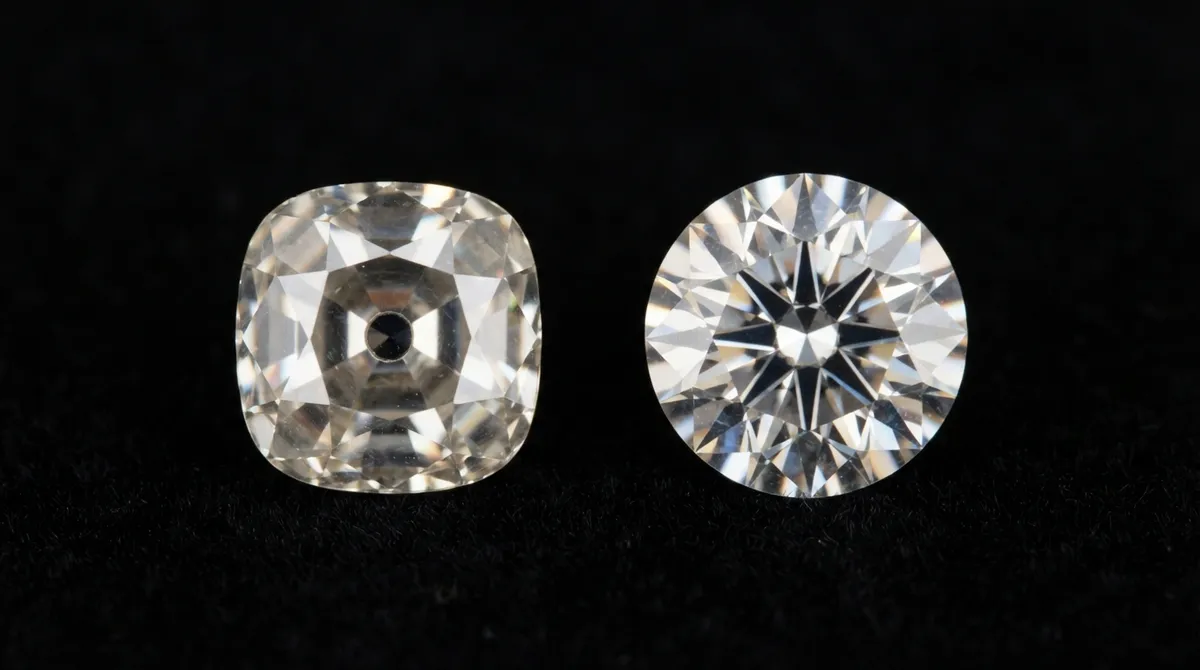
The result, through the 1700s and most of the 1800s, was the old mine cut: a cushion-shaped stone, slightly squarish with rounded corners, a small table, a tall crown, a deep pavilion and a large flat culet that shows as a small circle when you look down through the table. Brazilian diamonds, discovered in the 1720s, and then South African diamonds from the late 1860s supplied the rough. Cutters rounded stones by hand, rubbing one diamond against another in a process called bruting, which is why old mine cuts are rarely truly round. They were cut to save weight and for the light of candles and gas lamps, which bring out their big, chunky flashes of colour.
Weight versus light was the central argument of the era, and the Koh-i-Noor settled it in public. Shown at the Great Exhibition in London in 1851 in its Mughal form, it disappointed visitors who expected it to blaze. In 1852 it was recut in London by Levie Benjamin Voorsanger of the Amsterdam firm Coster, from about 186 carats to 105.6 carats, trading more than 40 percent of its weight for brilliance. It remains the most famous argument for cutting for light.
Machines: 1870s to 1910s
Henry Morse, a Boston cutter, argued that diamonds should be cut to proportions that return light even at a loss of weight, which was heresy in the European trade. With the engineer Charles Field he patented a steam-driven bruting machine in 1874, which could turn a diamond into a true circle for the first time. The round shape that followed is the old European cut, dominant from about 1890 to 1930: a circular outline, a table a little larger than the old mine's, a tall crown and a smaller but still visible flat culet. Mechanical sawing, which let cutters divide a crystal instead of grinding half of it away, spread around the turn of the century.
The same decades produced the first named, designed cuts. Joseph Asscher of Amsterdam patented his square step cut, the Asscher cut, in 1902, and in 1908 his firm cleaved and cut the Cullinan, at 3,106 carats the largest gem diamond ever found, into the stones now in the British Crown Jewels.
Mathematics: Tolkowsky's Diamond Design, 1919
In 1919 Marcel Tolkowsky, a Belgian engineer from a family of diamond cutters, published Diamond Design, which treated the round brilliant as an optics problem. He calculated the pavilion angle at which light entering the table is reflected off the back facets and sent back up rather than leaking out, and balanced the crown so that light leaving it is spread into colour. His proportions (a table about 53 percent of the diameter, a crown angle of 34.5 degrees and a pavilion angle of about 40.75 degrees) became the basis of the American Ideal or American Standard cut.
The modern round brilliant has 57 facets, or 58 if the culet is polished as a tiny facet, and a larger table than Tolkowsky suggested, a change that trades a little fire for more brightness.
The rest of the 20th century refined the round and added fancy shapes. The emerald cut grew out of the old table and step cuts; the radiant cut appeared in 1977 and the princess cut in 1980, both brilliant-style square shapes. "Hearts and arrows" stones, cut so precisely that a viewer shows eight arrows from above and eight hearts from below, were popularised in Japan in the 1980s. In 2006 GIA began issuing a cut grade for round brilliants based on years of computer modelling of how light moves through different proportions, which put numbers on what Tolkowsky had started and what Morse had argued.
Coloured stones follow different rules
Diamond's refractive index of 2.42 gives it a critical angle of about 24 degrees: light striking an inside surface at a steeper angle than that is trapped and reflected. Sapphire and ruby (about 1.77) have a critical angle of about 34 degrees, and quartz (about 1.54) about 40. A coloured stone cut to diamond angles lets light fall straight through the pavilion, and you see a lifeless see-through patch called a window.
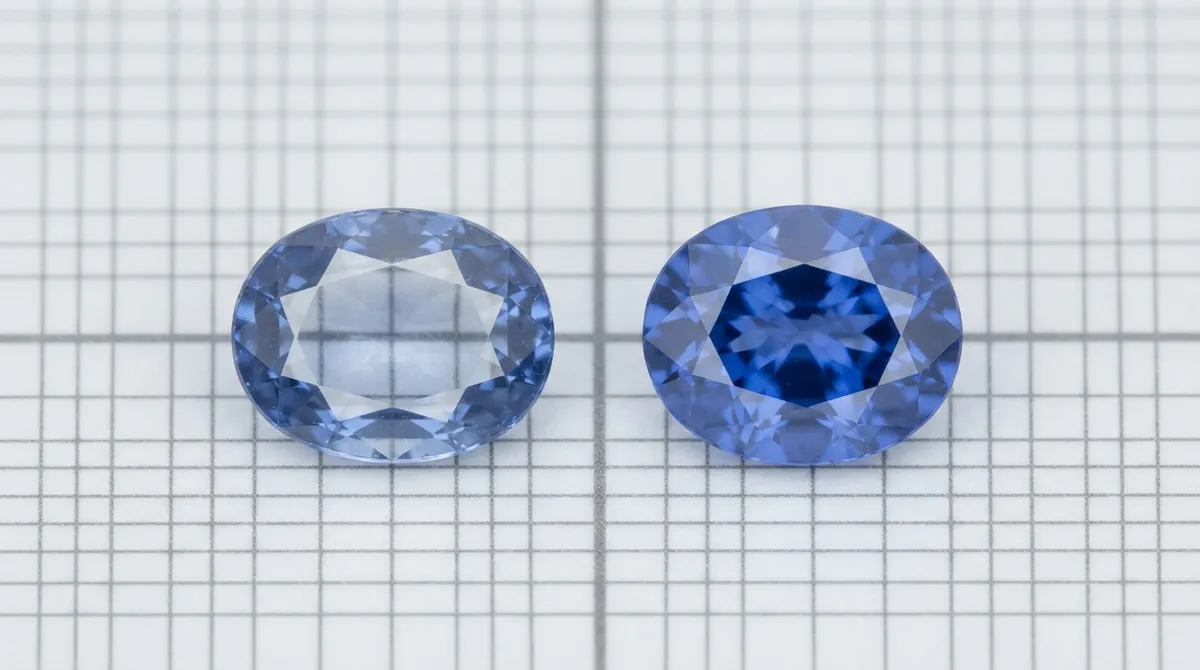
So coloured stones are cut with steeper pavilions, and the standard shapes differ: step cuts for emerald, whose brittle corners are protected by the cut-off corners of the emerald cut, and mixed cuts, a brilliant crown over a step-cut pavilion, for many sapphires.
Colour adds a second job. Ruby and sapphire can look different colours along different directions in the crystal, so a cutter orients the rough to show the best hue through the table, and often leaves a deep belly to hold weight and saturation. The traditional "native cut" of Sri Lankan sapphire, lopsided and deep, keeps carats at the cost of symmetry, and many are recut when they reach Western markets. Until the 20th century most coloured stones were faceted on hand-held tools such as the jamb peg, a stick of wood with holes in which the cutter set the angle by feel; mast-style faceting machines with precise angle indexing made accurate coloured-stone cutting routine and opened it up to hobbyists from the mid-20th century.
Today: lasers, scanners and cheap rough
Modern diamond cutting starts with a scan. Software maps the rough in three dimensions, finds the inclusions and plans the combination of stones that yields the most value; lasers do much of the sawing and shaping; automated polishers can hold facet angles closer than a human hand. The underlying design is still the scaife and the brilliant, but precision that once belonged to top-grade stones is now common.
That is the part that matters for a tray like ours. Lab-grown rough is cheap, so a cutter can give up weight to get the shape right, and most inexpensive lab gems and simulants are cut in high-volume workshops, many in Wuzhou in southern China, the centre of that trade. Moissanite is cut with its optic axis straight through the table so that the double refraction does not show from above; how lab gems are grown explains why. The quality still varies. Look straight down through the table under a single light: a well-cut stone shows lively flashes across the whole face, while a poor one shows a dark centre, a see-through window or a dull ring near the edge. That check costs nothing, and it is the one thing about a cheap gem that six hundred years of cutters would recognise.
Timeline
| When | What changed | Why it mattered |
|---|---|---|
| Antiquity to the Middle Ages | Cabochons, beads, engraved gems | Colour shown by polish, not by facets |
| Mid-1300s | Point cut; Nuremberg polishers' guild by 1375 | First regular faceting of diamond |
| 1400s | Table cut; the scaife | Flat table and culet, ancestor of step cuts |
| Mid-1500s | Rose cut | Flat-backed dome of triangular facets, made for candlelight |
| 1600s to about 1700 | Double-cut and triple-cut brilliants | More facets and a deeper pavilion start returning light |
| 1700s to 1800s | Old mine cut | Cushion shape, small table, flat culet; Brazilian then South African rough |
| 1852 | Koh-i-Noor recut, 186 to 105.6 carats | Public case for cutting for light over weight |
| 1874 | Morse and Field's bruting machine | True round outline; the old European cut follows |
| 1902 and 1908 | Asscher cut; the Cullinan cleaved | Designed, patented cuts and modern cutting houses |
| 1919 | Tolkowsky's Diamond Design | Proportions calculated for brightness and fire |
| 1977 and 1980 | Radiant and princess cuts | Brilliant sparkle in square shapes |
| 2006 | GIA cut grade for round brilliants | Cut quality graded from light-modelling research |
| Now | 3D scanning, laser sawing, automated polishing | High precision even on inexpensive lab-grown stones |
For how each stone on the tray is made before it reaches the cutter, see how lab gems are grown; for what a listing's cut description does and does not tell you, see how to read a gem listing.
Frequently Asked Questions
When were gemstones first faceted?
Diamonds were being polished into regular shapes in Europe by the mid-1300s; there was a guild of diamond polishers in Nuremberg by 1375. The first cut, the point cut, simply polished the faces of the natural eight-sided crystal. Before that, and for most coloured stones long after, gems were polished smooth into rounded cabochons, carved or engraved rather than faceted.
Who invented the brilliant cut?
No single person. The round brilliant grew out of the 17th-century double-cut and triple-cut stones (the names Mazarin and Peruzzi are attached to them by tradition, not by records), became the old mine cut and then the old European cut, and was put on a mathematical footing by Marcel Tolkowsky in his 1919 book Diamond Design. The modern round brilliant with 57 or 58 facets is a refinement of his proportions.
What is a scaife?
The polishing wheel used to facet diamonds: a horizontal cast-iron disc, spinning fast, charged with olive oil and diamond powder. Only diamond is hard enough to grind diamond, so the wheel works by carrying diamond dust against the stone. Tradition credits Lodewyk van Berquem of Bruges with introducing it around the 1470s, but that story was first printed in the 1660s by a writer who claimed to be his descendant.
Why do old cut diamonds look different from modern ones?
They were cut for candlelight and to save weight. Old mine and old European cuts have a small table, a tall crown and a large flat culet you can see as a small circle through the top. Under a flame they throw broad, chunky flashes of colour. A modern round brilliant has a larger table, a pointed culet and angles calculated for maximum return of light under electric lighting, so it looks brighter and more evenly sparkly.
Why are coloured gems cut differently from diamonds?
They bend light less. Diamond has a refractive index of 2.42, so light is trapped inside it at any angle steeper than about 24 degrees; sapphire at 1.77 needs about 34 degrees and quartz about 40. A coloured stone cut to diamond angles leaks light through the bottom and shows a see-through "window". Coloured stones also have colour to manage: cutters orient ruby and sapphire to show the best hue through the table and often cut deeper to hold weight and saturation.
Are lab-grown gems cut differently from mined ones?
No. A lab sapphire or lab diamond is cut on the same wheels to the same designs. The difference is economic: rough lab material is cheap, so cutters can sacrifice weight for a precise shape, and most inexpensive lab gems are cut in high-volume workshops, many in Wuzhou in southern China, the centre of the synthetic and simulant cutting trade. Moissanite has one special rule: it is cut with its optic axis straight through the table to hide its double refraction.
Sources
- GIA: Baroque-era rose cuts of coloured stones (2020); A foundation for grading the overall cut quality of round brilliant cut diamonds (2004).
- Tolkowsky, M., Diamond Design, 1919.
- Morse and Field: H. D. Morse, first diamond cutter in America, and C. M. Field, modern diamond cutting machinery (Internet Archive); Lang Antique Jewelry University, Brilliant cut.
- Wikipedia: Diamond cut, Diamond cutting, Koh-i-Noor, Cullinan Diamond.