We earn a commission if you buy through links on this page, at no extra cost to you.
Zirconium dioxide · ZrO₂ · 8 to 8.5
Cubic zirconia
Cubic zirconia is the cheapest way to get a diamond look, but it is softer than moissanite and diamond, so it scratches and dulls with daily wear. For studs and solitaire rings, moissanite costs about the same and lasts; CZ makes sense for big, many-stone pieces like tennis chains. Cubic zirconia (CZ) is zirconium dioxide grown in labs, the most common diamond simulant in the world. Soviet scientists at the Lebedev Physical Institute in Moscow worked out how to grow it in the early 1970s by melting zirconia inside a shell of its own powder, and it has been made in huge quantities since the late 1970s. It is hard, cheap and flashes more rainbow fire than diamond, but it is heavier and softer, and it is not a diamond. It is also not zircon, a natural mineral with a similar name.
From the ground to your hand
The same stone at four moments. Tap a photo of a listing to see it on Amazon.
01 In nature (step 1 of 4)
Natural cubic zirconia exists only as microscopic grains, first identified in 1937 inside zircon crystals. Every gem CZ is made in a lab.
02 Out of the melt (step 2 of 4)
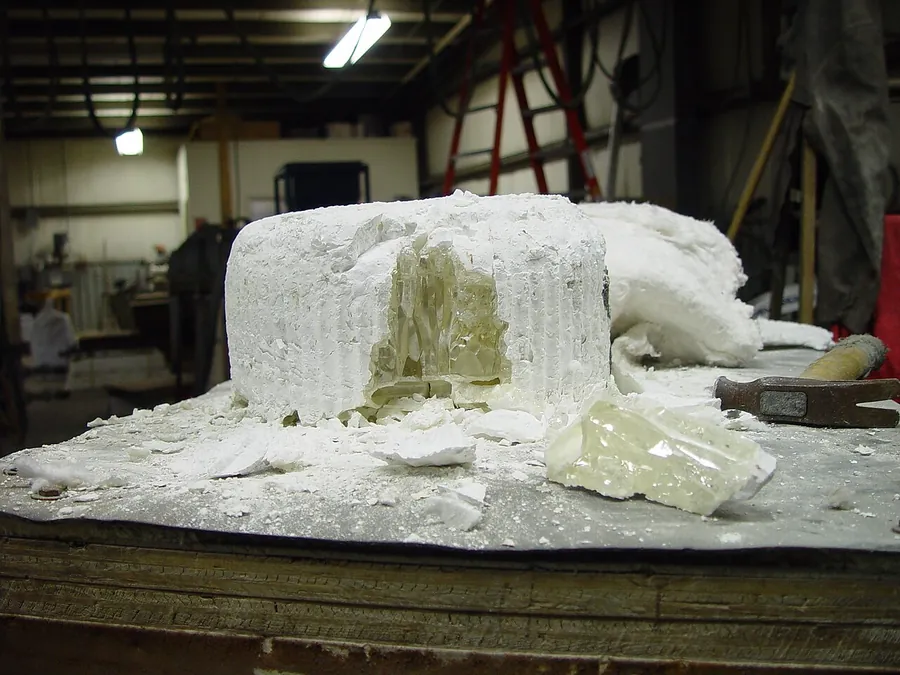
A "skull" of zirconia broken open after a growth run: the crust of powder is cracked away to reveal the crystals that grew inside.
Zirconium dioxide, stabilised with yttrium or calcium oxide
Hardness
8 to 8.5, below diamond (10) and moissanite (9.25)
Fire
More rainbow fire than diamond
Weight
About 1.7 times as heavy as diamond for the same size
Natural?
Only as microscopic grains; every gem CZ is lab-made
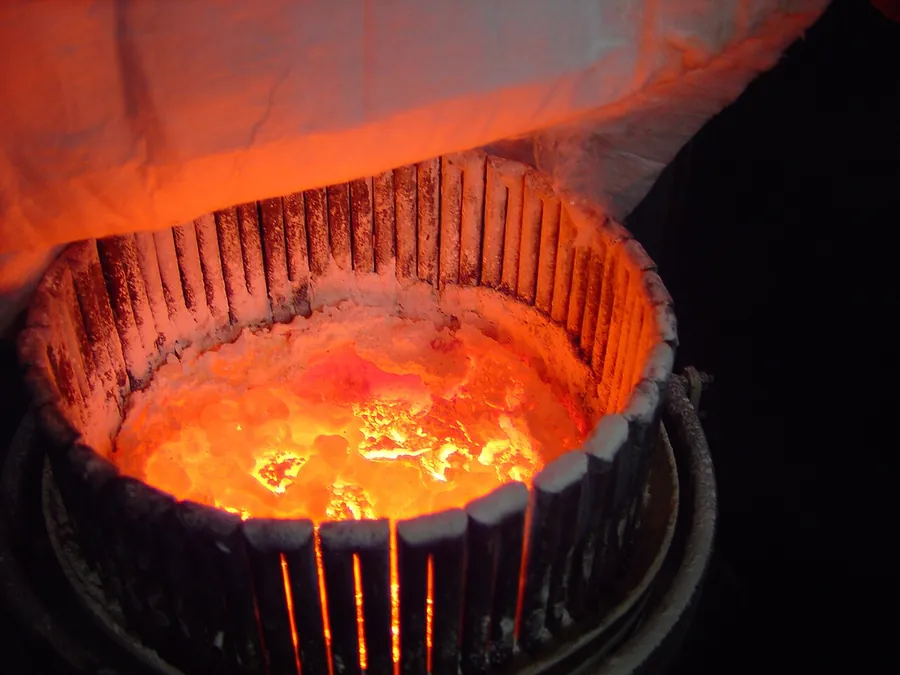
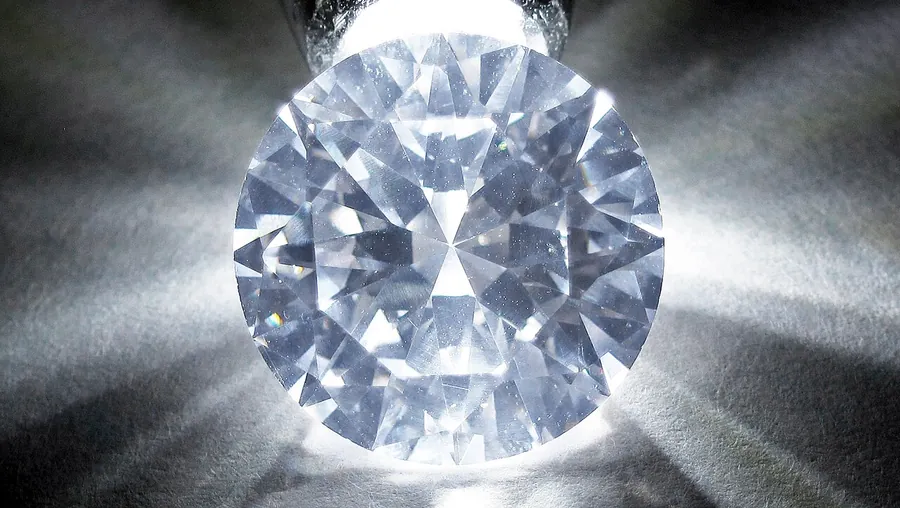
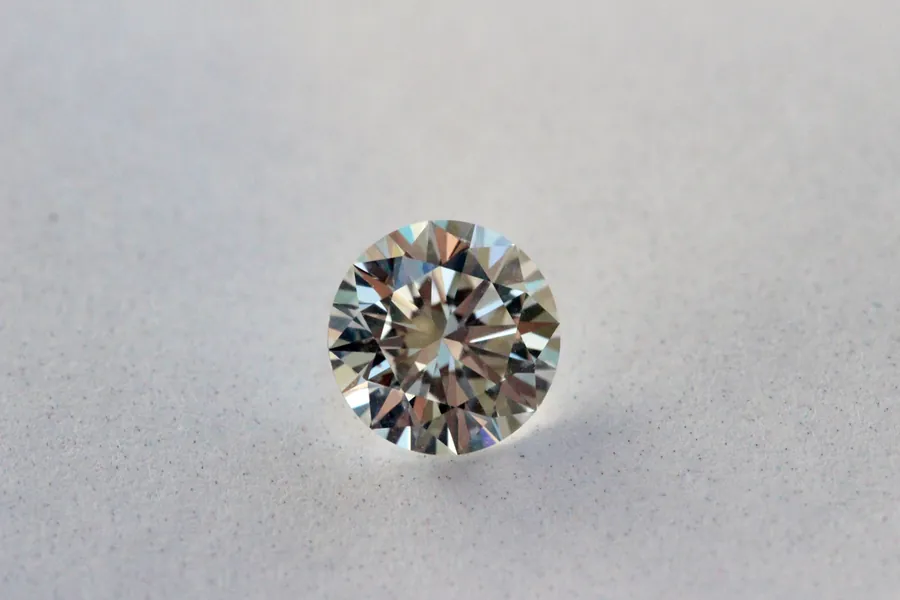
Inside the : zirconia melted at more than 2,700 °C, held in a crust of its own powder. Photo: LarryPKelley at English Wikipedia, Public domain.A cut cubic zirconia under strong light, showing the coloured flashes that give it away. Photo: James St. John, CC BY 2.0.
Cubic zirconia vs diamond and moissanite
Three clear stones that look alike from across the room
Cubic zirconia
Moissanite
What it is
Zirconium dioxide
Hardness
8 to 8.5
9.25
Sparkle
More rainbow fire, a slightly glassy look
Much more rainbow fire
Over time
Scratches and its facet edges round off with years of wear
Stays sharp
Diamond tester
Fails a thermal tester
Passes a basic thermal tester
Price for a 1 ct look
A few dollars
Tens of dollars
A basic thermal diamond tester tells cubic zirconia from diamond at once, because CZ conducts heat poorly. Without one, CZ looks slightly too colourful and "glassy", and an old CZ shows scratches and rounded facet edges that a diamond would not. It is also heavy: a CZ the same size as a 1 ct diamond weighs about 1.7 ct. A stone that passes the thermal tester but has doubled facet edges under a loupe is moissanite.
Treatments. Cubic zirconia is not treated; its colours come from small amounts of metals added to the melt. "5A" and "AAAAA" are factory grades, not lab grades. Some CZ is sold with a thin diamond-like coating, which wears off. Clean it with warm soapy water; skin oil and lotion make CZ go dull faster than diamond, and it needs cleaning more often. All gem treatments explained.
Cubic zirconia (where it is made): Lebedev Physical Institute (FIAN), Moscow, Russia. Where Soviet scientists developed skull melting to grow cubic zirconia in the early 1970s. In Russia it is still called fianit, after the institute.
Cubic zirconia (where it is made): Wuzhou, Guangxi, China. The world's largest centre for cutting synthetic gems, cubic zirconia above all.
A big diamond-stud look on solid sterling silver posts.
We say never buy cubic zirconia over moissanite when you can, and with studs you can: moissanite studs are the same price on Amazon.
Brighter: moissanite bends light more strongly ( about 2.65 to 2.69, against 2.15 to 2.18 for CZ), so more light comes back out of the top.
More fire: it splits light into rainbow colours about 1.6 to 1.8 times as much as CZ (dispersion 0.104 against 0.058 to 0.066), and more than twice as much as diamond.
Much harder: moissanite is 9.25 on the Mohs scale, beaten only by diamond (10). Ruby and sapphire come next at 9, and CZ is 8 to 8.5. Everyday dust contains quartz (7), close enough to CZ to slowly scratch it and round its facet edges, while moissanite and diamond shrug it off.
Stays bright: moissanite does not dull or cloud with wear; a CZ worn every day slowly loses its crisp sparkle over years of wear.
Tougher: it is less likely to chip if you knock it.
Lighter: a CZ is about 1.7 times as heavy as a diamond of the same size, while moissanite weighs a little less than diamond.
Lasts a lifetime: it is a stone you can keep and pass on, not a piece you replace.
A classic six-prong solitaire to try a ring style before spending more.
Almost the same deal as the studs: the same JewelryPalace 1 ct solitaire in sterling silver with a moissanite stone is about $25, only $8 more. For a ring you will wear every day, we say spend the $8.
Brighter: moissanite bends light more strongly (refractive index about 2.65 to 2.69, against 2.15 to 2.18 for CZ), so more light comes back out of the top.
More fire: it splits light into rainbow colours about 1.6 to 1.8 times as much as CZ (dispersion 0.104 against 0.058 to 0.066), and more than twice as much as diamond.
Much harder: moissanite is 9.25 on the Mohs scale, beaten only by diamond (10). Ruby and sapphire come next at 9, and CZ is 8 to 8.5. Everyday dust contains quartz (7), close enough to CZ to slowly scratch it and round its facet edges, while moissanite and diamond shrug it off.
Stays bright: moissanite does not dull or cloud with wear; a CZ worn every day slowly loses its crisp sparkle over years of wear.
Tougher: it is less likely to chip if you knock it.
Lighter: a CZ is about 1.7 times as heavy as a diamond of the same size, while moissanite weighs a little less than diamond.
Lasts a lifetime: it is a stone you can keep and pass on, not a piece you replace.
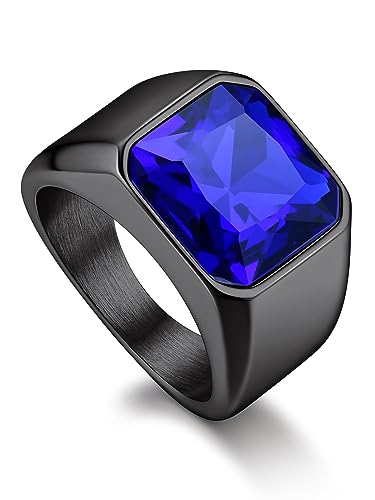
Coloured cubic zirconia: big red, blue, green and pink stones for about $10 to $35
Cubic zirconia can be made in almost any colour by adding a little metal to the melt, so it is the cheapest way to wear a big coloured stone. A coloured stone this size in lab ruby, sapphire or emerald costs far more, and a natural one far more again. Many cheap coloured rings are sold as "synthetic" ruby, sapphire or emerald without naming the material; at these prices they are simulants such as CZ or glass, not lab-grown gems. Every piece here was checked in stock on October 16, 2026. Photos are the listings’ own; prices are rounded.
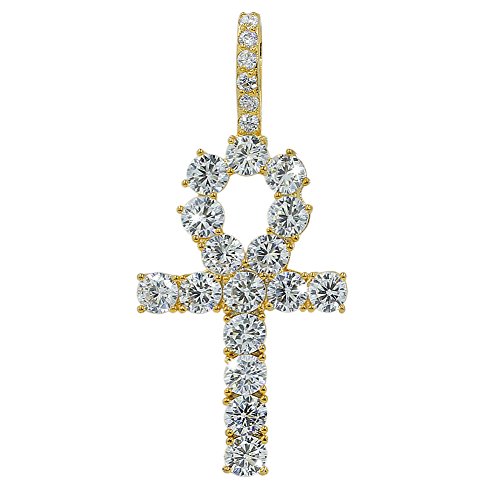
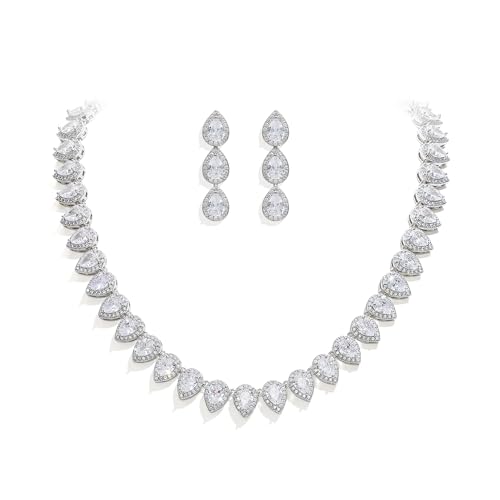
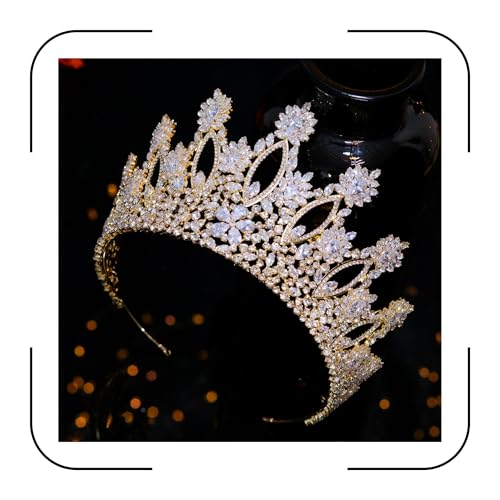
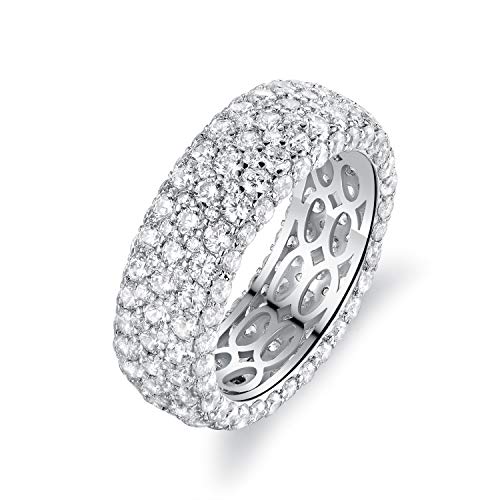
Cubic zirconia showpieces: iced-out chains, crosses, tiaras and bridal sets
Amazon is flooded with cubic zirconia, more than almost any other stone, so here is the most elaborate of it: iced-out Cuban chains, giant crosses, bridal sets, full tiaras, pavé rings and an iced-out watch. Each card names the metal under the plating, and the moissanite version is linked under every one so you can see the price difference. Checked in stock on October 16, 2026. Photos are the listings’ own; prices are rounded.
We are big fans of moissanite, and every cubic zirconia piece on this page has a moissanite (or real lab gem) version linked right under it. Cubic zirconia earns its place for mass-made pieces: a chunky coloured steel ring, a tennis chain or a tennis bracelet, where it is the cheapest way to get started with a look and find out whether you even like it. If you are happy with the CZ piece, keep wearing it; just look after it, because CZ scratches and dulls faster than moissanite or diamond.
It is still a cut gem. Every stone on this page was sawn, ground and polished facet by facet, and cutting any gem takes real work, whether it is a lab ruby, a quartz crystal or a rock from your front yard. Even when a machine does the cutting, it is not free:
It always costs diamond. In lapidary, the cutting tools are diamond saw blades (a steel disc with diamond grit bonded to the rim) and diamond laps (flat spinning discs coated with diamond grit, used to grind each facet). Diamond is the only thing hard enough to cut every other gem, and the grit wears away as the disc spins against the stone, so blades and laps wear out and have to be replaced.
The machines wear too. Motors, bearings and the faceting heads that hold each stone at its angle wear with use, and the water that cools the cut carries away stone dust that has to be cleaned out.
Polishing is its own job. After the facets are ground, every one is polished on finer and finer laps with diamond paste or polishing powders such as cerium oxide until it shines. That last stage is what makes a stone sparkle, and it takes time even by machine.
Warm water, a drop of mild dish soap and a soft toothbrush. Soak for a few minutes, brush gently behind the stone where oil and lotion build up (that film is what makes CZ look cloudy), rinse and dry with a lint-free cloth.
Clean it often. CZ picks up skin oil faster than diamond and dulls quickly; a weekly wash brings the sparkle straight back.
No harsh chemicals. Keep bleach, chlorine pools, hot tubs and household cleaners away from it; they can damage plating and the metal holding the stones.
Be careful with ultrasonic cleaners. Fine for a solid sterling silver piece, but they can loosen stones and strip plating on cheap or plated jewellery, and they can knock out glued stones.
Keeping it from getting scratched
Store pieces apart, each in its own pouch or box compartment. CZ is scratched by harder stones (moissanite, diamond, sapphire), and CZ pieces scratch each other in a pile.
Take it off for rough jobs: the gym, gardening, cleaning, moving furniture. Everyday dust contains quartz, which is hard enough to wear the facet edges round over time.
Put it on last, after lotion, perfume and hairspray, and take it off before sleeping and showering.
Look after the metal too. Wipe sterling silver with a silver polishing cloth when it tarnishes; dry stainless steel after it gets wet; and treat gold plating gently, since rubbing and chemicals wear it through.
Why CZ, moissanite and diamond sparkle differently
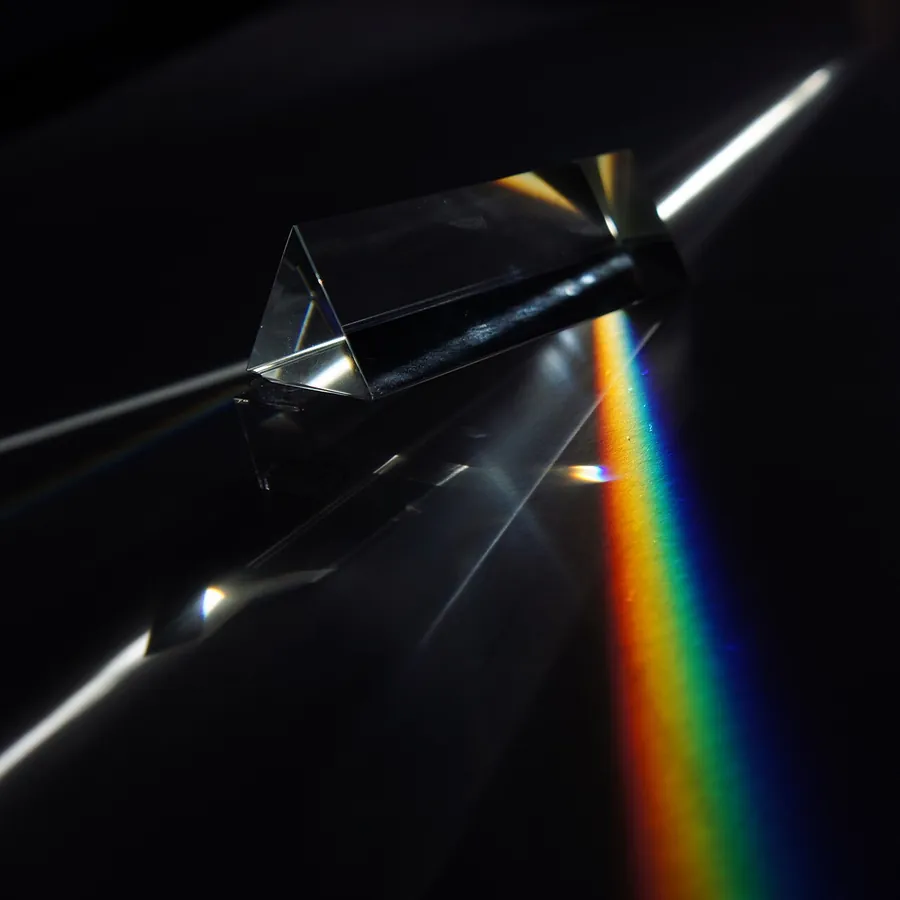
Two numbers explain most of what you see. Refractive index is how strongly a stone bends light: the higher it is, the more light bounces back out of the top as brightness. Dispersion is how far it splits white light into rainbow colours, the flashes jewellers call fire. A prism shows the same effect.
StoneRefractive index (brightness)Dispersion (rainbow fire)
Cubic zirconiaLess bright than diamond but more colourful: the slightly glassy, rainbowy look.2.15 to 2.180.058 to 0.066
DiamondCrisp white brightness with fire in balance.2.420.044
MoissaniteThe brightest of the three, with more than twice diamond's fire: big rainbow flashes, strongest in sunlight.2.65 to 2.690.104
Cubic zirconia. Photo: James St. John, CC BY 2.0.Diamond. Photo: Petragems, CC BY-SA 4.0.Moissanite. Amazon listing photo. See it on AmazonDispersion. A prism splitting white light into colours, the same thing a cut stone does as fire. Photo: User:Kelvinsong, CC0.
The photos are of different stones under different lights, so compare the numbers, not the pictures. In person, CZ looks a little softer and more colourful than diamond, moissanite looks brighter and throws bigger rainbows, and diamond gives the crispest white flashes.
Numbers are not taste. What looks best on paper is not always what a particular person likes best in real life. Some people love moissanite's big rainbow flashes; others find them too much and prefer the cooler white sparkle of diamond, or the softer look of CZ. Lighting, cut, size and setting change how every stone looks. To truly know which you like, see them in person for yourself, side by side if you can, in daylight and under indoor lights.
Why we like cubic zirconia for tennis chains
A tennis chain is a lot of stones, so it is the place where cubic zirconia makes the most sense. It is the cheapest way into the look: for $20 to $50 you can wear one for a few months and find out whether you like the weight, the width and the flash before spending real money. If you love it, upgrade to a moissanite tennis chain, which stays sharp and bright for decades. And if you are curious from there, the next step is lab-grown diamond.
What the same big chain costs in each stone, with stones about 6.5 mm across (the size of a 1 carat diamond) at 22 and 24 inches. The coloured pills show the metal: sterling silversolid goldgold platedstainless steel.
Cubic zirconia: about $36 to $53. 6.5 mm CZ chains on Amazon stop at 20 inches, so at 22 and 24 inches the sizes are 6 mm and 7 mm:
Belacqua sterling silver, the cheapest real-diamond chains at these lengths: 22 in, about $500 and 24 in, about $500. The stones are tiny (Belacqua's line uses 1.6 to 1.7 mm stones), nowhere near 6.5 mm.
Amazon has no natural chain this big either. The cheapest GIA-certified natural 1 carat diamond we found on Amazon is a K colour, SI2 oval pendant at about $1,99014K solid gold.
85 to 92 of those is about $170,000 to $185,000 before any gold, and whiter, cleaner, matched stones cost far more. Our estimate, built from that listing.
Prices checked on Amazon on October 16, 2026 and rounded; Amazon listings are our baseline, linked above. Same look across the room, from tens of dollars to hundreds of thousands.
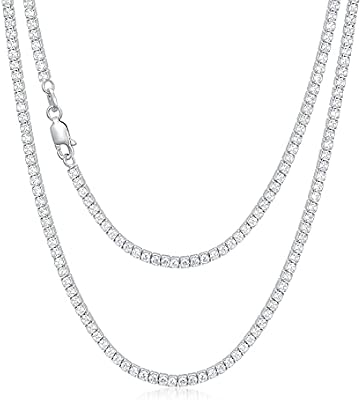
Cubic zirconia tennis chains and bracelets: 24 we checked
Each card is one exact size: the pill shows the stone width and the length the link opens to. Checked in stock on October 16, 2026. Prices are rounded. Plated brass is cheapest but can wear through; sterling silver lasts longer. Tip: 2 to 3 mm reads as dainty, 4 mm as classic, 5 mm and up as a bold or men's line.
Five tools that let you check what you bought (a loupe, a UV torch, locking tweezers, a gem box and a pocket scale), plus a turntable that spins your stone under the light the way jewellers show one. The full collector's kit.
Cubic zirconia is lab-made zirconium dioxide: the cheapest convincing diamond look you can buy. It is perfect for trying a style or for jewellery you might lose, but expect it to scratch and dull with years of daily wear. For a stone that lasts, moissanite or lab diamond.
Should I buy cubic zirconia or moissanite earrings?
Moissanite. Moissanite stud earrings in sterling silver cost about the same as cubic zirconia studs on Amazon (about $14 for a 1 carat pair), and moissanite is harder, brighter and keeps its sparkle. Earrings get knocked by hair, phones and pillows every day, which slowly scratches and dulls cubic zirconia.
How do I clean cubic zirconia jewelry?
Soak it for a few minutes in warm water with a drop of mild dish soap, brush gently behind the stone with a soft toothbrush, rinse, and dry with a lint-free cloth. Do it weekly, because skin oil is what makes cubic zirconia look cloudy. Avoid bleach, chlorine and harsh cleaners, and skip ultrasonic cleaners on plated or glued pieces.
Is cubic zirconia a real diamond?
No. It is zirconium dioxide, a different material made in labs. It is only a fake if it is sold as a diamond.
Is cubic zirconia the same as zircon?
No. Zircon is a natural mineral, zirconium silicate, mined for thousands of years and found in some of the oldest rocks on earth. Cubic zirconia is lab-made zirconium dioxide. They share the element zirconium and little else.
Does cubic zirconia get cloudy?
The stone does not change, but it picks up a film of oil and soap that looks cloudy, and after years of wear its surface collects fine scratches. Cleaning brings back the sparkle; scratches stay. That is why we recommend moissanite over cubic zirconia as a diamond alternative for anything you will wear every day: it is harder, keeps its sharp facets and sparkle for decades, and still costs a small fraction of a diamond. See moissanite
How is cubic zirconia made?
By "skull melting": zirconia powder is melted by radio waves inside a water-cooled cup, so the outer layer stays solid and holds the melt in a crust of its own powder. As it cools, columns of crystal grow inside, and they are cracked out of the crust and cut.
Photo credits
cz-skull-opened.webp: LarryPKelley, Public domain, via Wikimedia Commons.
cz-skull-molten.webp: LarryPKelley at English Wikipedia, Public domain, via Wikimedia Commons.
cz-brilliant-lit.webp: James St. John, CC BY 2.0, via Wikimedia Commons.
Product photos: Amazon listings, via the Amazon Product Advertising (Creators) API.
Amazon links are affiliate links (tag thegemtray-20): buying through them costs you nothing extra and supports the site. As an Amazon Associate we earn from qualifying purchases.