
Our first pick
Cherry Tree Collection Madagascar rose quartz bracelet, 8 mm
about $14
Natural Madagascar rose quartz, the soft pink most people picture.
See it on AmazonQuartz · SiO₂ · 7
Rose quartz is pale to medium pink quartz. Unlike most quartz it almost never forms crystals: it grows as solid masses, usually a little cloudy, in pegmatites. Its pink comes from microscopic fibres of another mineral scattered through the quartz. It is hard enough for everyday jewellery and inexpensive, so it is cut into beads, , hearts and carvings. Strong pink stones from Madagascar and Brazil cost more; dyed quartz and pink glass are the common fakes.
The same stone at four moments. Tap a photo of a listing to see it on Amazon.
01 In the ground (step 1 of 4)
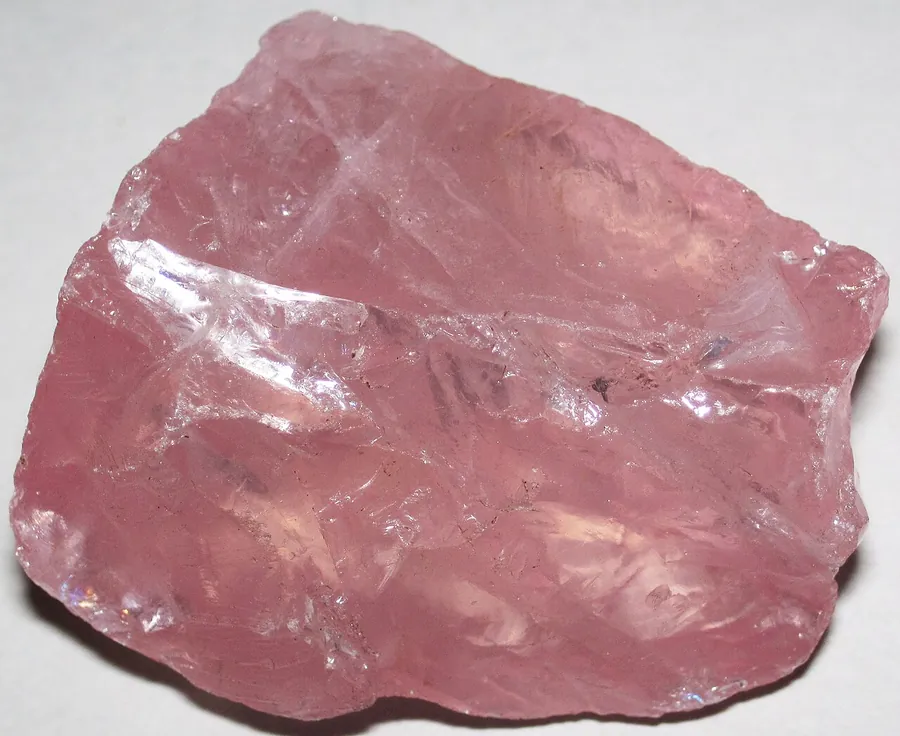
Massive rose quartz: it grows as solid pink masses with no crystal faces.
Real specimen. Photo: James St. John, CC BY 2.0.
02 Rough (step 2 of 4)

Two pounds of rough rose quartz, sold for tumbling and cutting.
Amazon listing photo. See it on Amazon
03 Cut (step 3 of 4)

A rose quartz teardrop, cut as a smooth drop because the slightly cloudy pink shows best as a cabochon.
Amazon listing photo. See it on Amazon
04 Set (step 4 of 4)

Rose quartz set in a 925 sterling silver pendant.
Amazon listing photo. See it on Amazon
| Natural rose quartz | Dyed quartz | |
|---|---|---|
| Colour | Soft, slightly milky pink, even or gently patchy | Strong pink, concentrated in cracks |
| Clarity | Usually a little hazy | Clear quartz with pink lines in fractures |
| Feel | Cold, hard (7) | Cold, hard |
| Price | Low; deep pink, clear pieces cost more | Low |
| How it is listed | "Natural rose quartz", often Madagascar or Brazil | "Pink quartz" or just "rose quartz" |
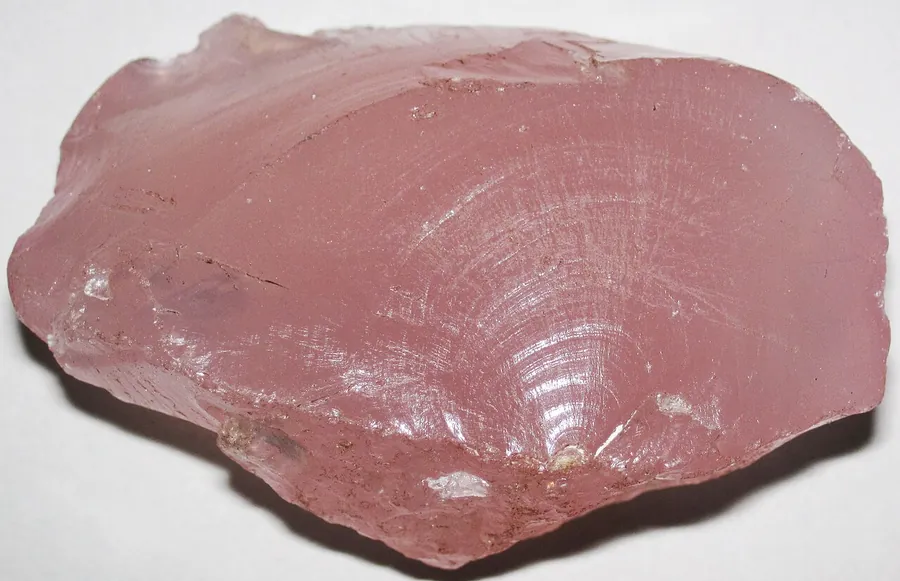
Natural rose quartz is a soft, slightly cloudy pink. If the colour is strongest along cracks, the stone has been dyed. Bright see-through pink "cherry quartz" with streaks or round bubbles is glass. A loupe on a drill hole of a bead usually settles it: dye collects there.
Treatments. Rose quartz is rarely treated, but cheap beads are sometimes dyed and some pale material is coated. Its colour can fade with years of strong sunlight or heat, so do not leave it in a sunny window. Clean with warm soapy water. All gem treatments explained.
Pins mark mining districts, not exact mines. Drag to move, pinch or scroll to zoom, tap a pin to read about it. Map data © OpenStreetMap contributors.
Lab rose quartz is mostly machine-cut in calibrated sizes, which is why a cut lab stone costs little more than its rough. Fine mined stones are often native-cut to keep weight, then recut by precision cutters. See cuts from easiest to hardest and whether cutting your own is cheaper than buying cut.
Checked in stock on October 10, 2026. Photos are the listings' own; prices are rounded.
Our first pick
about $14
Natural Madagascar rose quartz, the soft pink most people picture.
See it on AmazonAlso good
about $19
A simple real rose quartz pendant in sterling silver.
See it on AmazonAlso good
about $15
Plenty of natural rough for tumbling, cabbing or just a bowl.
See it on AmazonFive tools that let you check what you bought (a loupe, a UV torch, locking tweezers, a gem box and a pocket scale), plus a turntable that spins your stone under the light the way jewellers show one. The full collector's kit.
 LookGemOro 10x triplet loupeunder $20
 LookDARKBEAM filtered 365 nm UV flashlightabout $10
 HandleHonoson locking tweezers, 3 packabout $10
 StoreTeensery gem display boxes with clear lids, 10 packabout $9
 ShowComXim motorized turntable, adjustable speed and directionabout $15
 MeasureGemOro Platinum XP500 pocket scale, 0.01 gabout $40
In short
Rose quartz grows over millions of years in the earth, or in hours to months in a lab. Both are real rose quartz; the mined stone is rare and priced for rarity, the lab stone is priced for the cost of growing it. Buy lab to wear and enjoy, check the listing names the mineral, and test it when it arrives.
See our first pick: Cherry Tree Collection Madagascar rose quartz bracelet, 8 mmStudies have shown that its pink comes from tiny fibres of a pink mineral, related to dumortierite, spread through the quartz. The fibres also make it slightly cloudy.
It can, slowly, with long exposure to strong sunlight or heat. Keep pieces out of hot sunny windows.
Very rarely. Almost all rose quartz is massive, with no crystal faces. Small, true rose quartz crystals are found in a few pegmatites, mainly in Minas Gerais, Brazil, and are prized by collectors.
Amazon links are affiliate links (tag thegemtray-20): buying through them costs you nothing extra and supports the site. As an Amazon Associate we earn from qualifying purchases.