Our first pick
Labradorite sphere with stand, 700 g
about $60
About 500 ratings; a sphere shows the flash from every side.
See it on AmazonFeldspar · plagioclase · 6 to 6.5
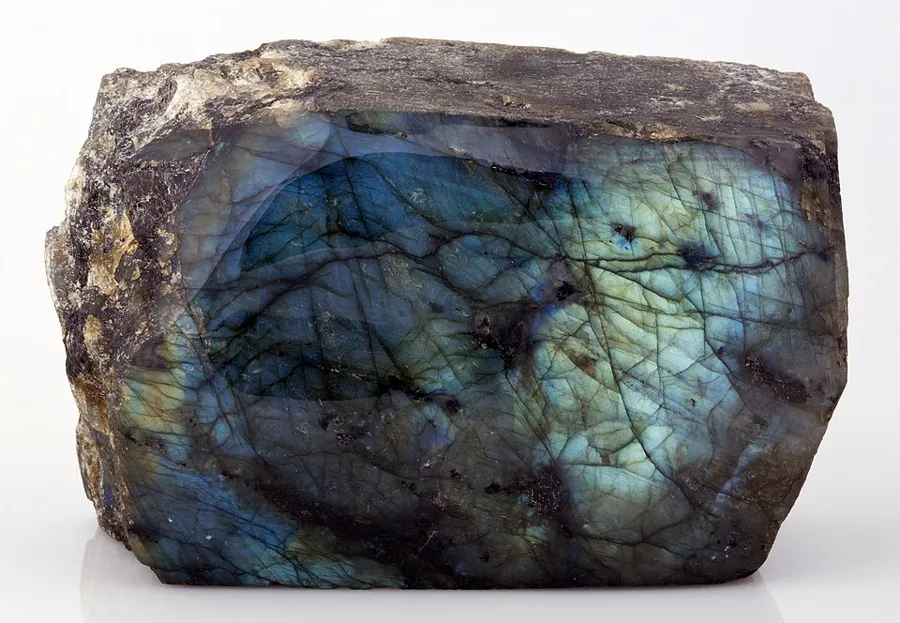
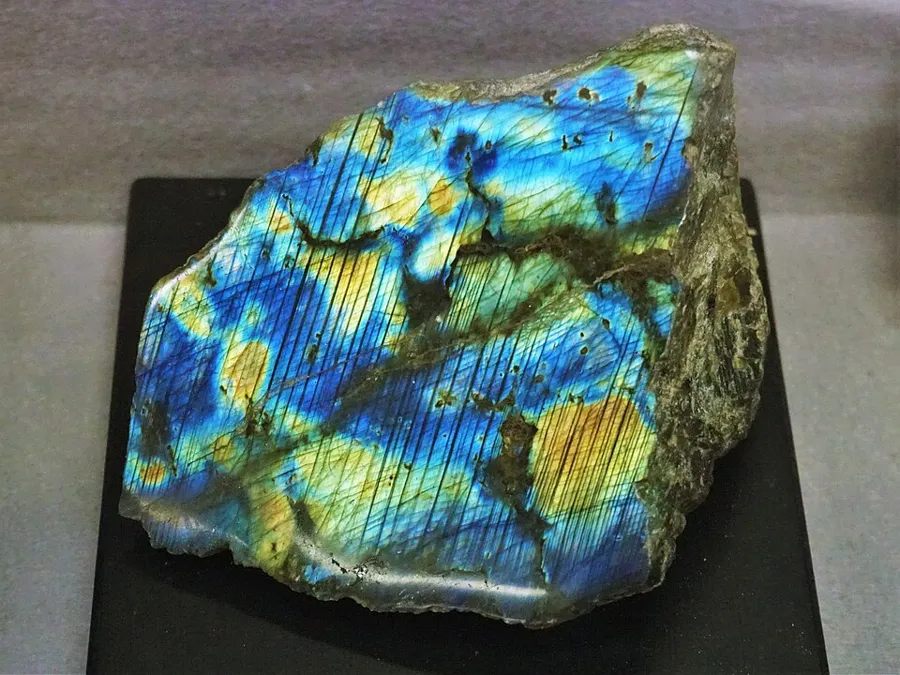
Labradorite is a grey feldspar that flashes blue, green, gold and sometimes every colour when light hits it at the right angle. The flash, called labradorescence, comes from microscopic layers inside the stone. It was named after Labrador in Canada, where it was described in the 1770s. It is natural only and affordable, which makes big polished pieces a collector favourite.
The same stone at four moments. Tap a photo of a listing to see it on Amazon.
01 In the ground (step 1 of 4)
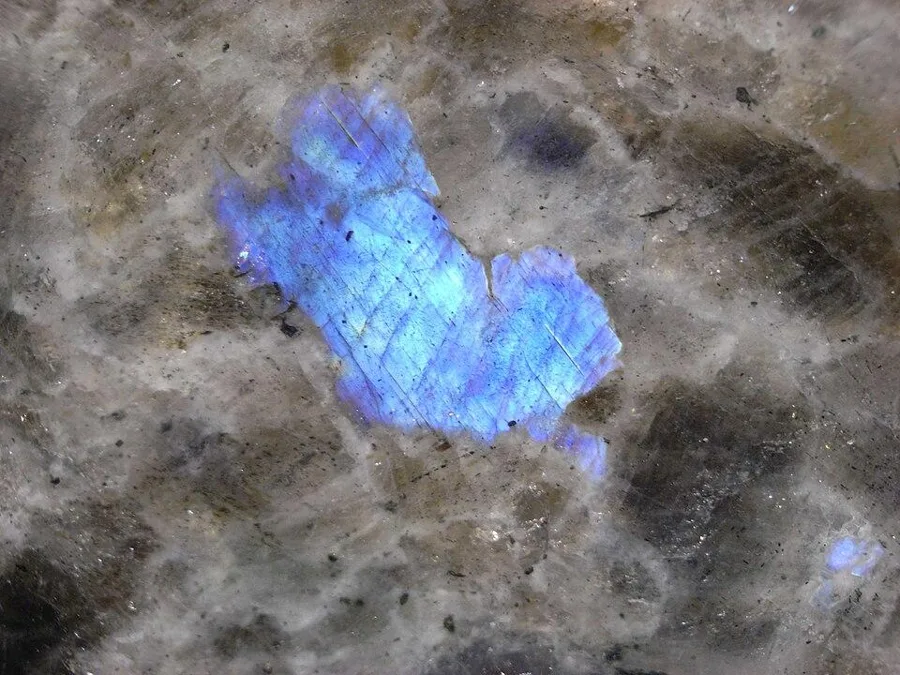
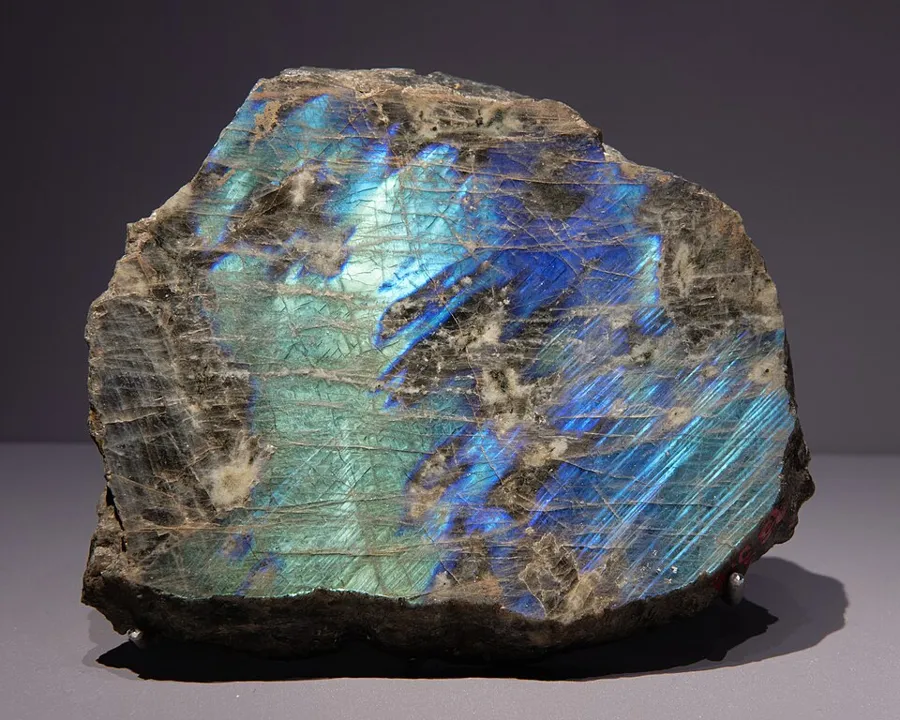
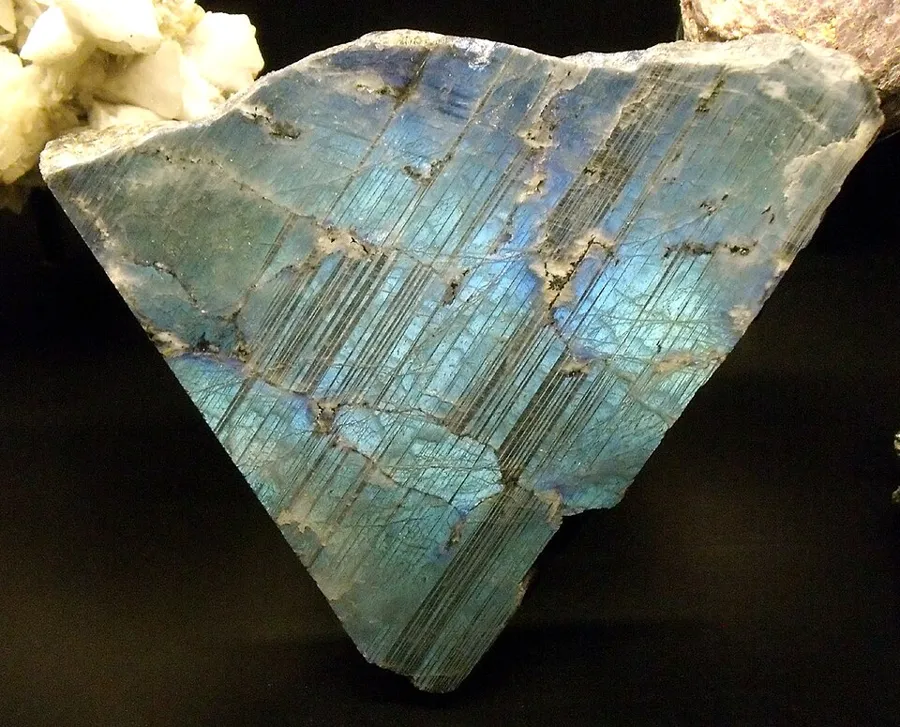
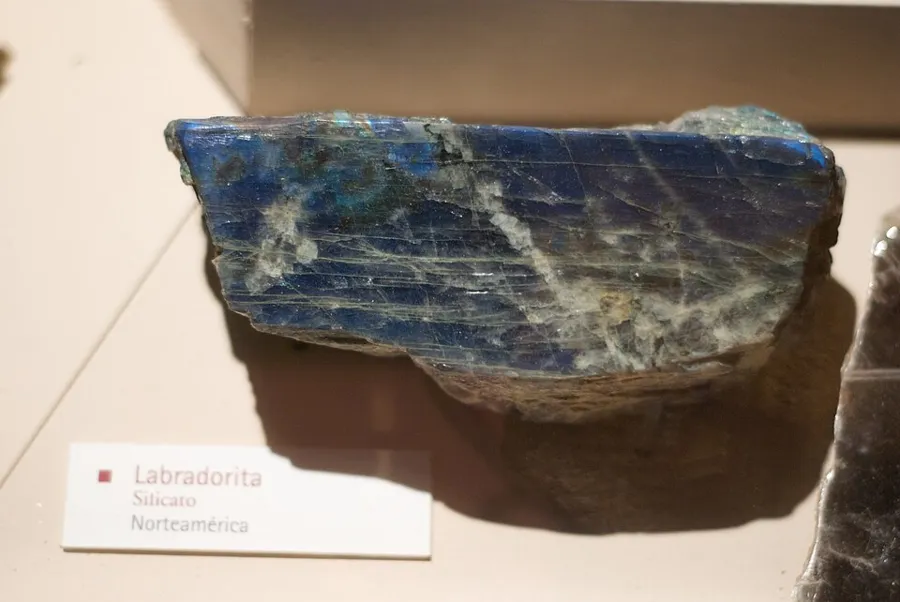
Labradorite flashing blue inside anorthosite rock from Paul Island, Labrador, Canada, the land the stone is named after. Stonemasons call it Blue Eyes.
Real specimen. Photo: Lysippos, CC BY-SA 3.0.
02 The flash (step 2 of 4)
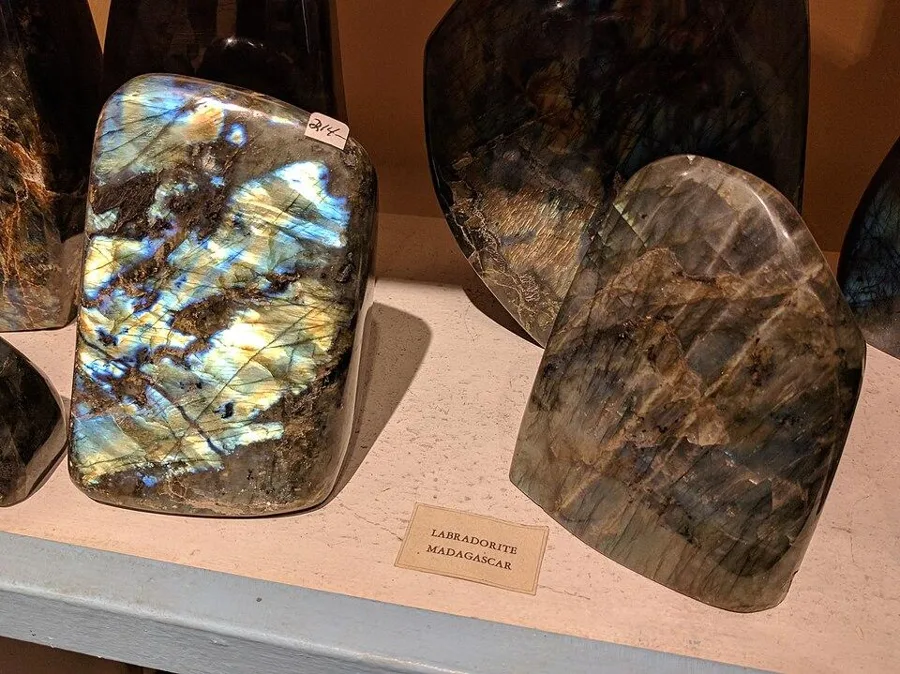
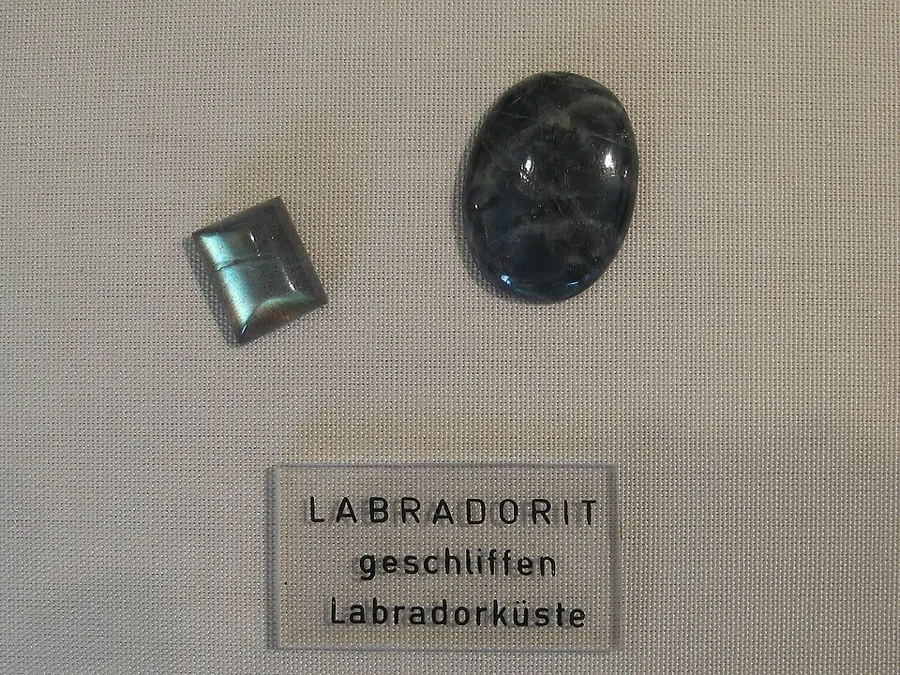
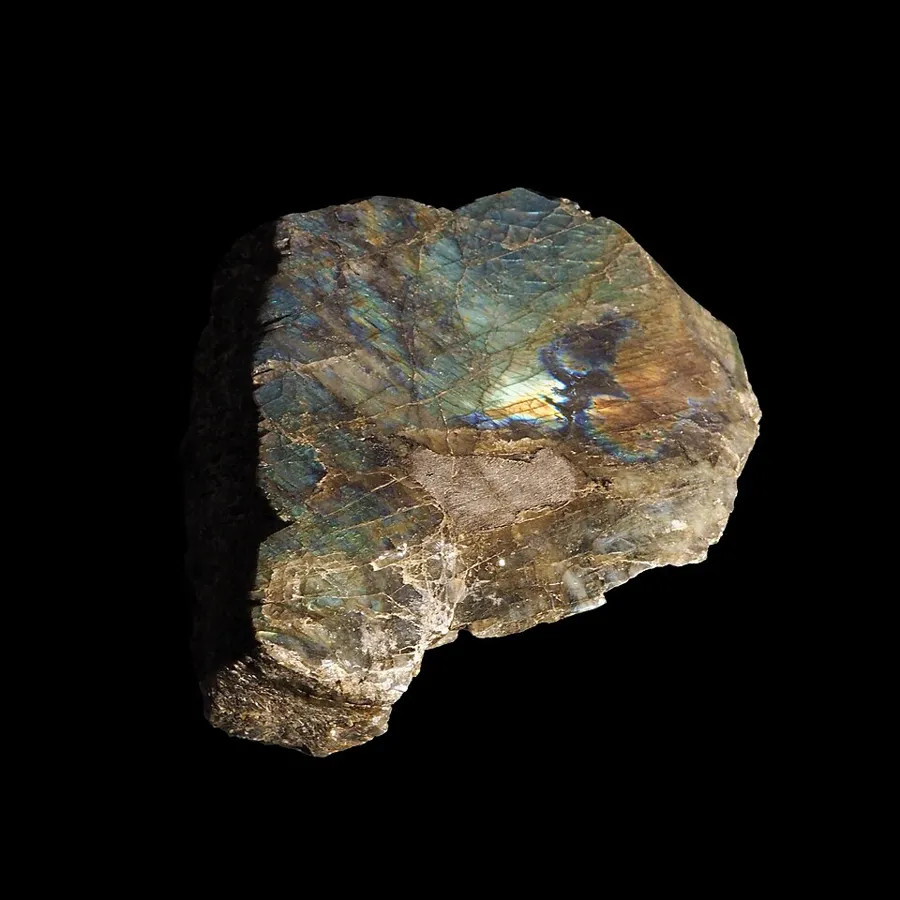
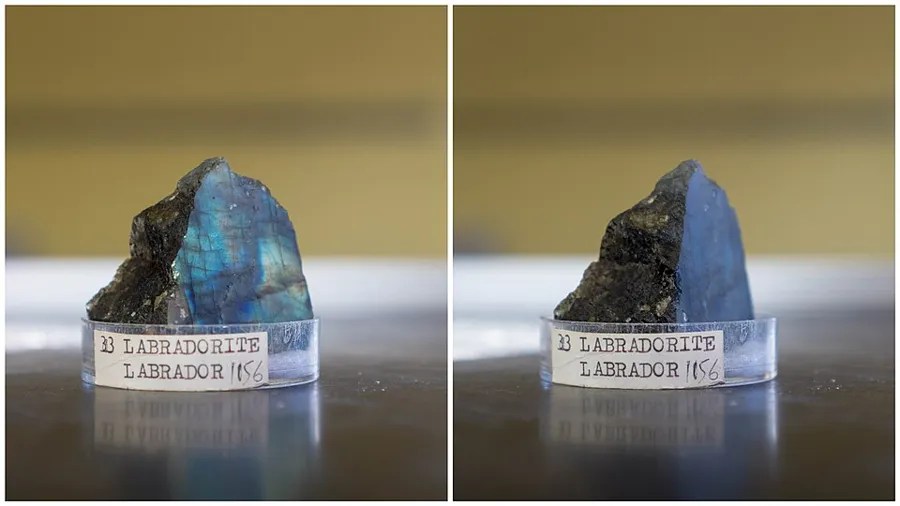
Two polished labradorites in a shop in New Mexico: one blazes blue and gold, the other looks plain grey. Turn either one and they swap.
Real specimen. Photo: Grendelkhan, CC BY-SA 3.0.
03 Polished to own (step 3 of 4)

A 700 g labradorite sphere: turn it and the blue rolls across the ball.
Amazon listing photo. See it on Amazon
04 Set (step 4 of 4)

A labradorite statement ring in sterling silver.
Amazon listing photo. See it on Amazon
What the finest natural stones look like: real pieces in public collections. The whole gem museum.
True stories of labradorite, from the Moravian missionaries of Labrador to Finnish spectrolite and the Moon, each with its sources underneath.
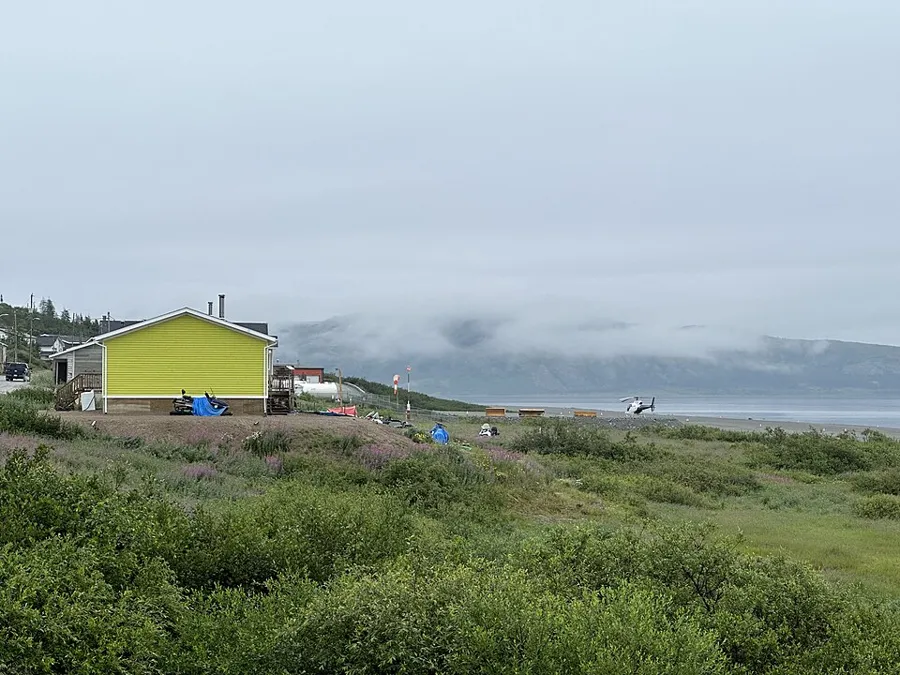
The Moravians were a Protestant church based at Herrnhut in Saxony. One of them, the Danish-born joiner Jens Haven, reached the Strait of Belle Isle in 1764, came back with three more missionaries in 1765, and in 1771 led a group of 14 who founded a mission on the northern Labrador coast and named it Nain.
Around 1770 the mission found boulders of a grey feldspar that flashed blue, green and other colours when it caught the light, and specimens were sent to Europe soon after. In Germany it became known as Labrador Stein; in England it was called Labrador stone and firestone. The mineral's type locality, the place it was first described from, is Paul's Island near Nain.
Accounts of the very first find differ. Some name Paul Island, others nearby Tabor Island, where a small quarry later worked the stone. Nain itself is still there: it is the northernmost permanent settlement in Newfoundland and Labrador, and most of its 1,204 residents (2021 census) are Inuit.
Sources: en.wikipedia.org, en.wikisource.org, rockngem.com, en.wikipedia.org, en.wikipedia.org
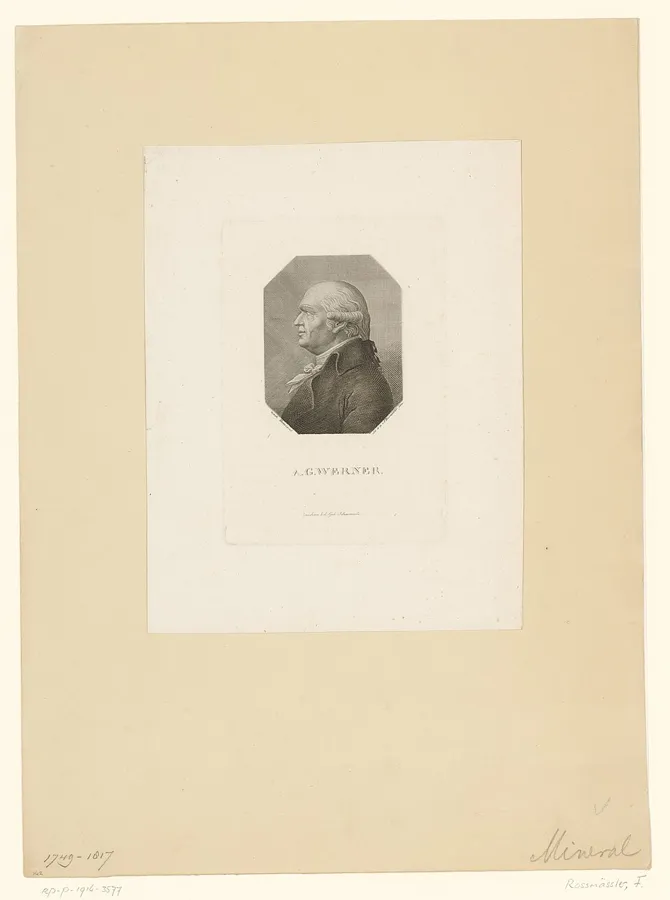
Nobody in Europe knew quite what the Labrador stone was. In 1780 the German mineralogist Abraham Gottlob Werner, unable to work out its chemistry, described it as a mineral species of its own.
The answer came with the feldspars. In 1820 the feldspars albite and anorthite were described, and soon after the French mineralogist François-Sulpice Beudant showed that the Labrador specimens were a feldspar too and named them labradorite. By 1850 mineralogists treated it as the colour-flashing gem variety of that family.
Today labradorite is defined by its chemistry: a plagioclase feldspar, (Ca,Na)(Al,Si)4O8, with 50 to 70 percent of the calcium end member anorthite. It is triclinic, about 6 to 6.5 on the Mohs scale, and splits easily along its cleavage planes.
Sources: rockngem.com, en.wikipedia.org
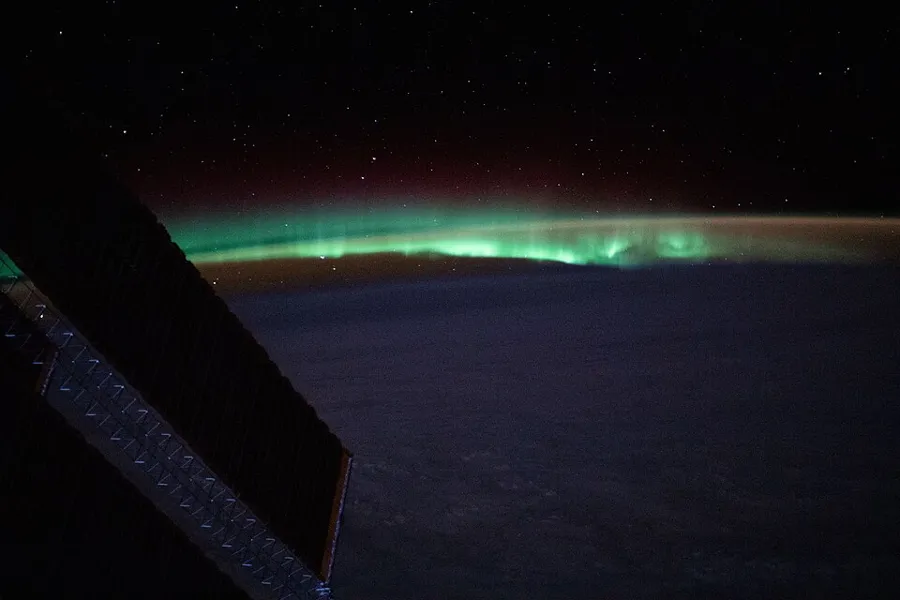
This is a legend, not history. One version was written down by Jason Sikoak, an artist from Rigolet in Nunatsiavut, and published in Inuktitut Magazine (Issue 125, Summer 2019) by Inuit Tapiriit Kanatami. He introduces it as a story that was told to him.
In his telling, a powerful angakok, or shaman, wanted the northern lights for himself and trapped them in the rocks around his home on the northern Labrador coast, leaving a nearby community in darkness. A respected hunter went to ask him to let the lights go. When the angakok refused, the hunter killed him, but the spell did not break. So the hunter struck the brightest part of the rock with his harpoon. Some of the lights escaped back into the sky; the rest stayed in the stone, which, the story says, is what we call labradorite today.
Other versions are repeated on gem websites, including one in which the lights froze and fell to earth in a hard winter, but most do not say who told them or where they were recorded.
Sources: itk.ca, rockngem.com
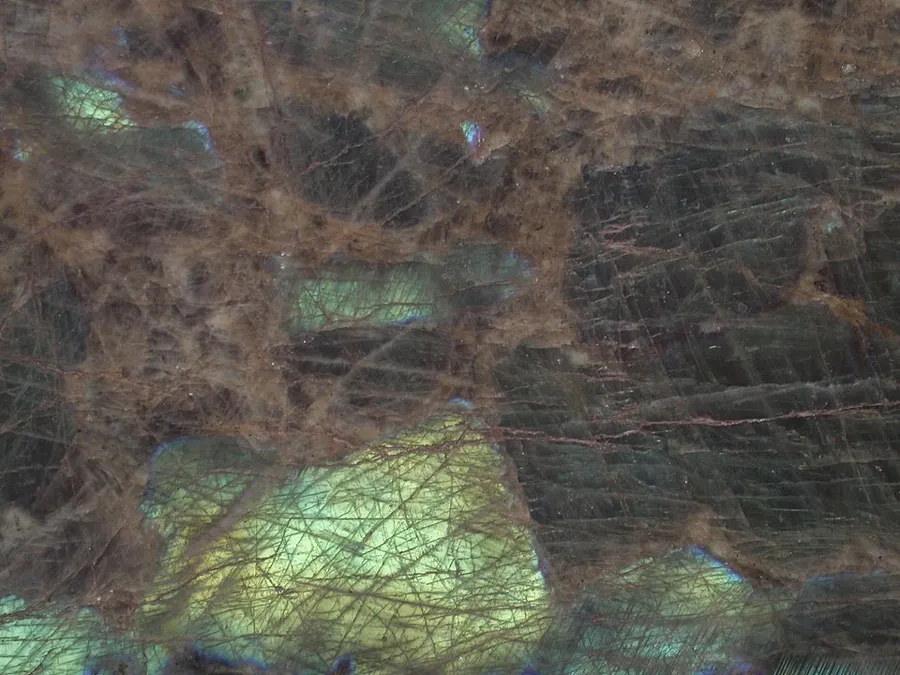
The Danish mineralogist Ove Balthasar Bøggild coined the word labradorescence and described it as the peculiar reflection of light from submicroscopic planes. Work by Lord Rayleigh in 1923 and Bøggild in 1924 began to explain it.
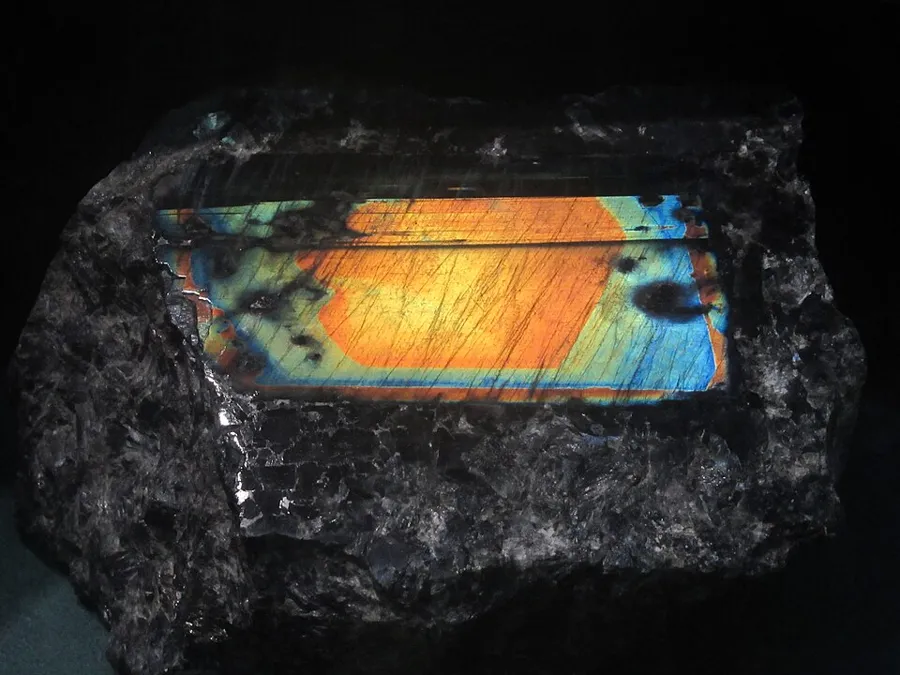
Labradorite crystallises hot, and if it then cools extremely slowly, its calcium-rich and sodium-rich parts separate into alternating sheets far thinner than a wavelength of light. In this Bøggild intergrowth the calcium-rich sheets are about 70 to 200 nanometres thick and the sodium-rich ones about 50 to 100. Light reflected from the stack of sheets interferes, much as it does in a soap film, and only some colours survive.
The colour depends on spacing: a pair of sheets about 150 nanometres thick gives blue, and thicker pairs move through the spectrum to red above about 250. Because the sheets lie in one orientation, the flash appears on one face and only at the right angle. A dark body, coloured by tiny iron oxide , makes it stand out; spectrolite from Finland is almost black.
Sources: en.wikipedia.org, gia.edu
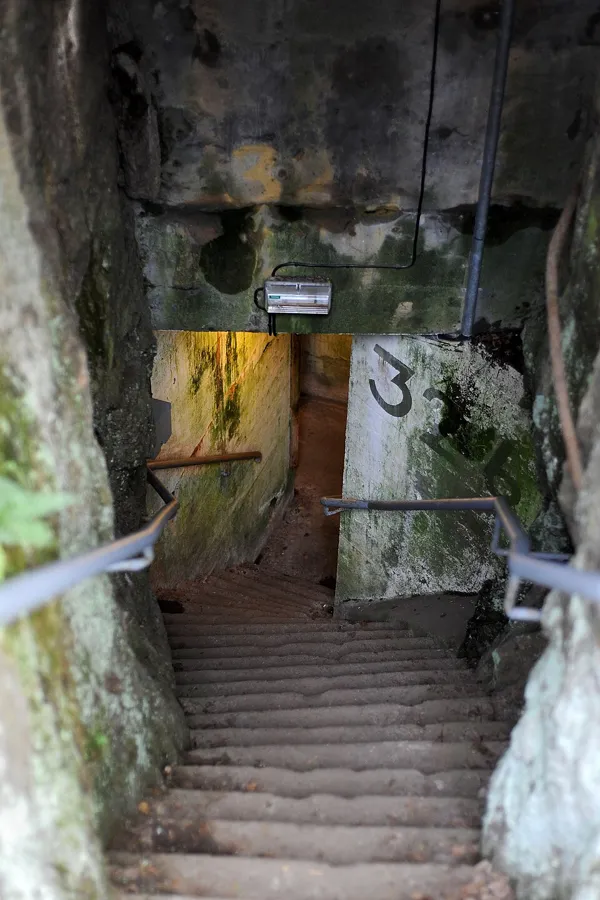
The Finnish geologist Aarne Laitakari (1890 to 1975) described spectrolite and looked for its source for years. In 1940 his son Pekka found a deposit at Ylämaa, in south-eastern Finland, while building the Salpa Line fortifications there.
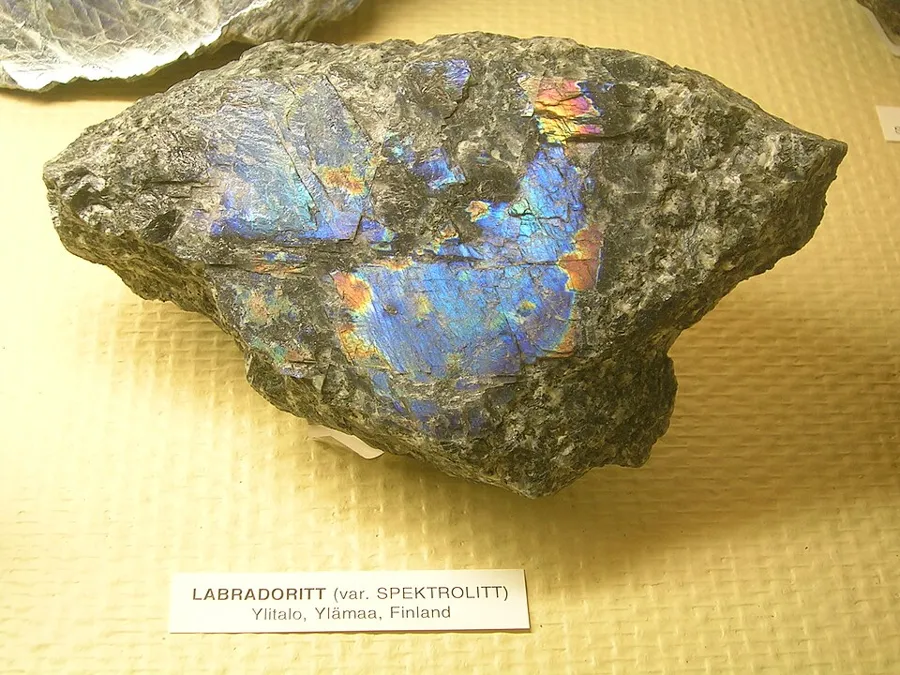
A 2017 report by Paavo Härmä of the Geological Survey of Finland and Olavi Selonen says spectrolite is found only in the Ylämaa region and has been quarried as a gemstone since the end of the 1940s. It sits in six anorthosite areas inside the Wiborg rapakivi granite batholith, which is 1,615 to 1,646 million years old. Quarrying began in the early 1950s; from 1959 the stone was also cut in blocks under the name Labrador for monuments, gravestones and interiors, including the Bank of Finland in Rovaniemi.
In 1973 the first workshop in Ylämaa began cutting spectrolite for jewellery. The name is a brand for the Finnish material, although it is sometimes applied to labradorite from Madagascar. Production in Ylämaa had come to a halt by the end of the 2000s, according to the 2017 report.
Sources: en.wikipedia.org, en.wikipedia.org, kivi.info
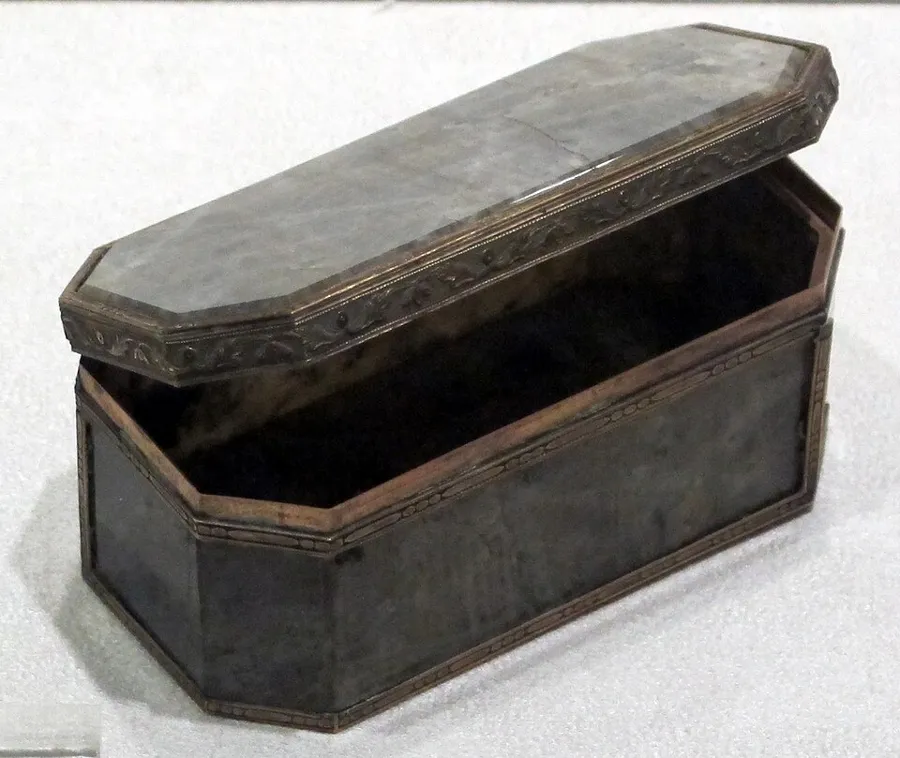
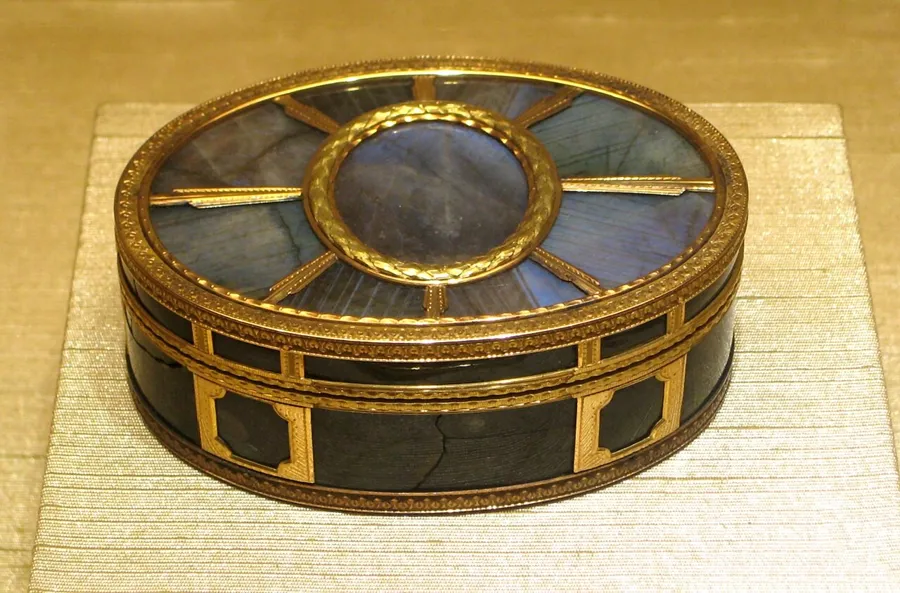
Labradorite only reached European collectors in the 1770s and 1780s, and within twenty years jewellers were setting it in gold. The State Hermitage in Saint Petersburg has a gold snuffbox with labradorite made in the city in 1792 by the master I. Kayser.
Florence has one too. A Florentine snuffbox of labradorite and gold, made about 1790, is in the mineralogy collection of the city's Museo di Storia Naturale; its label records it as a gift from Ferdinand III, Grand Duke of Tuscany, on 1 July 1794.
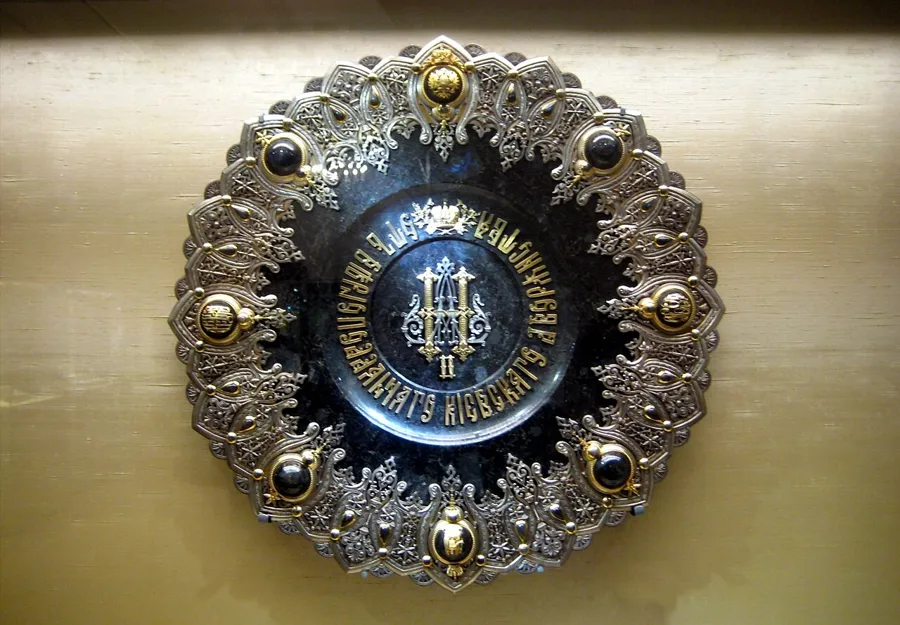
A century later the stone was still a court gift. In 1896, the year of his coronation, the nobility of Kyiv presented Nicholas II with a labradorite dish and saltcellar mounted in silver by the Marshak firm, which are also in the Hermitage.
Sources: commons.wikimedia.org, commons.wikimedia.org, commons.wikimedia.org, en.wikipedia.org
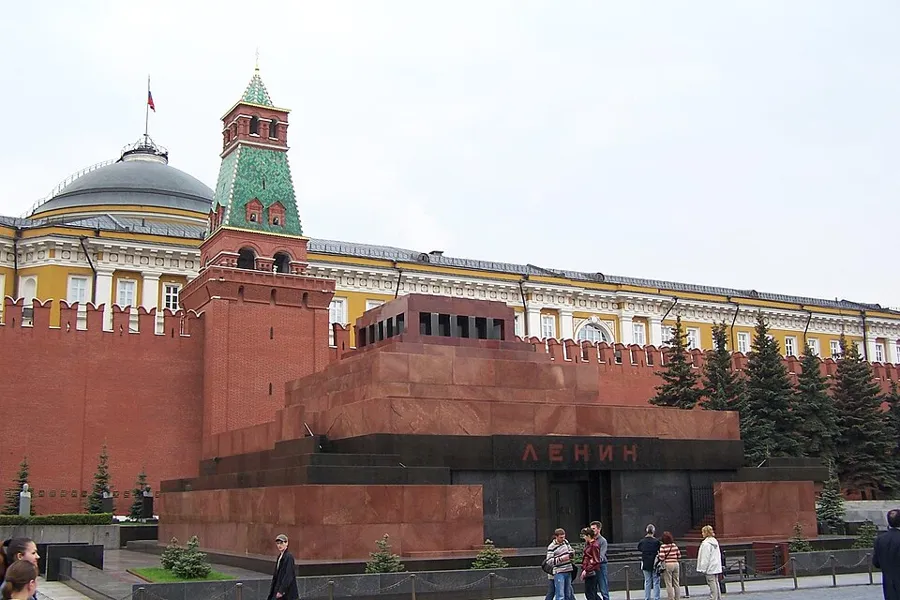
The stone version of Lenin's Mausoleum in Moscow, designed by Alexey Shchusev, was finished in 1930 after sixteen months of building. It was decided to clad it in red granite together with black and grey labradorite, alongside marble and porphyry.
Inside, the walls of the descent are grey labradorite, and in the hall a band of black labradorite runs right round the room, with pilasters of red porphyry standing on it.
Labradorite-rich rock has gone into other public buildings too. In Finland, spectrolite quarried at Ylämaa was used in 1959 and 1960 for monuments, a savings bank facade, and the interior of the Bank of Finland in Rovaniemi.
Sources: en.wikipedia.org, kivi.info
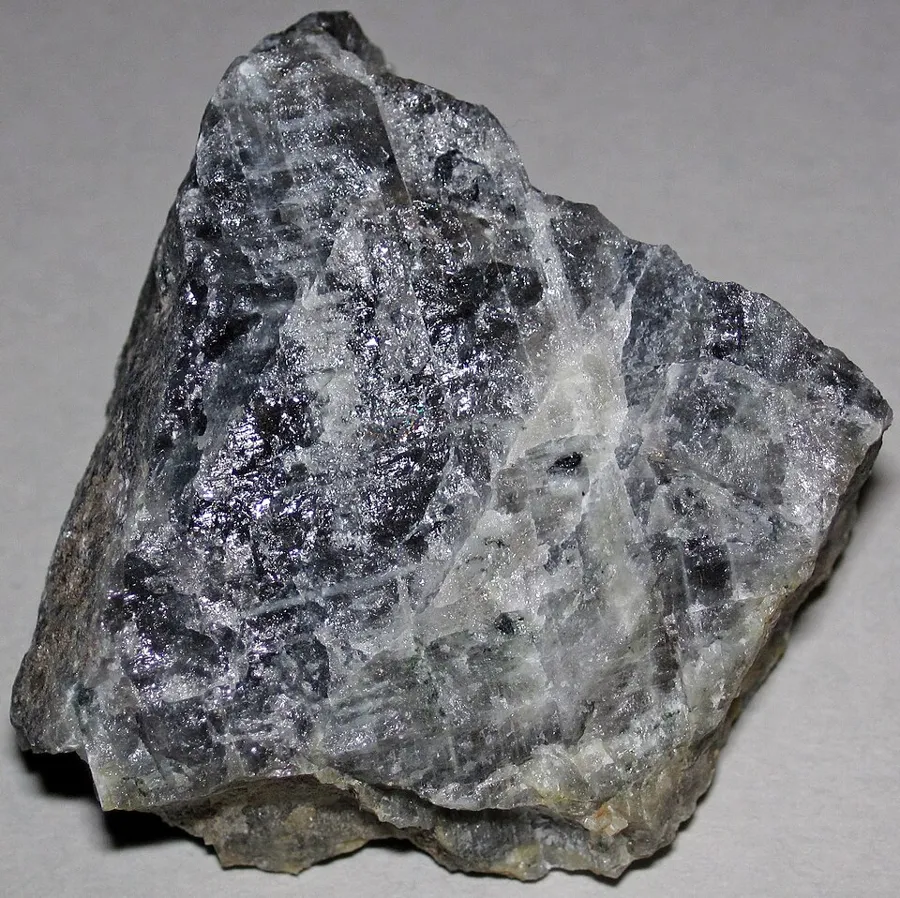
Labradorite from Labrador comes out of anorthosite, a rock made almost entirely (90 to 100 percent) of plagioclase feldspar. The Nain anorthosite crystallised 1.29 to 1.35 billion years ago and belongs to the Nain Plutonic Suite, which covers a vast area of northern Labrador. Big anorthosite bodies of this age usually have plagioclase of 40 to 60 percent anorthite, and some are quarried for labradorite as a gem and as building stone.
People have tried to make a business of it for over a century. Ralph Graham Taber opened a small quarry on Tabor Island in 1890 and shipped about eight tons to the United States before closing in 1896; the Smithsonian bought large display pieces from him in 1894. In the 1990s the Ten Mile Bay quarry near Nain began cutting the rock as Blue Eyes granite, which is actually anorthosite, and the Inuit sculptor Gilbert Hay began carving it. The quarry closed around 2010.
In 1975 Newfoundland and Labrador made labradorite its official mineral emblem.
Sources: en.wikipedia.org, rockngem.com, en.wikipedia.org, assembly.nl.ca
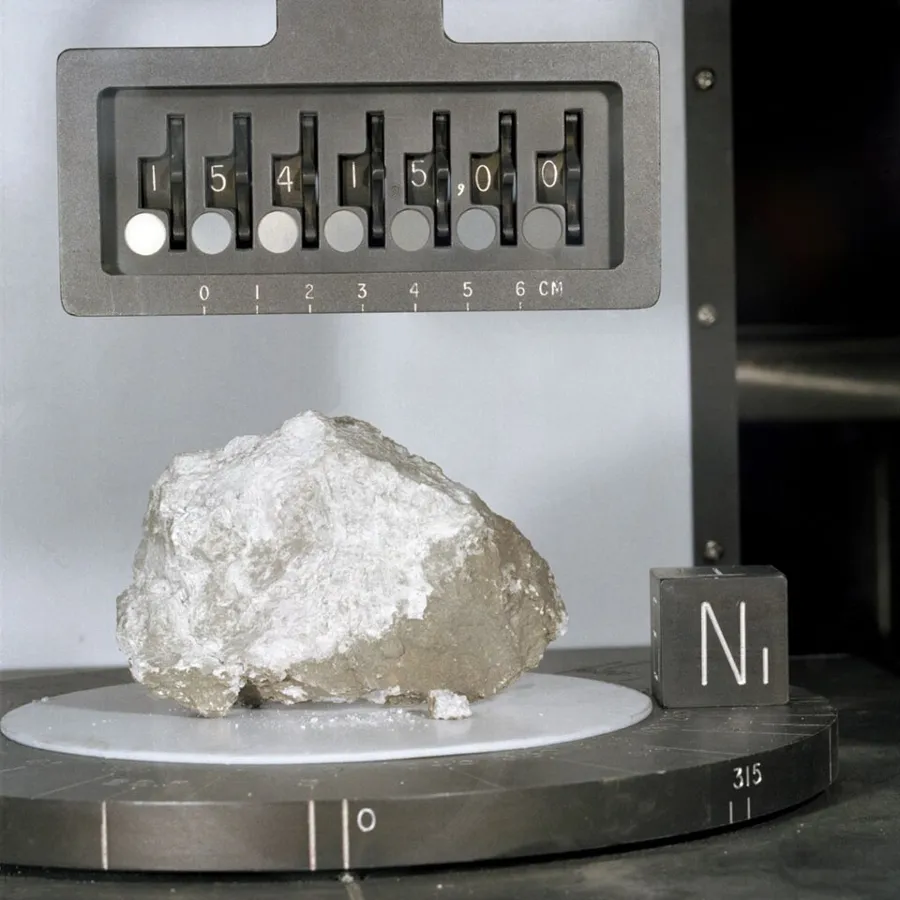
Anorthosite, the plagioclase-rich rock that labradorite comes from on Earth, is the dominant rock of the lunar highlands, which make up about 80 percent of the Moon's surface.
The most famous piece is the Genesis Rock, sample 15415, picked up by the Apollo 15 astronauts David Scott and James Irwin at Spur crater in 1971. It weighs about 270 grams, is at least 4 billion years old, and is kept at the Lunar Sample Laboratory Facility in Houston.
It is not labradorite, though. The Genesis Rock is made mostly of anorthite, the calcium-rich end of the same plagioclase series, while labradorite sits in the middle at 50 to 70 percent anorthite. Very old anorthosites on Earth are also mostly above 80 percent anorthite; the younger ones that yield labradorite are closer to 40 to 60.
Sources: en.wikipedia.org, en.wikipedia.org, en.wikipedia.org
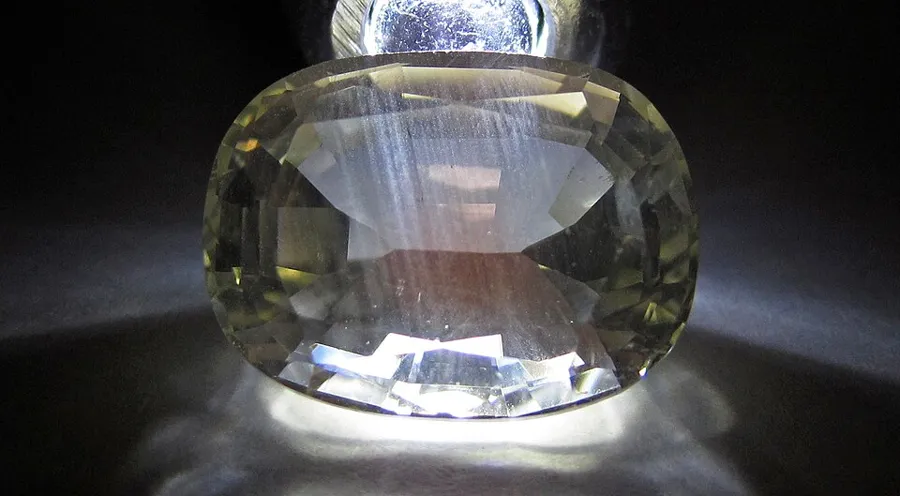
Oregon sunstone is labradorite too. GIA reports that three mines in the high desert of eastern Oregon, Ponderosa in Harney County and Dust Devil and Sunstone Butte in Lake County, all produce copper-bearing labradorite, with about 70 percent anorthite, ranging from almost colourless through pale yellow to red and green.
The crystals grew in basalt lava. They sit as large crystals in flows erupted during widespread volcanism 15 to 17 million years ago, and they are scarce: each ton of basalt at the Dust Devil mine yields about one pound of rough. The copper is what gives the stones their colour and their coppery shimmer.
Oregon made sunstone its state gemstone on 4 August 1987. The Bureau of Land Management runs a public collection area north of Plush where anyone can collect sunstones for free, as long as it is not for sale or trade.
Sources: gia.edu, en.wikipedia.org, blm.gov
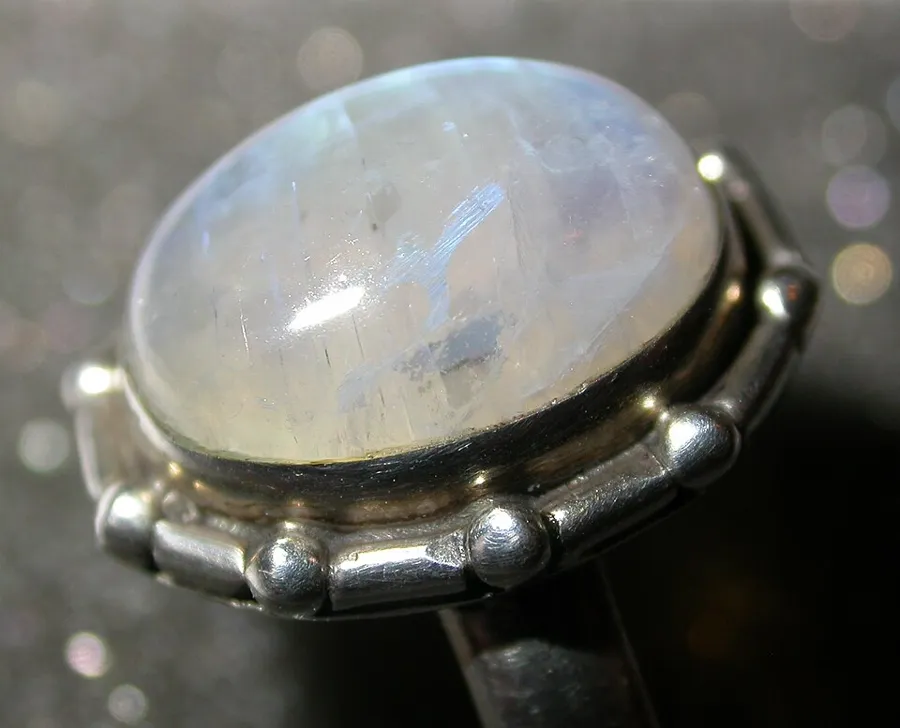
True moonstone is an orthoclase feldspar with a soft blue-white glow. The gem sold as rainbow moonstone is something else: GIA describes it as transparent labradorite, a closely related feldspar, and calls the trade name a misnomer, although the trade has accepted it as a gem in its own right.
In 2024 GIA reported unusually fine rainbow moonstone from Andilamena, in the Alaotra-Mangoro region of north-eastern Madagascar, mined in 2023. Bear Williams of Stone Group Laboratories confirmed it by Raman spectroscopy as plagioclase within the labradorite variety. The stones were clear enough to facet, including a 9.30 carat oval.
Because rainbow moonstone is so transparent, its colour comes from deep inside the stone, while in nearly black spectrolite it shows at the surface. Madagascar is also a notable source of ordinary labradorite; the Royal Museum for Central Africa in Belgium holds a large dark grey block with a bluish sheen from Ihosy, donated in 1978.
Sources: gia.edu, gia.edu, gia.edu, gia.edu, en.wikipedia.org, africamuseum.be
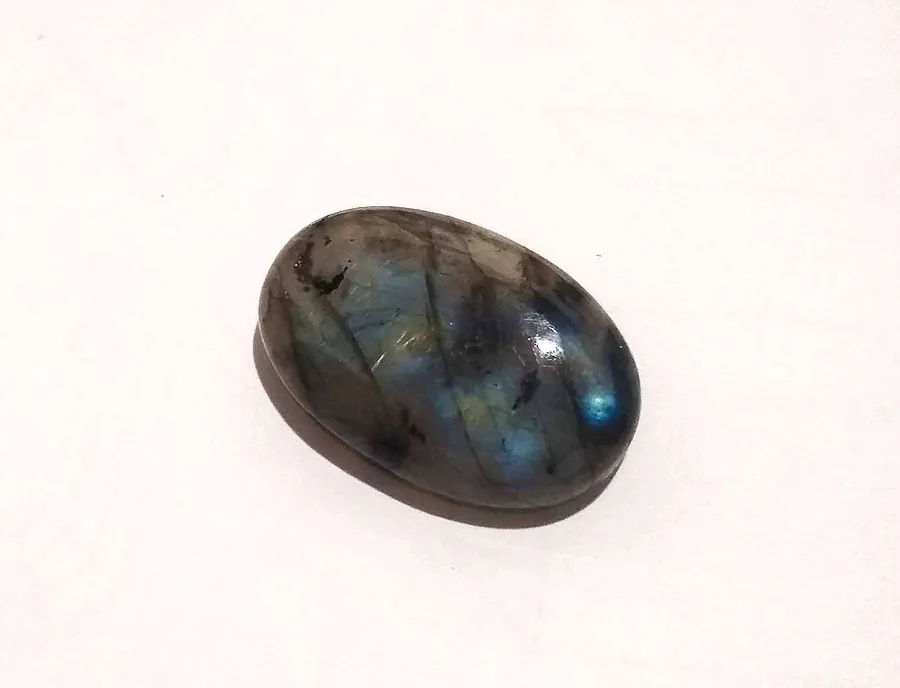
Real labradorescence comes from layers inside the crystal, so the colour lies in patches and switches on and off as you tilt the stone. It shows best on one face; turned the wrong way, a fine piece can look plain grey. Not every labradorite flashes at all.
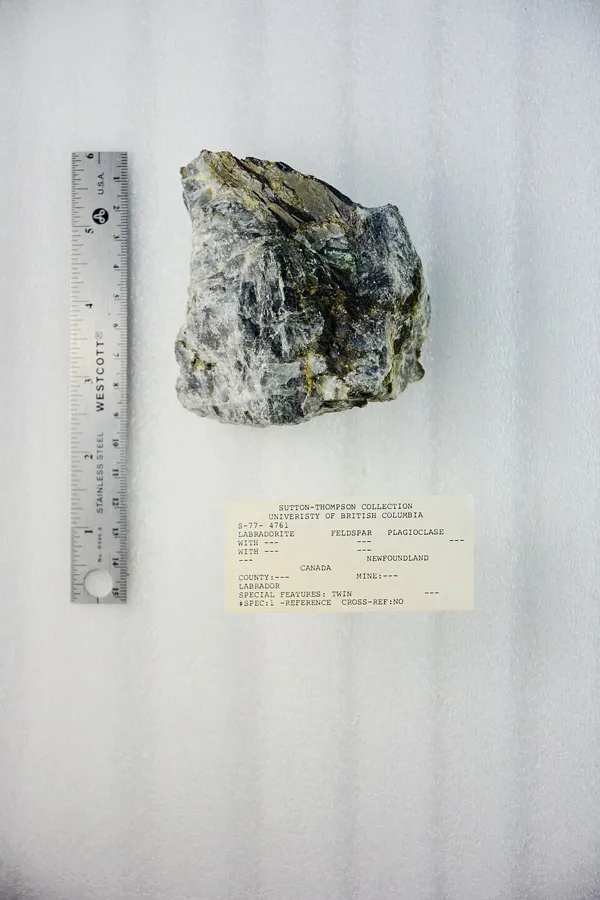
Hobby guides add a few checks: real stones often show straight parallel lines from crystal twinning, while coated glass tends to show a bright, even rainbow from every angle, and resin or polymer copies may glow under ultraviolet light. These are hints, not proof. A gem lab can settle it with (about 1.55 to 1.57 for labradorite) and specific gravity (2.68 to 2.72).
Watch the names too. Spectrolite is a brand name for Finnish material, sometimes used for Madagascar stone. And the blue-sheened Norwegian building stone sold as larvikite is a different rock: the 1911 Encyclopaedia Britannica already noted that its feldspar is of the orthoclase type, not labradorite.
Sources: gia.edu, en.wikipedia.org, howtofindrocks.com, en.wikipedia.org, en.wikisource.org, en.wikipedia.org
| Better | Plainer | |
|---|---|---|
| Flash | Strong, across most of the face | Patchy or only at one angle |
| Colours | Blue plus gold, green, orange or purple | Grey-blue only |
| Body | Dark, so the flash pops | Pale or cloudy |
| Price | Still modest: tens of dollars for a big piece | A few dollars |
Photos of labradorite are taken at the best angle. Expect the flash to appear only when you tilt the piece; buy big polished faces for the most colour.
Treatments. Labradorite is not usually treated. Some cheap pieces are coated with a clear lacquer to boost the shine. All gem treatments explained.
Pins mark mining districts, not exact mines. Drag to move, pinch or scroll to zoom, tap a pin to read about it. Map data © OpenStreetMap contributors.
Lab labradorite is mostly machine-cut in calibrated sizes, which is why a cut lab stone costs little more than its rough. Fine mined stones are often native-cut to keep weight, then recut by precision cutters. See cuts from easiest to hardest and whether cutting your own is cheaper than buying cut.
Checked in stock on October 10, 2026. Photos are the listings' own; prices are rounded.
Our first pick
about $60
About 500 ratings; a sphere shows the flash from every side.
See it on AmazonAlso good
about $40
A big cabochon with strong blue flash.
See it on AmazonAlso good
about $80
A wide flat face: the most flash per dollar.
See it on AmazonThe heaviest and largest pieces we found on Amazon, all checked in stock on October 11, 2026. Weights and sizes are the listings' own. Photos are the listings' own; prices are rounded.
 Giant piecesExtra large polished labradorite slabA big flat face shows the flash best.about $80on Amazon →
 Giant piecesJIC Gem class 1 labradorite upright stone, 2.3 to 2.5 lbabout $60on Amazon →Giant piecesLabradorite sphere with stand, 700 gAbout 500 ratings. Turn it and the blue flash rolls across the ball.about $60on Amazon →
Every piece names the real stone and comes from a seller with a record, checked in stock on October 11, 2026. Photos are the listings' own; prices are rounded.
 WomenAvicrafts labradorite ring, sterling silverAbout 220 ratings.about $30on Amazon →
 WomenLabradorite hexagon wrap pendantabout $24on Amazon →
 Carvings and decorLabradorite tower, 4.7 to 5.1 inabout $26on Amazon →
 Carvings and decorCarved labradorite winged skullabout $18on Amazon →
 Carvings and decorCarved labradorite wolf, 2.2 inabout $9on Amazon →
 Carvings and decorLabradorite palm stones, 1.5 to 2.7 inOver 2,600 ratings.about $9on Amazon →
 Raw and tumbledRaw labradorite, 1.25 to 2 inabout $6on Amazon →
 JewelleryNavya Craft labradorite ring, sterling silverA simple sterling silver ring set with a natural labradorite.about $25on Amazon →
 JewelleryKoral Jewelry delicate oval labradorite ring, sterling silverA slim, vintage-style silver ring with a small oval labradorite.about $25on Amazon →
 JewelleryKoral Jewelry pear labradorite ring, sterling silverA boho silver ring built around a pear-shaped labradorite.about $40on Amazon →
 JewelleryKoral Jewelry vintage gipsy labradorite ring, sterling silverA bolder silver setting with a larger labradorite, in the same maker's vintage style.about $60on Amazon →
 JewelleryMyhealingworld labradorite cocktail ring, dotted and rope silverA 12 mm round labradorite cabochon in a handmade solid sterling silver setting.about $40on Amazon →
 Signet ringsFULA JEWELS men's labradorite signet ring, sterling silverA bold men's signet with a natural labradorite face set in sterling silver.about $45on Amazon →
 Signet ringsMOUNTEN JEWELLERY men's labradorite statement ring, sterling silverA handmade men's silver ring with a large labradorite top.about $45on Amazon →
 JewelleryDanique Jewelry large round labradorite pendantAn 18 mm round labradorite on a pendant necklace, big enough to show a good flash.about $45on Amazon →
 JewelleryGEMKORA bezel-set oval labradorite pendant, sterling silverA polished oval labradorite in a clean silver bezel.about $20on Amazon →
 JewelleryJoyfulmuze labradorite necklace, sterling silverA handmade silver pendant with natural labradorite.about $40on Amazon →
 JewelleryRocks2Rings labradorite and moonstone necklaceLabradorite paired with moonstone, the two feldspars side by side.about $95on Amazon →
 JewellerySilver Palace marquise labradorite earrings, sterling silverMarquise-shaped labradorite set in sterling silver.about $25on Amazon →
 JewelleryJoyfulmuze labradorite teardrop threader earrings, sterling silverSmall labradorite drops on long sterling silver threader chains.about $25on Amazon →
 JewelleryJay Jools labradorite cufflinks, sterling silverSterling silver cufflinks set with natural labradorite, a classic groom's gift.about $60on Amazon →
 JewelleryAmazing Gemstone labradorite bead braceletA stretch bracelet of polished labradorite beads for men or women.about $25on Amazon →
 JewellerySoulRoot 8 mm labradorite bead braceletRound 8 mm labradorite beads on a unisex stretch band.about $10on Amazon →
 BeadsAD Beads 8 mm A++ labradorite round beads, 15 inch strandSmooth round labradorite beads, graded A++, for necklaces and bracelets.about $20on Amazon →
 BeadsGEM-Inside AAA rainbow flash labradorite beads, 8 mmGrey labradorite beads picked for blue flash, sold as a strand.about $20on Amazon →
 BeadsBEADIA spectrolite tube beads, 13 x 4 mmThirty rectangular tube beads sold as spectrolite, for spacers and designs.about $10on Amazon →
 Carvings and decorRALDMOV natural labradorite sphere with stand, 500 gA half-kilo polished labradorite ball with a pedestal.about $45on Amazon →
 Carvings and decorMOGEMT large labradorite sphere with stand, 90 to 100 mmA big polished sphere, about 3.5 to 4 inches across, for a shelf or desk.about $70on Amazon →
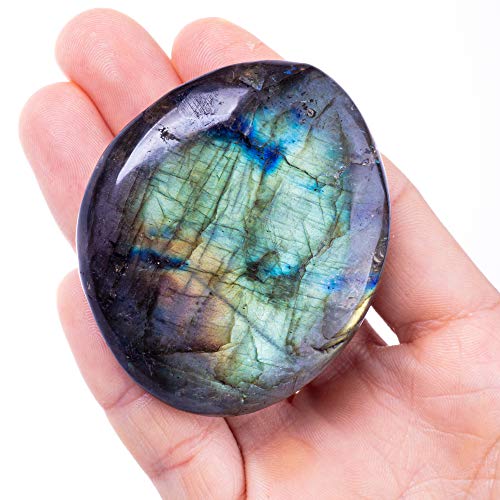 Carvings and decorUFEEL labradorite palm stoneA smooth pocket-sized labradorite palm stone.about $15on Amazon →
 Carvings and decorAmazing Gemstone labradorite palm stone, 45 to 50 mmA larger palm stone with room for the flash to show.about $15on Amazon →
 Carvings and decorKALIFANO labradorite heartA polished labradorite heart that fits in the hand.about $20on Amazon →
 Carvings and decorAmazing Gemstone labradorite towers, 2 to 3 inchA small six-sided labradorite point that stands upright.about $15on Amazon →
 Carvings and decorArtistone hand-carved labradorite wolf, 2 inchA small carved wolf figure in labradorite.about $15on Amazon →
 Carvings and decorYtbeoxk labradorite skull carving, 2 inchA palm-sized skull carved from labradorite.about $15on Amazon →
 Carvings and decorTop Chi labradorite Baoding balls, 1.6 inchA pair of polished labradorite balls for rolling in the hand.about $30on Amazon →
 Carvings and decorFZBHRO large polished labradorite slab, 1.3 to 1.7 lbA big polished block with a broad flat face for the flash.about $45on Amazon →Carvings and decorFZBHRO polished labradorite slab, 0.8 to 1.3 lbA smaller polished block from the same maker, still large enough to display.about $40on Amazon →
 Raw and tumbledCrocon 1 lb rough labradoriteA pound of raw labradorite for tumbling or cabbing.about $20on Amazon →
 Raw and tumbledZenkeeper 1 lb raw labradoriteRough labradorite pieces for tumbling, polishing or display.about $20on Amazon →
 Raw and tumbledOrientrea 1.1 lb raw labradorite roughA bag of natural rough labradorite crystals.about $15on Amazon →
 Loose stonesMyhealingworld 8 mm round labradorite cabochon, calibratedA calibrated round cabochon for setting in a ring or earrings.about $20on Amazon →
 Loose stonesMyhealingworld 10 x 14 mm pear labradorite cabochons, 3 piecesCalibrated pear cabochons with blue flash, sold in a box of three.about $20on Amazon →
Five tools that let you check what you bought (a loupe, a UV torch, locking tweezers, a gem box and a pocket scale), plus a turntable that spins your stone under the light the way jewellers show one. The full collector's kit.
 LookGemOro 10x triplet loupeunder $20
 LookDARKBEAM filtered 365 nm UV flashlightabout $10
 HandleHonoson locking tweezers, 3 packabout $10
 StoreTeensery gem display boxes with clear lids, 10 packabout $9
 ShowComXim motorized turntable, adjustable speed and directionabout $15
 MeasureGemOro Platinum XP500 pocket scale, 0.01 gabout $40
In short
Labradorite grows over millions of years in the earth, or in hours to months in a lab. Both are real labradorite; the mined stone is rare and priced for rarity, the lab stone is priced for the cost of growing it. Buy lab to wear and enjoy, check the listing names the mineral, and test it when it arrives.
See our first pick: Labradorite sphere with stand, 700 gIt is made of thin, alternating layers of slightly different feldspar. Light bouncing between the layers interferes like the colours on a soap bubble, so you see blue or gold only at certain angles.
A dark labradorite from Finland, found in the 1940s, that flashes the whole spectrum of colours.
Close: rainbow moonstone is a pale, almost transparent labradorite sold under the moonstone name.
Amazon links are affiliate links (tag thegemtray-20): buying through them costs you nothing extra and supports the site. As an Amazon Associate we earn from qualifying purchases.