
Our first pick
Zenkeeper rough fluorite, 1 lb, mixed purple and green
about $16
A pound of natural rough showing the colour zoning that real fluorite has.
See it on AmazonCalcium fluoride · CaF₂ · 4
Fluorite is calcium fluoride, a mineral that grows as glassy cubes and comes in more colours than almost any other: purple, green, blue, yellow, pink and clear, often banded together as "rainbow fluorite". Many pieces glow under ultraviolet light, and the word was coined from its name. It splits cleanly in four directions, so it breaks into neat eight-sided octahedra. It is soft, number 4 on the Mohs scale, so it is a collector's stone more than an everyday ring stone. Clear synthetic fluorite is grown for camera and telescope lenses. Is it valuable? Most fluorite is inexpensive: a pound of rough costs about $15 to $45 on Amazon, and collectors pay more only for sharp, brightly coloured crystals from famous mines.
The same stone at four moments. Tap a photo of a listing to see it on Amazon.
01 In the ground (step 1 of 4)
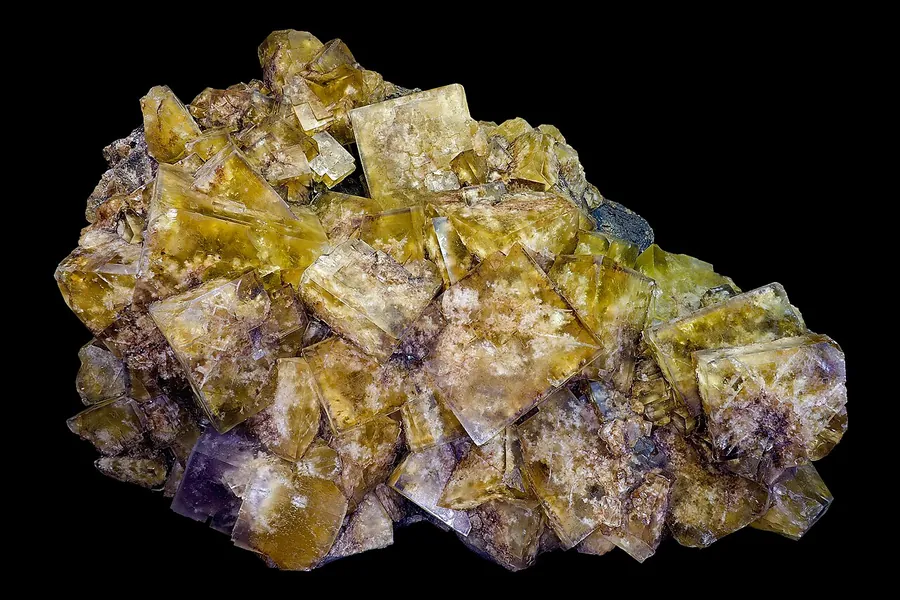
Fluorite cubes from Peyrebrun, France: yellow with purple corners, grown in a mineral vein.
Real specimen. Photo: Didier Descouens, CC BY-SA 3.0.
02 Cleaved (step 2 of 4)

A green fluorite octahedron. Fluorite splits cleanly in four directions, so rough cubes are tapped into eight-sided shapes like this.
Amazon listing photo. See it on Amazon
03 Polished (step 3 of 4)

A polished fluorite sphere showing the purple and green bands. Fluorite is too soft to facet for wear, so it is mostly polished.
Amazon listing photo. See it on Amazon
04 Set (step 4 of 4)

A fluorite heart in sterling silver.
Amazon listing photo. See it on Amazon
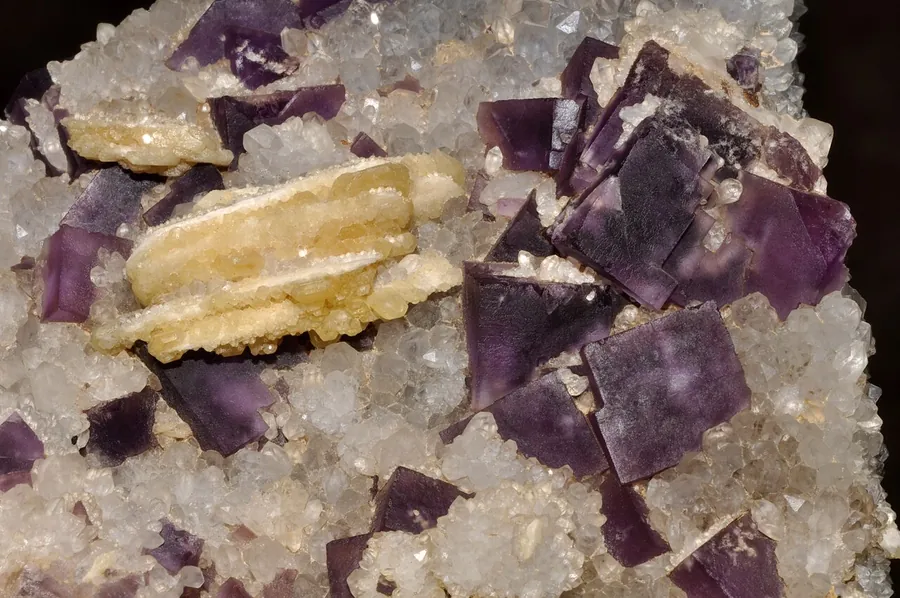
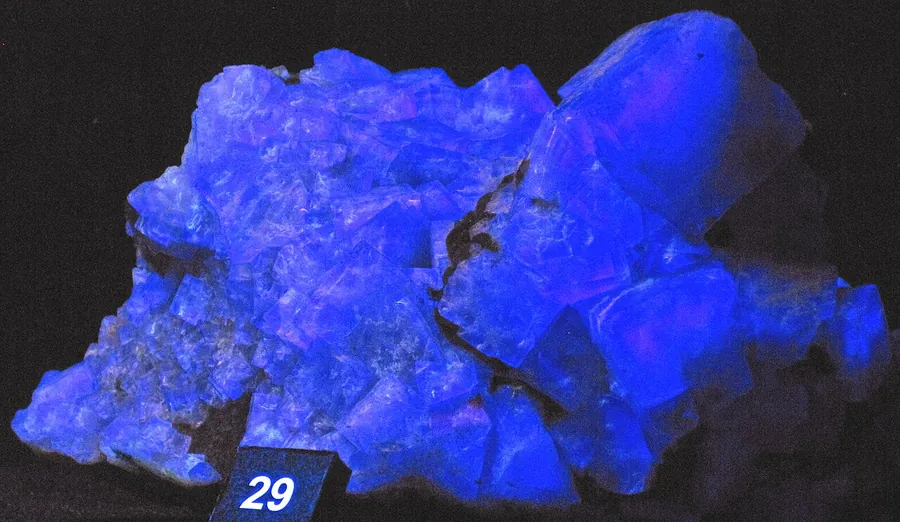
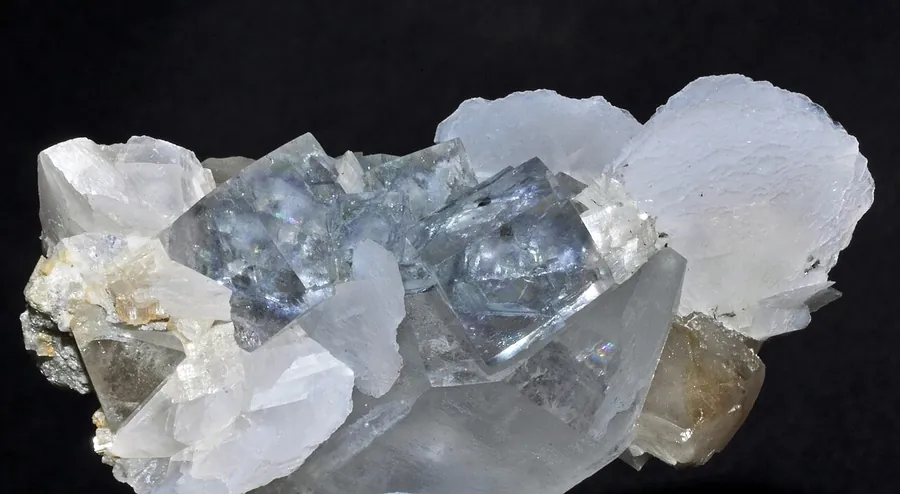
| Natural fluorite | Common imitations | |
|---|---|---|
| What it is | Natural calcium fluoride | Glass, resin, or dyed quartz |
| Colour | Purple, green, blue, yellow; often in bands or zones with sharp edges | Even colour, or swirls that look poured |
| Shape of rough | Cubes, or octahedra with flat cleavage faces | Moulded or tumbled shapes with no cleavage |
| Hardness | 4: a steel knife scratches it | Glass and quartz are harder |
| Under UV light | Many pieces glow blue or violet | Glass rarely glows the same way |
Real fluorite shows its colour in zones and bands that follow the crystal's shape, with sharp straight boundaries, and rough pieces break along flat, shiny cleavage planes. A cheap UV torch makes many fluorites glow blue. Glass imitations have even colour, tiny round bubbles and no cleavage; a "fluorite" sphere with perfectly regular swirls is worth a second look.
Treatments. Most fluorite is sold untreated. Some soft or cracked material is stabilised with resin before cutting, and a small amount is irradiated or heated to change its colour. Fluorite fades in strong sunlight over time, so keep a specimen out of a sunny window. Do not put it in an ultrasonic cleaner or a hot bath, which can crack it along its cleavage; wipe it with a damp cloth. All gem treatments explained.
Pins mark mining districts, not exact mines. Drag to move, pinch or scroll to zoom, tap a pin to read about it. Map data © OpenStreetMap contributors.
Fluorite is soft and splits easily, so it is mostly polished into spheres, towers and tumbled stones, or cut as . Faceted fluorite exists, but it is a collector's stone because it needs careful cutting and careful wear. See cuts from easiest to hardest and whether cutting your own is cheaper than buying cut.
Checked in stock on October 10, 2026. Photos are the listings' own; prices are rounded.
Our first pick
about $16
A pound of natural rough showing the colour zoning that real fluorite has.
See it on AmazonAlso good
about $43
A bag of cleaved blue-green octahedra, the classic way to see fluorite's cleavage.
See it on AmazonAlso good
about $10
Green fluorite still on its host rock, as it grew.
See it on AmazonFive tools that let you check what you bought (a loupe, a UV torch, locking tweezers, a gem box and a pocket scale), plus a turntable that spins your stone under the light the way jewellers show one. The full collector's kit.
 LookGemOro 10x triplet loupeunder $20
 LookDARKBEAM filtered 365 nm UV flashlightabout $10
 HandleHonoson locking tweezers, 3 packabout $10
 StoreTeensery gem display boxes with clear lids, 10 packabout $9
 ShowComXim motorized turntable, adjustable speed and directionabout $15
 MeasureGemOro Platinum XP500 pocket scale, 0.01 gabout $40
In short
Fluorite is a soft, colourful crystal: beautiful on a shelf and under a UV torch, risky on a ring. Buy rough, octahedra or polished pieces, look for colour in sharp bands, and keep it out of the sun and the ultrasonic cleaner.
See our first pick: Zenkeeper rough fluorite, 1 lb, mixed purple and greenMost fluorite is inexpensive. A pound of rough fluorite costs about $15 to $45 on Amazon, and polished spheres and octahedra are usually under $50. Collectors pay more for sharp, brightly coloured crystals from famous localities, such as green fluorescent fluorite from Weardale in England or Blue John from Castleton.
Not for everyday wear. At 4 on the Mohs scale, everyday dust (which contains quartz) scratches it, and a knock can split it along its cleavage. It is better as a pendant, earrings or a specimen.
The shape is natural but usually made by hand. Fluorite grows mostly as cubes, but it splits cleanly along four directions, so miners and cutters tap it apart into eight-sided octahedra. Their flat faces are cleavage planes, not crystal faces.
Traces of elements such as europium and yttrium in the crystal absorb ultraviolet light and give off visible light, usually blue. In 1852 the physicist George Stokes named this effect fluorescence after fluorite.
Handling it is safe; it is the same calcium fluoride that forms in nature everywhere. Do not grind it and breathe the dust, and do not put it in drinking water.
A banded purple and yellow fluorite found only near Castleton in Derbyshire, England, carved into bowls and vases since the 18th century.
Amazon links are affiliate links (tag thegemtray-20): buying through them costs you nothing extra and supports the site. As an Amazon Associate we earn from qualifying purchases.

