As an Amazon Associate, The Gem Tray earns from qualifying purchases. Amazon links on this page are paid links; buying through them costs you nothing extra.
Cut gems, explained in 3D
LearnNovember 2026
A cut gem is a set of tiny mirrors and prisms. Its shape (round, oval, marquise, emerald cut and more) decides how light bounces inside it, and the gem's own and dispersion decide how bright it looks and how much rainbow "fire" it throws. Every stone on this page is a 3D render we made from the real cut geometry and each gem's real optics, so you can compare shapes and stones side by side.
The shapes
Cuts fall into two families. Brilliant cuts use many triangle and kite facets that break light into sparkle. Step cuts use long parallel facets like stairs, for broad flashes and a clear view into the stone. Each shape below is a diamond, rendered with diamond's real optics and turning so you can see how it plays with light. Length-to-width ratios are the usual ranges graders and cutters work to.
Round brilliant Brilliant
Length to width 1.00Facets 57 or 58
Its angles were worked out mathematically by Marcel Tolkowsky in 1919, and it is the only shape GIA gives an overall cut grade.
The most sparkle per carat and the easiest to judge, which is part of why it costs the most per carat.
Oval Brilliant
Length to width 1.30 to 1.50Facets About 56 to 58
The modern oval brilliant was developed around 1960 by the cutter Lazare Kaplan.
Looks bigger than a round of the same weight. Check for a dark "bow-tie" across the middle, which some ovals show.
Marquise Brilliant
Length to width 1.75 to 2.25Facets About 56 to 58
Legend says Louis XV of France had it cut to recall the smile of the Marquise de Pompadour; that story is a legend, not a record.
The largest-looking shape per carat. The two points are fragile, so they are usually protected by V-shaped prongs.
Pear Brilliant
Length to width 1.50 to 1.75Facets About 56 to 58
A teardrop that joins a round end to a point; the shape is old and is often credited to the 15th-century cutter Lodewyk van Berquem.
Look for a symmetrical outline: the two shoulders should match. Protect the point.
Cushion Brilliant
Length to width 1.00 to 1.25Facets Varies, often 58 or more
A square or rectangle with rounded corners, the "pillow" shape, descended from the old mine cut of the 1700s and 1800s.
Softer and more romantic than a princess; great in coloured stones, where it keeps weight and colour.
Princess Brilliant
Length to width 1.00 to 1.05Facets About 50 to 58
A square brilliant with sharp corners, introduced in 1980 and credited to Betazel Ambar and Israel Itzkowitz.
Very bright for a square. The sharp corners chip easily, so they should sit under prongs.
Radiant Brilliant
Length to width 1.00 to 1.35Facets About 70
Created in 1977 by Henry Grossbard: an emerald-cut outline with clipped corners, faceted like a brilliant.
Combines the clean outline of an emerald cut with far more sparkle; the clipped corners make it sturdy.
Emerald cut Step cut
Length to width 1.30 to 1.50Facets About 50, in steps
Named after the stone: cutters used it for emerald because the clipped corners protect a brittle crystal and the shape keeps weight from long rough.
Long parallel "steps" give a hall-of-mirrors look. It shows the inside of a stone clearly, so clarity matters more.
Asscher Step cut
Length to width 1.00 to 1.05Facets About 58, in steps
A square step cut with large clipped corners, created in 1902 by Joseph Asscher of Amsterdam.
Deep, with a concentric "window" pattern looking down into the stone; an Art Deco favourite.
Baguette Step cut
Length to width Long and narrowFacets About 14
Named from the French for a long stick or loaf, and popular in Art Deco jewellery of the 1920s and 30s.
Mostly used as small side stones beside a centre stone, or in rows.
Three things happen when light hits a well-cut gem:
Brilliance: white light that enters the top, bounces off the angled facets underneath and comes back out to your eye. A stone cut too shallow leaks light out the back (a "window"); one cut too deep goes dark in the middle.
Fire: flashes of rainbow colour. A gem bends each colour of light by a slightly different amount (its dispersion), so white light fans out into colours inside the stone.
Scintillation: the sparkle that flickers on and off as the stone, the light or your eye moves.
How much of each you see depends on the material. Refractive index sets how strongly a gem bends light (more brilliance), and dispersion sets how far it spreads the colours (more fire):
Optics of common gems (refractive index and dispersion, standard gemmological values)
Gem
Refractive index
Dispersion
What you see
Diamond
2.42
0.044
The benchmark: bright white sparkle with flashes of colour.
Moissanite
2.65
0.104
More than twice diamond’s fire, so it throws strong rainbows.
Cubic zirconia
2.17
0.060
More fire than diamond, less brilliance.
Zircon (natural)
1.93 to 1.98
0.039
Near-diamond fire, the natural gem CZ is often confused with.
Ruby and sapphire
1.76 to 1.77
0.018
Little fire; their beauty is colour.
Spinel
1.72
0.020
Bright and lively for a coloured stone.
Emerald, aquamarine
1.57 to 1.59
0.014
Gentle sparkle; colour and clarity carry the stone.
Quartz (amethyst, citrine)
1.54
0.013
Glassy look with very little fire.
Glass
About 1.5
About 0.01
Bends light too little to really sparkle.
Same cut, different stone
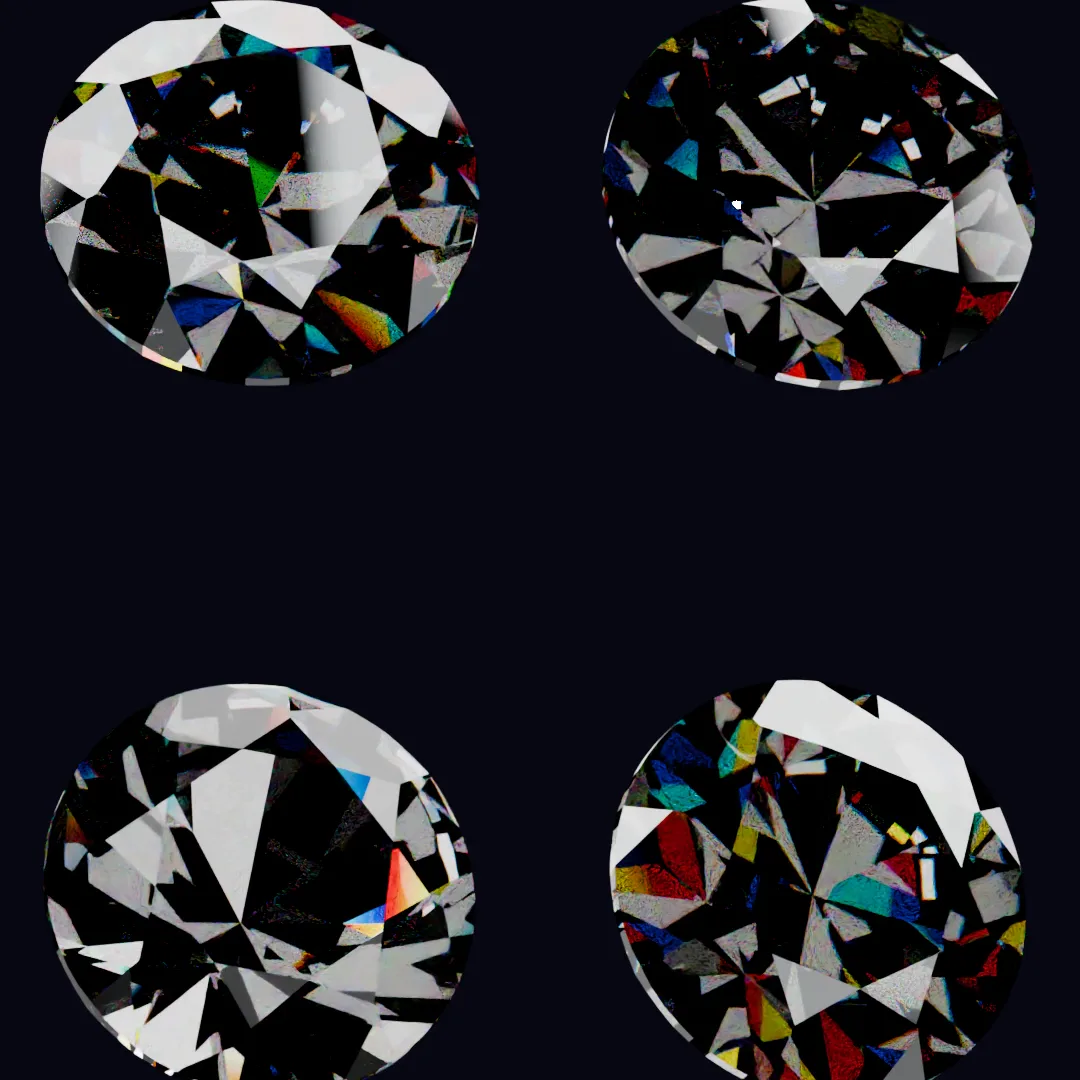
Cut four stones identically and light them the same way, and the material is the only difference. Below, the same round brilliant in cubic zirconia, diamond, glass and moissanite: moissanite throws the most rainbow, glass the least, and diamond sits in between with the crispest white sparkle.
Top: cubic zirconia, diamond. Bottom: glass, moissanite. 3D render by The Gem Tray.
Coloured stones in 3D, each with its own refractive index, dispersion and colour:
Real stones are not perfect, and that is part of them
Our renders show an ideal stone: perfectly cut and flawless. Real gems almost never are. Most natural stones carry , tiny things trapped inside as the crystal grew, and no two are alike, which is why two "identical" stones can look different in the hand. Lab-grown stones have their own tell-tale signs that come from how they were grown. Here is what a gemmologist looks for:
Natural diamond
Tiny crystals of other minerals trapped as it grew, "feathers" (small internal cracks), and clouds of pinpoints. Clarity grades from Flawless to Included describe how much of this a grader sees at 10× magnification.
Natural ruby and sapphire
Fine needles of rutile called "silk", which can give a soft glow or, cut as a , a star. Heating, the most common treatment, partly dissolves the silk, which is one way labs spot a heated stone.
Natural emerald
Almost always included, so much that the French call it the "" (garden). Colombian emeralds can hold three-phase inclusions: a pocket of liquid with a gas bubble and a salt crystal. Most mined emeralds are oiled or resin-filled to hide cracks.
Lab ruby, sapphire and spinel (flame-grown)
Grown by melting powder in a flame (the Verneuil method). Under a loupe they can show and tiny round gas bubbles, which never occur in natural .
Lab gems grown in flux or water
Flux-grown stones can hold wispy "fingerprints" of trapped flux and sometimes flat flakes of platinum from the . Hydrothermal (water-grown) emerald often shows growth zoning and a .
Lab diamond
HPHT diamonds can contain specks of the metal they grew in, so a strong magnet may pull them; CVD diamonds can show faint graining and pinpoints. Many are very clean, and a lab report is the reliable way to know.
Moissanite, CZ and glass
Moissanite is doubly refractive, so facet edges look doubled through the side, and it can hold fine parallel needles. CZ is usually flawless. Glass can show gas bubbles, swirl lines and rounded, moulded facet edges.
Many coloured stones are also treated, most often heated, to improve colour or clarity: see gem treatments explained.
How lab stones are made
A lab-grown gem is the same mineral as the mined one, grown under controlled conditions instead of over millions of years. The main methods: flame fusion (powder melted in a flame and built up drop by drop, used for cheap ruby, sapphire and spinel), pulling from a melt (a seed slowly drawn out of molten material), flux growth (crystals grown from a molten solvent over months), hydrothermal growth (in hot, pressurised water, used for lab emerald and quartz), and for diamond, HPHT (high pressure and temperature, like deep in the earth) and CVD (carbon laid down atom by atom from a gas). The full story, with photos of the rough: how lab gems are grown, and how they compare: lab-grown vs natural.
About our 3D renders
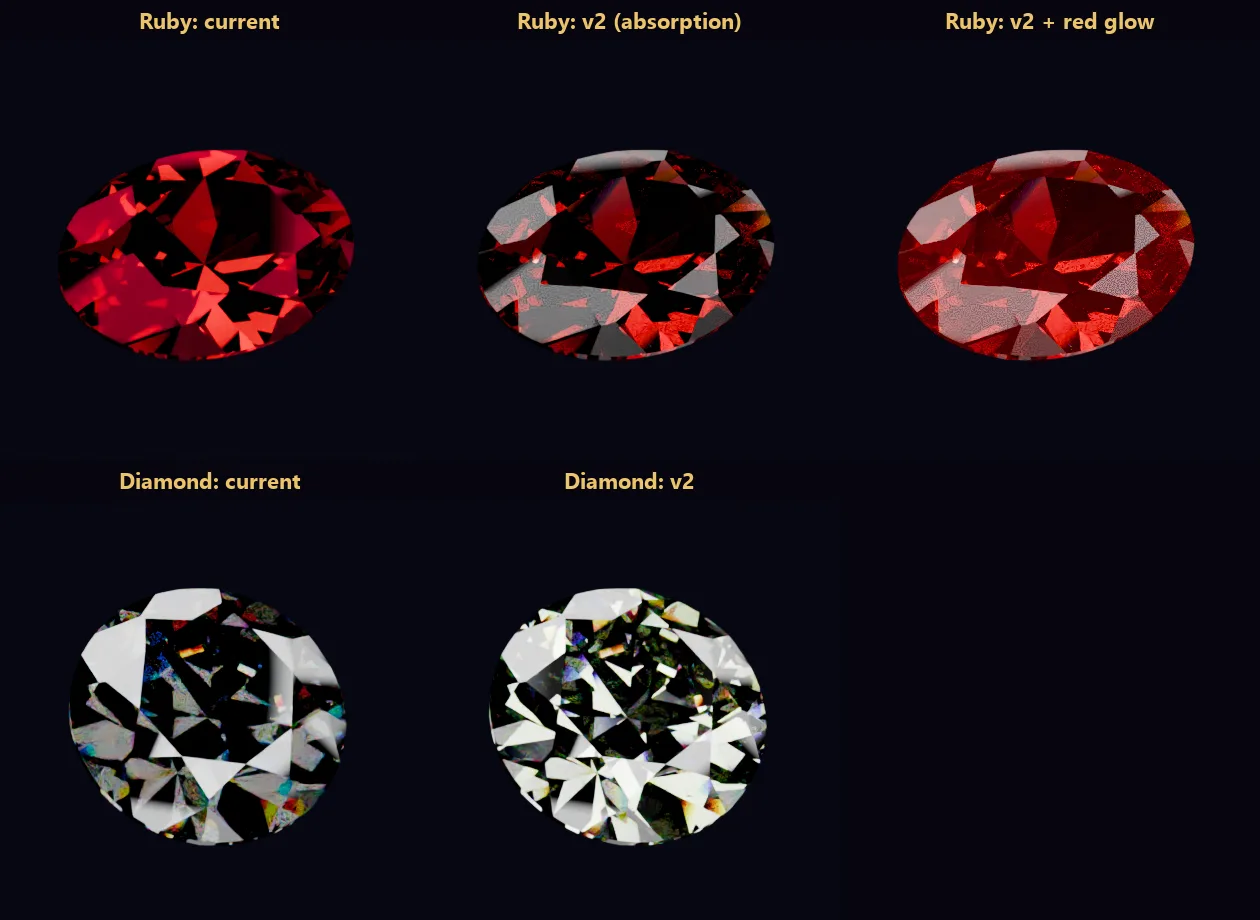
Every stone here is built and lit in code by The Gem Tray. Each cut is modelled facet by facet from its real geometry, and each gem gets its real refractive index and dispersion, so brilliance and fire behave as they do in the real material. Colour comes from how much light the stone absorbs. Not simulated: inclusions, the doubled facet edges of doubly refractive gems such as moissanite, and the endless lighting conditions of real life. We keep improving them; below, our current look beside a newer, more physical one that models how colour deepens with thickness, a smoother spread of fire, jeweller's spotlights, and the red glow () that makes fine rubies look lit from within.
Our render versions compared. 3D renders by The Gem Tray.
Frequently Asked Questions
Which gem cut sparkles the most?
The round brilliant. Its 57 or 58 facets and angles were worked out to send the most light back to your eye, which is why it is the most popular and the most expensive per carat. Radiant, princess and oval are also very bright brilliant-style cuts.
Which cut looks the biggest for its weight?
Elongated shapes: marquise, oval and pear spread their weight over a longer outline, so they look larger face-up than a round of the same carat weight.
What is the difference between a brilliant cut and a step cut?
Brilliant cuts (round, oval, princess, radiant) use many triangular and kite-shaped facets that scatter light into sparkle. Step cuts (emerald, Asscher, baguette) use long parallel facets like stairs, which give broad flashes and a clear look into the stone.
Do real gems look exactly like these 3D renders?
Close, but not exactly. The renders use each gem’s real refractive index and dispersion and a precisely cut shape, so the sparkle and fire behave like the real stone. They show a flawless, ideal stone under studio light; real stones have inclusions, cutting variations and different lighting, and doubly refractive gems such as moissanite are not simulated.
Can you tell a lab gem from a natural one by eye?
Usually not. Lab and natural stones of the same mineral share the same optics. Gemmologists separate them with magnification and lab instruments, looking at inclusions such as curved growth lines and gas bubbles in flame-grown stones or natural crystals and silk in mined ones.