Home tests
How to tell if it’s real
Most home tests can catch a fake but cannot prove a piece is real. A magnet catches steel inside “gold” or “silver”; GP, GF or HGE beside a karat stamp means plated; a thermal diamond tester separates diamond from cubic zirconia but reads moissanite as diamond; a 10x loupe shows moissanite’s doubled facet edges; a CZ weighs far more than a diamond of the same size; and real pearls feel gritty on your teeth. Use two or three tests together, inside the return window, and have a jeweller test anything costly.
We film many of these tests as short videos: see The Gem Tray on YouTube.
Amazon prices as of . Prices and availability are accurate as of that date and time and are subject to change; the price shown on Amazon at the time of purchase applies.
1. Gold
Gold: the magnet test
What you do. Hold a strong magnet against the links of the chain or the band of the ring, away from the clasp.
Real
Solid gold does not move. Gold, silver and copper are diamagnetic: they are very weakly pushed away by a magnet, never pulled towards it.
Fake or not what it claims
If the chain jumps to the magnet, there is steel or iron inside, and it is not solid gold.
What it does not prove. It catches only one kind of fake. Gold-plated brass, copper and silver do not stick either, and nor does most gold-plated stainless steel (316L is non-magnetic when annealed). A steel spring in the clasp can tug a little. The mostly copper “14K” ring NBC 7 reported in 2026 would most likely have passed.
In depth: How to tell if gold is real · Gold-plated steel
2. Gold
Gold: plated or solid: read the stamp (GP, GF, HGE)
What you do. Find the stamp inside the band or beside the clasp with a 10x loupe or your phone’s zoom, and read every letter next to the number.
Real
A karat mark on its own: 10K or 417, 14K or 585, 18K or 750, with a maker’s mark beside it. US law asks whoever stamps a karat mark to put its trademark or name as close to it as possible.
Fake or not what it claims
GP or GEP is gold plate (the FTC’s electroplate example is at least 0.175 microns), HGE is heavy gold electroplate (at least 2.5 microns), GF is gold filled and RGP rolled gold plate: a gold layer over base metal. 925 on a gold-coloured piece means silver under a gold coat.
What it does not prove. A stamp is a claim, not a test: a punch can strike 14K on anything, and the 14K-stamped ring in the NBC 7 report read 0.00 karats. Check the weight and the price per gram against the gold, and for anything costly have a jeweller acid-test or XRF-test it inside the return window.
In depth: How to tell if gold is real · Gold prices per gram · Is gold jewelry on Amazon real?
3. Silver
Silver: the 925 stamp
What you do. Look inside the ring, on or beside the clasp, on the earring post or on the pendant’s bail. Then read the listing’s Metal Type and Material fields, not just the title.
Real
925, S925, Sterling or Ster. means at least 92.5% silver. Expect a maker’s mark beside it, a Metal Type field that says sterling silver, and worn spots that stay white, because sterling is the same alloy all the way through.
Fake or not what it claims
Yellow or pink metal showing through at the edges, the clasp or inside a ring means a white coat over brass or copper. A Material field that says copper or brass beats a title that says 925.
What it does not prove. In the US the 925 is the maker’s or seller’s own claim; only a UK hallmark means an assay office has tested the piece. A bare 925 with no maker’s mark is one more reason to have it tested.
In depth: What does 925 mean? · Is sterling silver on Amazon real?
4. Silver
Silver: the magnet test
What you do. Hold a strong magnet to the chain or the band, away from the clasp.
Real
Nothing you can feel. Silver and copper, the metals in sterling, are diamagnetic.
Fake or not what it claims
If the links or the band jump to the magnet, there is iron or steel inside, and the piece is not solid sterling.
What it does not prove. Silver-plated copper ignores a magnet just as sterling does, and 304 and 316 stainless steel are generally non-magnetic. A slight tug at the clasp can be a steel spring, which the assay rules exempt.
In depth: Is 925 sterling silver magnetic? · Does sterling turn your skin green?
5. Silver
Silver: ePNS, German silver and “silver-tone” are not sterling
What you do. Read the stamp and the listing words before you pay a silver price.
Real
925, S925, sterling, 999 (fine silver) or coin silver (at least 90% silver).
Fake or not what it claims
EPNS means electroplated nickel silver: a coat of silver over nickel silver, an alloy that has no silver in it until it is plated. German silver, nickel silver and alpaca are copper, nickel and zinc with no silver at all. Silver-tone is a colour, not a metal.
What it does not prove. The words only tell you what the seller claims. A piece marked 925 can still be fake, so run the checks above as well.
In depth: What does 925 mean? (the full table) · Sterling silver
6. Diamond
Diamond: the thermal diamond tester
What you do. Touch the probe of a diamond tester to the stone. A thermal tester measures how fast its heated tip loses heat into the stone.
Real
Diamond, mined or lab-grown, reads as diamond: it is the best heat conductor of any gem.
Fake or not what it claims
Cubic zirconia reads as not diamond, because CZ is a thermal insulator.
What it does not prove. Moissanite reads as diamond on a thermal tester, so you need one that also tests electrical conductivity; even that misreads a few weak-reading moissanites and some blue diamonds. A diamond tester cannot tell a lab-grown diamond from a mined one.
In depth: Does moissanite pass a diamond tester? · Can a jeweler tell if a diamond is lab-grown? · Lab diamond vs cubic zirconia

7. Moissanite
Moissanite: doubled facet edges under a 10x loupe
What you do. Tilt the stone and look in through a side facet rather than straight down through the top, and focus on the facet edges at the back.
Real
Moissanite is doubly refractive, so those back edges look doubled.
Fake or not what it claims
Diamond and cubic zirconia are singly refractive and never double.
What it does not prove. It confirms moissanite, not its grade: “D colour”, “VVS1” and “GRA certified” are still the seller’s claims. A stone with no doubling could be diamond or CZ, so follow it with a diamond tester or the weight.
In depth: Is moissanite on Amazon real? · Is a GRA certificate real? · Moissanite vs cubic zirconia
8. Cubic zirconia
Cubic zirconia: cZ weighs more than diamond
What you do. Weigh a loose stone on a scale that reads to 0.01 g (0.05 carat) and measure its width with calipers.
Real
Diamond has a specific gravity of about 3.52: a 6.5 mm round brilliant weighs about 1 carat.
Fake or not what it claims
Cubic zirconia is far denser, 5.6 to 6.0, so a CZ the same 6.5 mm size weighs about 1.6 to 1.7 carats.
What it does not prove. It only works on a loose stone, and allow for cut proportions. Moissanite is lighter than diamond (3.22; a 6.5 mm round is about 0.88 carat), so a stone that is not heavy is not proven diamond.
In depth: Cubic zirconia · The weight checker · Moissanite carat size chart
9. Emerald
Emerald: the Chelsea filter
What you do. Hold the filter close to your eye and look at the stone through it under a bright light.
Real
Emerald coloured by chromium turns red or pink through the filter, as chromium-coloured ruby does.
Fake or not what it claims
Many green glasses and dyed stones stay green.
What it does not prove. Lab emerald is the same coloured the same way, so the filter cannot tell lab from mined. Some emerald is coloured by vanadium instead of chromium, and only many glasses stay green, not all, so a single reading is a clue, not proof. A big, cheap “lab emerald” is usually glass.
In depth: Emerald · Are lab emeralds real emeralds? · How are lab emeralds made?
10. Opal
Opal: what water does to Ethiopian (hydrophane) opal
What you do. Know what to expect before an Ethiopian (Welo) opal gets wet, rather than soaking one to find out.
Real
Much Ethiopian opal is hydrophane: it soaks up water and often turns more transparent for a while, then returns to its normal look as it dries, which can take days. That is normal for that type. Solid Australian opal is fine with water.
Fake or not what it claims
Doublets and triplets are thin opal glued to a backing, sometimes under a quartz cap; water can weaken the glue, so they should never be soaked.
What it does not prove. It is not a real-versus-fake test: it shows an opal is porous, not that it is natural. Hydrophane opal also absorbs chemicals, which can spoil its look, so keep it dry. For glass “opal”, see opalite.
In depth: Opal · Which gems can get wet? · Opalite: is it real opal?
11. Pearl
Pearl: the tooth test
What you do. Rub the pearl gently against the edge of your front teeth.
Real
Real and cultured pearls feel slightly gritty, because nacre is made of tiny overlapping plates. They also feel cool at first and are rarely perfectly identical.
Fake or not what it claims
Imitations, glass, plastic or shell beads coated to look pearly, feel glassy smooth.
What it does not prove. It does not tell natural from cultured, and it does not need to: nearly all pearls sold today are cultured, and cultured pearls are real pearls. Be gentle; pearls are soft.
In depth: Pearl: natural vs cultured vs imitation
12. Hematite
Hematite: the magnet and streak test
What you do. Try a magnet on the beads, and rub one on the unglazed back of a tile.
Real
Natural hematite is only weakly magnetic and leaves a red-brown streak.
Fake or not what it claims
Beads that snap together hard are man-made, sometimes sold as “magnetic hematite” or hematine.
What it does not prove. Golden and rainbow hematite are coated, so you cannot streak-test them without scratching through the coat.
In depth: Hematite
13. Lab ruby
Lab ruby: weight and a 365 nm UV torch
What you do. Weigh and measure the stone and put the numbers in the weight checker; then shine a 365 nm UV torch on it.
Real
is about 60 percent heavier than glass for its size (about 4.0 against 2.5), and lab ruby glows strong red under long-wave UV.
Fake or not what it claims
Ordinary glass lands near 2.5. A “lab ruby” that stays dark under UV deserves a closer look.
What it does not prove. The heaviest glass weighs as much as corundum, and a red glow alone does not prove ruby, so use the two together.
In depth: Ruby · Home tests and the weight checker
Tools for testing at home
Everything on this page needs only a few inexpensive tools. For gold and silver, any strong magnet will do.
 GemOro 10x triplet loupeabout $15
 TEKCOPLUS 2-in-1 diamond and moissanite testerabout $110
 GemOro Platinum XP500 pocket scale, 0.01 gabout $40
 Adoric digital calipersabout $9
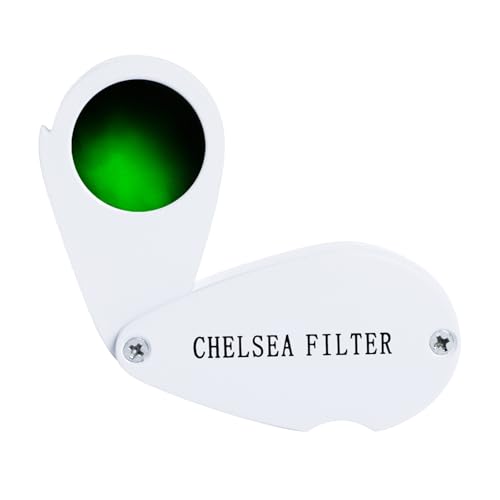 TEKCOPLUS Chelsea filterabout $20
 DARKBEAM filtered 365 nm UV flashlightabout $13
More: the best gem tools on Amazon and the gem collector’s kit.
When a home test is not enough
Run the tests the day the piece arrives and send back anything that fails them. For gold, a jeweller’s acid test or XRF reading settles most questions; for a diamond, buy with an IGI or GIA report and check the report number yourself. Our guide to reading a gem listing shows which listing words you can check at home and which you cannot.
Frequently Asked Questions
How can you tell if gold is real at home?
Read the stamp (10K, 14K or 18K with no GP, GF or HGE beside it, and a maker’s mark), try a strong magnet on the links, and compare the weight and price per gram with the gold. A strong pull from the magnet means steel inside, but no pull proves little, because plated brass and copper do not stick either. For anything costly, have a jeweller acid-test or XRF-test it.
Does a magnet tell you if silver is real?
Only one way round. If a strong magnet pulls the chain or band, there is iron or steel inside and it is not solid sterling. If it does not, that proves little: silver-plated copper and most stainless steel ignore a magnet too.
Is EPNS real silver?
No. EPNS means electroplated nickel silver: a thin coat of silver over nickel silver, an alloy of copper, nickel and zinc that has no silver in it until it is plated.
Can a diamond tester be fooled?
Yes. A thermal diamond tester reads moissanite as diamond, and it reads lab-grown and mined diamond alike. An electrical moissanite tester flags most moissanite, though a few read weakly and some blue diamonds read as moissanite.
Is cubic zirconia heavier than diamond?
Yes. CZ has a specific gravity of 5.6 to 6.0 against about 3.52 for diamond, so a CZ the size of a 1 carat diamond, about 6.5 mm, weighs about 1.6 to 1.7 carats.
Does the pearl tooth test work?
Yes, for imitations. Real and cultured pearls feel slightly gritty against your front teeth, and coated glass or plastic beads feel smooth. It does not tell natural pearls from cultured ones.
Which home test proves a gem is real?
None on its own. Most home tests can only catch a fake. Use two or three together inside the return window, and for anything costly get a jeweller’s test or a laboratory report.
Keep reading
Amazon links are affiliate links (tag thegemtray-20): buying through them costs you nothing extra and supports the site. As an Amazon Associate we earn from qualifying purchases. We describe what each test shows according to the published sources on the linked pages; we are not gemologists and do not certify stones.