
Our first pick
PEORA created pink sapphire solitaire ring, 2.75 ct, sterling silver
about $60
A bright 8 mm round from a long-running lab-gem brand.
See it on Amazon· Al₂O₃ · 9
Updated
Narrated by an AI voice (Kokoro, an open-source voice model) from a script we wrote from this page and its sources, fact-checked line by line.
Pink sapphire is pink corundum, the same mineral as ruby, coloured by a smaller amount of chromium. Where pink ends and ruby begins is a matter of judgement, and markets draw the line differently. It is hard enough for everyday rings, and lab-grown pink sapphire is the same mineral, grown in hours and sold for a small fraction of the price. The pinkish-orange variety is called padparadscha, from a Sinhala word for the lotus flower.
From the rock to the finished piece. How lab gems are grown.
01 In the ground (step 1 of 3)
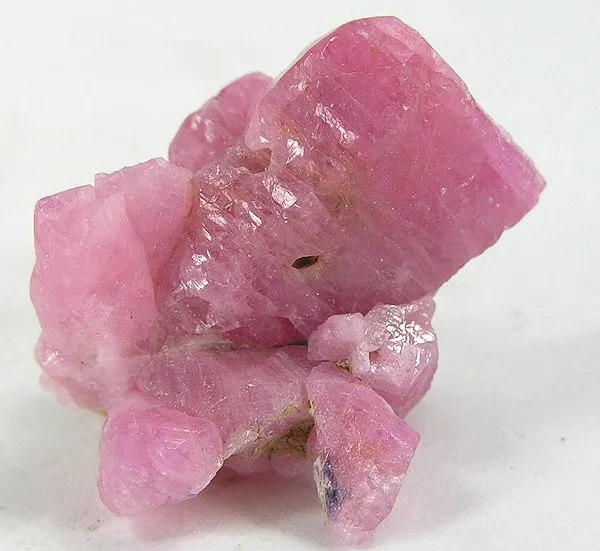
A pink corundum crystal: the same mineral as ruby and blue sapphire, before cutting.
Real specimen. Photo: Robert M. Lavinsky, CC BY-SA 3.0.
02 Cut (step 2 of 3)
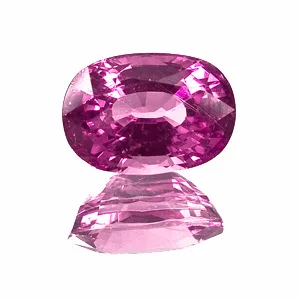
A faceted pink sapphire, 2.10 ct.
Real specimen. Photo: Wiener Edelstein Zentrum, CC BY-SA 3.0.
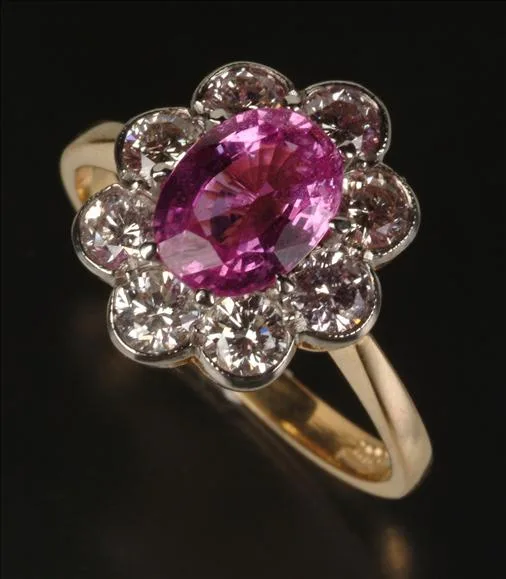
03 Set (step 3 of 3)

A created pink sapphire solitaire ring in sterling silver.
Amazon listing photo. See it on Amazon
| Mined | Lab-grown | |
|---|---|---|
| How it formed | Over millions of years in marble or metamorphic rock | In a flame or a , in hours to weeks |
| Inside | Silk, crystals and colour zoning | Usually clean; flame-grown stones show |
| Treatment | Usually heated; some orange-pink is beryllium-diffused | Normally none |
| Price | Hundreds to thousands of dollars a carat for fine colour | A few dollars a carat |
| Resale | Fine stones hold value | Very little |
All our picks are clearly sold as created or lab-grown pink sapphire. Be careful with very cheap "unheated natural" pink sapphire: big stones at a few dollars are lab-grown or glass, not mined.
Treatments. Most mined pink sapphire is heated, which is standard and permanent. Beryllium diffusion, which drives colour into the stone at very high heat, is used to make orange-pink and padparadscha colours and must be disclosed. Lab pink sapphire is usually untreated. All gem treatments explained.
Pins mark mining districts, not exact mines. Drag to move, pinch or scroll to zoom, tap a pin to read about it. Map data © OpenStreetMap contributors.
Lab pink sapphire is mostly machine-cut in calibrated sizes, which is why a cut lab stone costs little more than its rough. Fine mined stones are often native-cut to keep weight, then recut by precision cutters. See cuts from easiest to hardest and whether cutting your own is cheaper than buying cut.
Listing photos; prices are rounded. How we choose.
Amazon prices as of . Prices and availability are accurate as of that date and time and are subject to change; the price shown on Amazon at the time of purchase applies.
Our first pick
about $60
A bright 8 mm round from a long-running lab-gem brand.
See it on AmazonAlso good
about $85
Intense pink ovals with a halo, sold with a certificate per the listing.
See it on AmazonAlso good
about $100
The same maker in a chain-link band.
See it on Amazon LookGemOro 10x triplet loupeabout $15
 LookDARKBEAM filtered 365 nm UV flashlightabout $13
 HandleHonoson locking tweezers, 3 packabout $10
 StoreTeensery gem display boxes with clear lids, 10 packabout $9
 ShowComXim motorized turntable, adjustable speed and directionabout $14
 MeasureGemOro Platinum XP500 pocket scale, 0.01 gabout $40
In short
Pink sapphire is pink corundum, as hard as any sapphire and coloured by a little chromium. Mined stones are usually heated and cost far more; lab pink sapphire is the same mineral for a few dollars a carat. Ask whether a stone is mined or lab-grown and whether it is heated.
See our first pick: PEORA created pink sapphire solitaire ring, 2.75 ct, sterling silverOnly how strong the red is. Both are corundum coloured by chromium; ruby has more of it and reads as red. Labs and markets draw the line between pink and red differently, so the same stone can be called either.
It is the same mineral, corundum, with the same hardness and optical properties, and it must be sold as lab-grown, created or synthetic. It is not a fake, but it should cost far less than a mined stone.
A rare pinkish-orange sapphire, named from the Sinhala word for the lotus flower, classically from Sri Lanka. Many modern "padparadscha" colours are made by beryllium diffusion, which must be disclosed.
Amazon links are affiliate links (tag thegemtray-20): buying through them costs you nothing extra and supports the site. As an Amazon Associate we earn from qualifying purchases.

