
Our first pick
Le Vian cushion morganite and diamond ring, 14K rose gold
about $660
A natural 1.01 ct morganite from a long-established jeweller, in solid gold.
See it on Amazon· Be₃Al₂Si₆O₁₈ · 7.5 to 8
Updated
Narrated by an AI voice (Kokoro, an open-source voice model) from a script we wrote from this page and its sources, fact-checked line by line.
Morganite is pink to peach beryl, the same mineral as emerald and aquamarine, coloured by a trace of manganese. After a new find of pink beryl in Madagascar, the gemmologist George Kunz named it in 1910 after his friend and customer, the banker and gem collector J.P. Morgan. Much of it is gently heated to remove a yellow tint and leave a cleaner pink. Watch the names on listings: "nano morganite" is a man-made glass-ceramic, not beryl, and "morganite jade" or "morganite agate" beads are dyed stone.
From the rock to the finished piece. Where gems are mined.
01 In the ground (step 1 of 4)
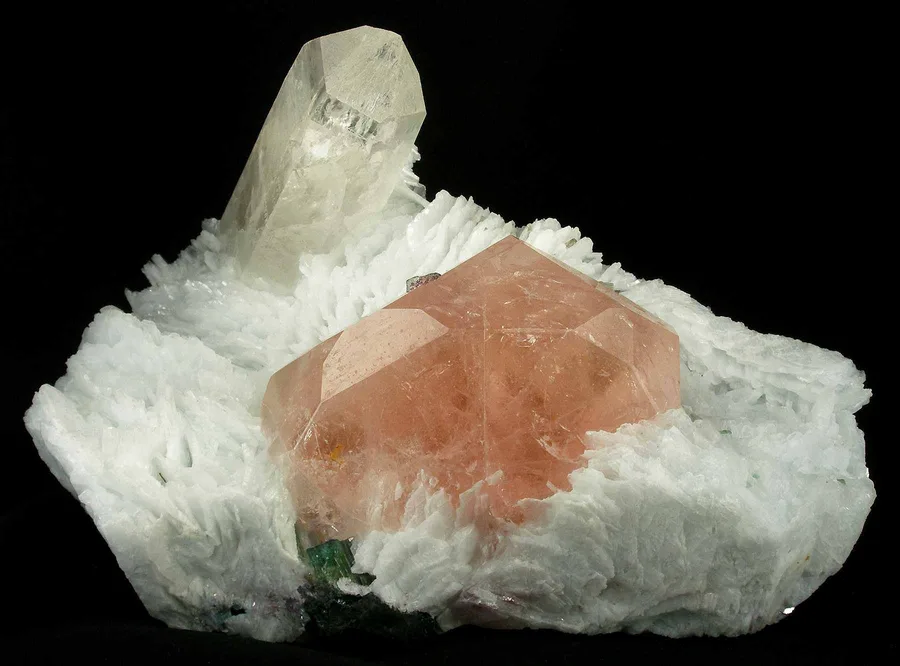
A peach morganite crystal with quartz and white albite, from Brazil.
Real specimen. Photo: Robert M. Lavinsky, CC BY-SA 3.0.
02 Crystal (step 2 of 4)
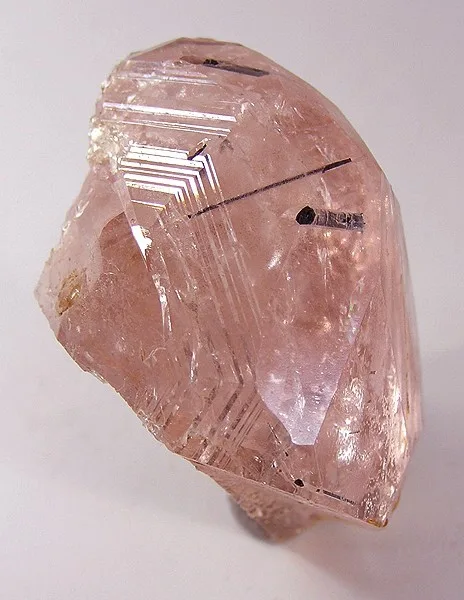
A gem-quality pink morganite crystal.
Real specimen. Photo: Robert M. Lavinsky, CC BY-SA 3.0.
03 Cut (step 3 of 4)
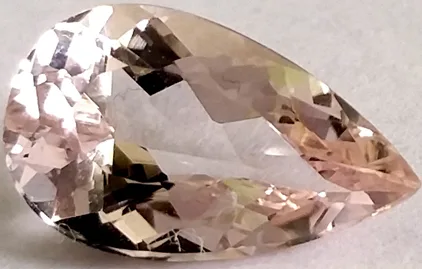
A faceted morganite pear. Pale pink to peach is its natural colour range.
Real specimen. Photo: DonGuennie (G-Empire The World Of Gems), CC BY-SA 4.0.
04 Set (step 4 of 4)

A natural morganite and diamond pendant in sterling silver.
Amazon listing photo. See it on Amazon
| On the listing | What it really is |
|---|---|
| Natural morganite | Pink to peach beryl; often heated, which is standard |
| Nano morganite | A man-made glass-ceramic simulant, not beryl at all |
| Morganite jade or morganite agate | Dyed jade or agate beads named for the colour |
| Lab or synthetic morganite | Lab-grown pink beryl exists but is rare; check the listing says beryl |
| Simulated morganite | Glass or cubic zirconia in a peach colour |
The rings and pendant we picked name natural morganite and come from established jewellery makers. We left out the many cheap "morganite" listings that turn out to be nano morganite, dyed beads or simulants.
Treatments. Heating is common: it removes yellow and leaves a purer pink, and it is permanent. Some morganite is irradiated to deepen the colour. Morganite is hard enough for rings at 7.5 to 8, but it can pick up oils and dirt that dull its sparkle, so clean it often with warm soapy water. All gem treatments explained.
Pins mark mining districts, not exact mines. Drag to move, pinch or scroll to zoom, tap a pin to read about it. Map data © OpenStreetMap contributors.
Morganite is usually pale, so cutters leave stones fairly large and deep to concentrate the colour, often as cushions, ovals and pears. Clean material is common, which is why morganite is sold eye-clean in sizes that would be very expensive in other gems. See cuts from easiest to hardest and whether cutting your own is cheaper than buying cut.
Listing photos; prices are rounded. How we choose.
Amazon prices as of . Prices and availability are accurate as of that date and time and are subject to change; the price shown on Amazon at the time of purchase applies.
Our first pick
about $660
A natural 1.01 ct morganite from a long-established jeweller, in solid gold.
See it on AmazonAlso good
about $110
A small natural morganite at a much lower price.
See it on AmazonAlso good
about $590
A natural 0.90 ct oval centre stone with brown diamonds.
See it on Amazon LookGemOro 10x triplet loupeabout $15
 LookDARKBEAM filtered 365 nm UV flashlightabout $13
 HandleHonoson locking tweezers, 3 packabout $10
 StoreTeensery gem display boxes with clear lids, 10 packabout $9
 ShowComXim motorized turntable, adjustable speed and directionabout $14
 MeasureGemOro Platinum XP500 pocket scale, 0.01 gabout $40
In short
Morganite is pink to peach beryl, coloured by manganese and usually heated. It is hard enough for rings and affordable in large sizes. Check that a listing names natural morganite or beryl, and skip nano morganite and dyed "morganite" beads.
See our first pick: Le Vian cushion morganite and diamond ring, 14K rose goldA man-made glass-ceramic material coloured to look like morganite. It is not beryl and not a natural gem, so it should be priced and sold as a simulant.
It is hard enough at 7.5 to 8 and popular for that reason. It is softer than sapphire or diamond, so it can scratch over the years, and it looks best kept clean.
The gemmologist George F. Kunz, who worked for Tiffany & Co., proposed the name in December 1910, after a new find of pink beryl in Madagascar, in honour of the banker J.P. Morgan, a major gem collector and donor to the American Museum of Natural History.
Amazon links are affiliate links (tag thegemtray-20): buying through them costs you nothing extra and supports the site. As an Amazon Associate we earn from qualifying purchases.

