Is moissanite on Amazon real?
Probably, but check it yourself. All moissanite used in jewellery is lab-grown (GIA), and it has become inexpensive since Charles & Colvard’s patents ran out in 2015 in the US and 2016 in the EU, so swapping in a different stone saves a seller little; we know of no survey of how often listings get it wrong. What a listing cannot prove is the grade: “D colour”, “VVS1” and “GRA certified” are the seller’s claims. A 10x loupe confirms moissanite at home: look in through a side facet and the back facet edges look doubled, the “doubling in the appearance of facet junctions” GIA described in 1997.
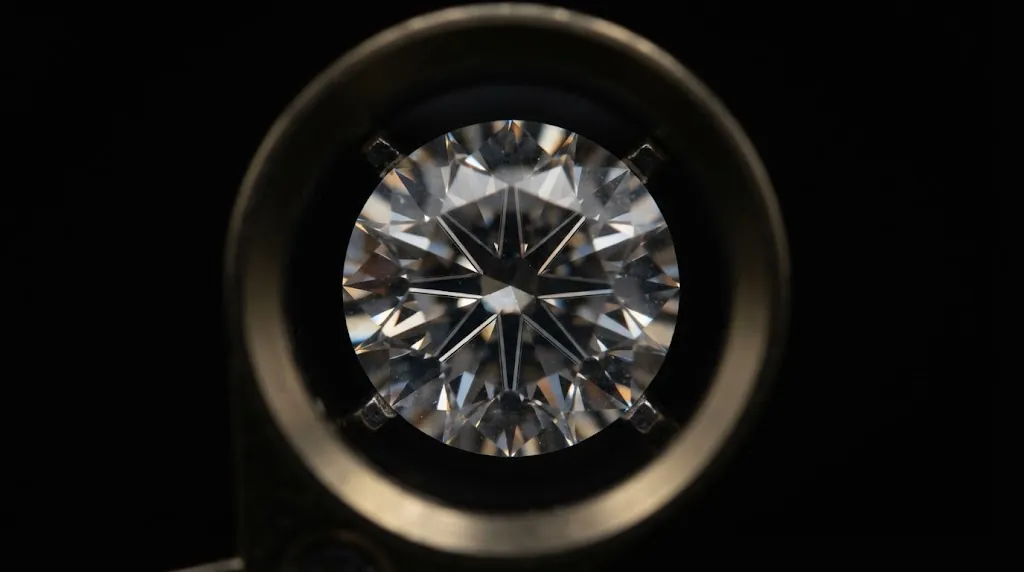
What moissanite is, and why it is cheap
Moissanite is . Natural moissanite is extremely rare, and GIA says all moissanite used in jewellery today is lab-created. Charles & Colvard was the first company to make and sell it, under a US patent; JCK reported in 2016 that its US patent had expired in 2015 and its EU patent in 2016, and that new makers were expected to enter the market. Our page on why moissanite is so cheap has the full story.
What the listing claims mean
Colour letters (D, E, F) and clarity grades (VVS1, VVS2) borrow GIA’s diamond vocabulary; on a moissanite listing they are the seller’s own description. “GRA certified” means a card that comes in the box, not a report from an independent laboratory (see is a GRA certificate real?). None of that makes the stone fake; it means the grade is a claim. Our guide to reading a gem listing goes through the other terms.
How to check it in two minutes
Tilt the stone and look in through a side facet with a 10x loupe, rather than straight down through the top, and focus on the facet edges at the back. Moissanite is doubly refractive, so those edges look doubled. Diamond and cubic zirconia are singly refractive (both are cubic crystals) and never double. An electrical moissanite tester flags most moissanite, because moissanite conducts electricity better than diamond. A thermal “diamond tester” is no help here: GIA found that thermal probes react to moissanite as if it were diamond (see does moissanite pass a diamond tester?).
Frequently Asked Questions
Can Amazon moissanite be cubic zirconia?
It can be, if a seller mislabels it. Cubic zirconia is softer ( 8 to 8.5, against 9.25 for moissanite, according to GIA), much denser (specific gravity 5.6 to 6.0, against 3.22), so it feels heavy for its size, and it shows no doubling. A loupe or a moissanite tester separates them.
Should I return moissanite that fails a diamond tester?
Check it first, and probably yes. Thermal testers react to moissanite as if it were diamond, so a stone that fails one is likely cubic zirconia or glass. Look through a side facet with a 10x loupe: moissanite shows doubled back facet edges and CZ does not; if it does not double, return it inside the window.
Sources
- GIA, Gems & Gemology: Synthetic Moissanite: A New Diamond Substitute (Winter 1997), abstract: thermal probes, doubling of facet junctions
- GIA 4Cs: Diamond Alternatives for Engagement Rings (22 December 2025): all jewellery moissanite is lab-created; hardness 9.25; CZ 8 to 8.5
- JCK: Moissanite: The Post-Patent Era (1 July 2016): US patent expired 2015, EU patent 2016
- Wikipedia: Moissanite (Charles & Colvard, electrical conductivity test)
- Wikipedia: Cubic zirconia (cubic crystal, specific gravity 5.6 to 6.0)
Keep reading
Amazon links are affiliate links (tag thegemtray-20): buying through them costs you nothing extra and supports the site. As an Amazon Associate we earn from qualifying purchases.