Lab ruby, sapphire and emerald tennis jewelry
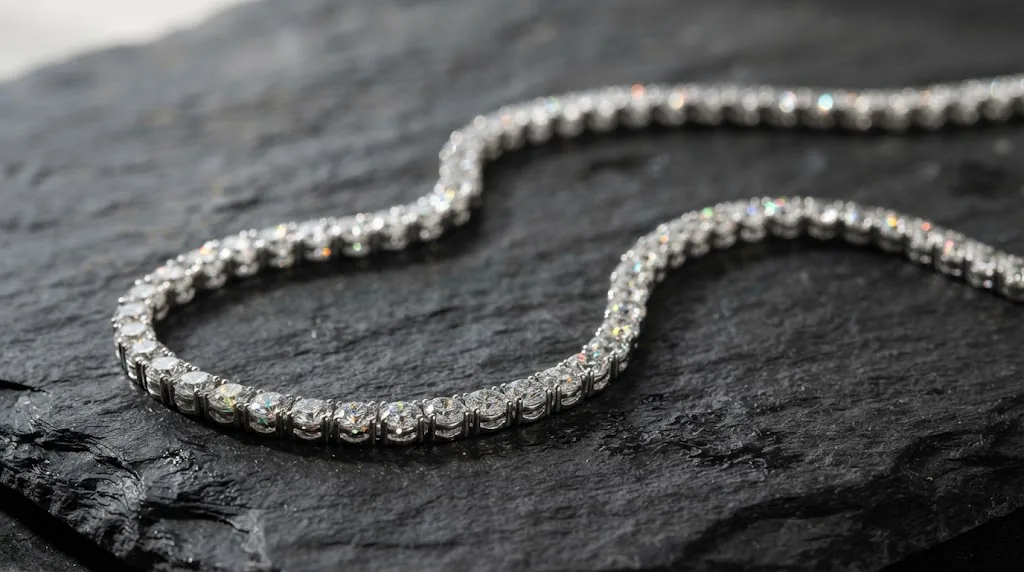
A coloured tennis line is a single row of matching stones like a diamond tennis bracelet, but in red, blue or green. Lab ruby and lab sapphire are the practical choices: they are real corundum, hardness 9, and so cheap to grow that the price of the piece is mostly the metal and the setting. Lab emerald is real beryl but softer (7.5 to 8) and more costly to grow, so an emerald line wants bezel settings and gentler wear. Whatever the stone, look for "lab-created" or "created" in the title, solid sterling silver or gold, and a box clasp with a safety latch.
How we pick: each entry is a kind of piece and the listing details that separate a good one from a bad one, with an Amazon search already narrowed to that spec. Pieces marked We own this are ones we bought with our own money; the rest we have not handled, so we tell you what to look for instead of pretending we tested them. Grades on listings are the seller's claims.
Lab sapphire tennis bracelet
Best for: The everyday coloured line
Sapphire is hard enough (9) to knock around daily, and lab sapphire costs little, so you get a strong blue line for the price of the silver.
Look for
- "Lab-created blue sapphire" or "created sapphire" in the title
- Round or oval stones, 3 to 4 mm
- Four-prong or bezel settings in 925 sterling silver or solid gold
- Box clasp with a safety latch
Lab ruby tennis necklace or bracelet
Best for: A red statement piece
Lab ruby is the same mineral as sapphire in a different colour and just as tough; a red line reads as fine jewellery from across a room.
Look for
- "Lab-created ruby" or "created ruby", not "simulated"
- Equal stones or a graduated line
- Rhodium-plated sterling silver or gold vermeil over silver
Lab emerald tennis line
Best for: Green, worn with care
Emerald is softer and more brittle than ruby or sapphire and chips on hard knocks, which is why the protective setting matters more than the stone size.
Look for
- "Lab-created emerald" or "created emerald"
- Bezel or channel settings that protect the edges
- Take it off for the gym and housework
Men's coloured tennis chain
Best for: A different look from iced-out moissanite
Moissanite chains are everywhere; a sapphire or ruby line is the less common choice, and the same buying rules apply.
Look for
- 4 to 5 mm stones, 20 to 22 inches
- Solid sterling silver, weight in grams listed
- Double safety clasp
Before you buy: the listing checklist
- The stone is "lab-created", "created", "lab-grown" or "synthetic" plus the gem name. "Simulated" means an imitation such as glass or cubic zirconia.
- A cheap line that calls itself "natural ruby" or "natural sapphire" is almost never what it says.
- Metal is 925 sterling silver or solid gold; plated brass wears through.
- Box clasp with at least one safety latch: tennis lines are lost when the clasp opens.
- Length for a bracelet is your wrist plus about 1 cm; 16 to 18 inches for a women's necklace, 20 to 22 for a men's chain.
Frequently Asked Questions
Are lab ruby and sapphire tennis bracelets real rubies and sapphires?
Yes. Lab ruby and sapphire are corundum, the same mineral as mined stones, grown in a factory rather than dug up. They are usually cleaner than affordable mined stones. The word to look for is "lab-created" or "created"; "simulated" is an imitation.
Why are coloured lab tennis bracelets so cheap?
Lab corundum has been grown since the early 1900s by flame fusion and is inexpensive to make, so the stones cost little and most of the price is the silver or gold and the labour of setting each stone.
Is a lab emerald tennis bracelet durable?
Less so than ruby or sapphire. Emerald is 7.5 to 8 on the hardness scale against 9 for corundum, and it is brittle, so edges can chip on hard knocks. Choose bezel or channel settings and take it off for sport and housework.
Why is it called a tennis bracelet?
At the 1978 US Open, Chris Evert's diamond line bracelet came off during a match and play stopped while it was found. The name stuck to any single continuous row of matching stones, whatever the stone.
Keep reading
Amazon links are affiliate links (tag thegemtray-20): buying through them costs you nothing extra and supports the site. As an Amazon Associate we earn from qualifying purchases.