Is it safe to buy an engagement ring or diamond on Amazon?
It can be, if you treat the listing as a claim and check it yourself. Buy a ring whose diamond has an IGI or GIA report number, look that number up on the laboratory’s own website before you pay and again when it arrives, confirm the metal stamp, and have an independent appraiser check the stone inside the return window. For an item sold and shipped by a third-party seller, Amazon’s A-to-z Guarantee covers one that arrives damaged, defective or not as described (Amazon help pages), but the report and the appraisal are what prove you got what you paid for.
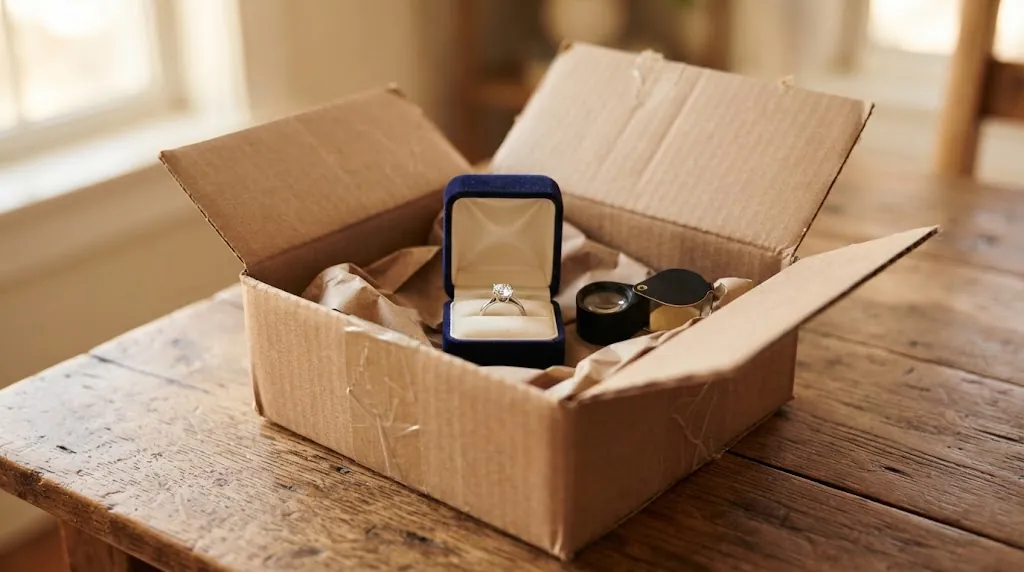
What actually protects you
A report from an independent laboratory (IGI or GIA) whose number you can look up, and the return window on the listing. For an item sold and shipped by a third-party seller, Amazon’s A-to-z Guarantee covers one that arrives damaged, defective or not as described: if the seller has not authorised your return within 48 hours of your request, you can claim from Amazon, within 90 days of the latest possible delivery date. Keep photos and any test results as evidence. A glossy certificate from the seller itself, or a GRA card, is marketing, not protection.
Red flags in an Amazon ring listing
| Words on the listing | What they mean |
|---|---|
| “Simulated diamond”, “diamond simulant”, “imitation” | Not diamond. US rules require a look-alike to be called “imitation” or “simulated” (16 CFR 23.25). |
| “Faux diamond” | The FTC says “faux” is not an adequate disclosure that a stone is not mined (16 CFR 23.25, Note 1). Ask what the stone is. |
| “Cultured diamond” with no “laboratory-grown” beside it | The FTC allows “cultured” only with a clear qualifier such as “laboratory-created” or “laboratory-grown” (16 CFR 23.12(c)(3)). |
| “Real”, “genuine” or “natural” on a lab-grown stone | Not allowed for anything made artificially (16 CFR 23.27). |
| “Moissanite” anywhere in a “diamond ring” listing | Moissanite is a different material. The unqualified word “diamond” may describe only diamond (16 CFR 23.12). |
| “1 ctw”, “1 ct T.W.”, “total carat weight” | The weight of all the diamonds together, not the centre stone: GIA’s example is a 1.00 ct centre with two 0.15 ct side stones, 1.30 carats total. |
| “GIA certified” or “IGI certified” with no report number | Nothing to look up. Ask for the number and check it on the laboratory’s own website. |
| “D colour, VVS1” beside a GIA report on a lab-grown stone dated after 1 October 2025 | GIA no longer gives lab-grown diamonds colour and clarity grades; its assessment says “Premium” or “Standard”. |
| “14K gold plated”, “GP”, “HGE” or “925” on a gold-coloured ring | Not solid gold; see how to tell if gold is real. |
What US rules say a diamond listing must disclose
Since 2018 the FTC Jewelry Guides have defined a diamond as “a mineral consisting essentially of pure carbon crystallized in the isometric system” (16 CFR 23.12), without the word natural, so a lab-grown diamond is diamond. But the listing must say so: the gem’s name must be immediately preceded, with equal conspicuousness, by “laboratory-grown”, “laboratory-created”, “[manufacturer name]-created” or words of like meaning (16 CFR 23.25), and “cultured” is allowed only with such a qualifier (16 CFR 23.12). A look-alike must be called “imitation” or “simulated”, and “faux” is not enough. A lab-grown diamond may not be called “real”, “genuine” or “natural” (16 CFR 23.27).
The five checks, in order
Before you buy: 1) the listing names the laboratory and the report number, and the report you find on the laboratory’s own website matches the listing’s shape, carat weight and measurements, plus its colour and clarity grades on an IGI report, or “Premium” or “Standard” on a GIA lab-grown assessment issued since 1 October 2025; 2) the listing says lab-grown or natural, and “ctw” is not being passed off as the centre stone’s weight; 3) the return window is long enough for an appraisal. When it arrives: 4) check the metal stamp (14K or 585, 18K or 750, or 950 for platinum) and look up the report again; 5) take it to an independent appraiser, ideally a GIA Graduate Gemologist, before the return window closes. Our guide to checking a report number goes step by step.
What a home test cannot tell you
A thermal diamond tester says “diamond” for a lab-grown diamond and a mined diamond alike, and it reads moissanite as diamond too (see does moissanite pass a diamond tester?). GIA says a trained gemmologist can sometimes recognise a lab-grown diamond with standard gem-testing equipment, but in other cases identification requires advanced scientific instruments, so a laboratory report or a qualified appraiser with the right equipment is what settles it.
Frequently Asked Questions
Does Amazon sell real diamonds?
Yes. Amazon lists both lab-grown and mined diamond jewellery from many sellers. The checks on this page cover three ways a listing can mislead: the grade, “total weight” passed off as the centre stone, and plated metal described as gold.
Should I buy an engagement ring on Amazon?
Only one with a report you can verify and a return window long enough for an appraisal. If a listing will not give a report number, buy elsewhere.
Does the A-to-z Guarantee cover a ring that is not as described?
For a ring sold and shipped by a third-party seller, yes: if it arrives damaged, defective or not as described, and the seller has not authorised your return within 48 hours of your request, Amazon lets you claim within 90 days of the latest possible delivery date. Keep the listing, photos and the appraiser’s findings as evidence.
Sources
- Amazon Customer Service: A-to-z Guarantee (third-party sellers; damaged, defective or not as described; 48 hours; 90 days)
- US FTC Jewelry Guides, 16 CFR 23.12: definition and misuse of the word “diamond”, Cornell LII
- US FTC Jewelry Guides, 16 CFR 23.25: laboratory-grown, imitation and simulated stones, Cornell LII
- US FTC Jewelry Guides, 16 CFR 23.27: misuse of “real”, “genuine” and “natural”, Cornell LII
- US FTC Business Blog: “Diamonds and Pearls” and revisions to the Jewelry Guides (24 July 2018)
- GIA: Updated laboratory-grown diamond services to launch October 1 (26 August 2025)
- GIA 4Cs: Nine things about diamond carat weight you need to know (total carat weight, 17 May 2018)
Keep reading
Amazon links are affiliate links (tag thegemtray-20): buying through them costs you nothing extra and supports the site. As an Amazon Associate we earn from qualifying purchases.