How is lab-grown sapphire made?
Lab sapphire is grown four ways, all producing real corundum (aluminium oxide, Mohs 9). Most inexpensive lab sapphire is made by flame fusion, the process Auguste Verneuil announced in 1902: powdered alumina with a trace of iron and titanium for blue falls through a hydrogen-oxygen flame at over 2,000 C and builds a single crystal called a boule, at a cost of cents per carat. Czochralski pulling draws a crystal from molten alumina; flux growth crystallises it from a molten solvent over months; hydrothermal growth deposits it from hot pressurised water over weeks and is the costliest. The colour comes from the same trace elements as in mined sapphire.
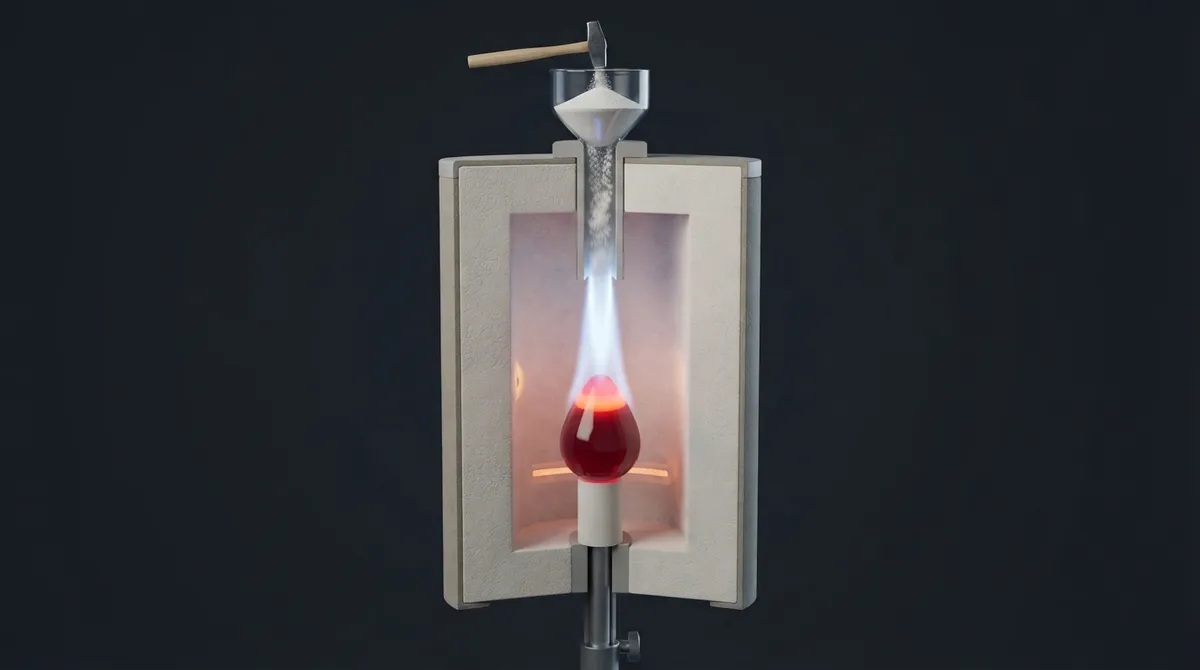
Flame fusion (Verneuil): nearly all cheap lab sapphire
Finely powdered aluminium oxide, with iron and titanium oxides for blue, trickles through an oxyhydrogen flame at over 2,000 C. The molten drops land on a ceramic rod that is slowly lowered, and a rounded single crystal, the boule, builds up: typically about 13 mm across and 25 to 50 mm long, roughly 125 carats. A factory can run close to a thousand furnaces at once, which is why this material fills created-sapphire jewelry under $30 and scratch-resistant watch crystals.
Czochralski pulling
A seed crystal is dipped into molten aluminium oxide in a crucible and slowly pulled upward while rotating, drawing out a single crystal. It was developed for lasers and electronics, which needed cleaner crystals than the flame makes. Pulled sapphire has no curved growth lines and sits between flame fusion and flux in price.
Flux growth
Aluminium oxide and the colouring elements are dissolved in a molten flux in a platinum crucible held at roughly 1,000 to 1,400 C, and corundum crystallises out over months. Growth on flat crystal faces gives straight, angular colour zoning like a mined stone, which is why flux-grown stones were the first synthetics to fool jewelers.
Hydrothermal growth
Nutrient dissolves in a hot, pressurised water solution inside a steel autoclave and deposits on a seed plate over weeks or months. It is the slowest and most expensive way to grow corundum and the rarest in inexpensive jewelry.
How a lab tells them apart
Curved growth lines and round gas bubbles mean flame fusion; no natural crystal grows curved lines. Angular zoning with wispy flux "fingerprints" or platinum platelets means flux. Roiled growth and water-related features in the infrared spectrum mean hydrothermal. Lab blue sapphire often glows chalky blue under short-wave ultraviolet light from titanium in the crystal.
Frequently Asked Questions
Is lab sapphire the same as natural sapphire?
The same mineral: aluminium oxide with the same crystal structure, hardness (9) and refractive index (about 1.76 to 1.77). A refractometer cannot tell them apart; a microscope usually can, from the growth features each process leaves.
Why is lab sapphire so cheap?
Flame fusion builds a boule of roughly 125 carats in a single run, and one factory can operate close to a thousand furnaces at once, so rough flame-fusion corundum can cost a few cents per carat.
What makes lab sapphire blue?
Iron and titanium together, the same pair that colours mined blue sapphire. Chromium instead makes ruby, and vanadium pushes corundum purple or green.
Keep reading
Amazon links are affiliate links (tag thegemtray-20): buying through them costs you nothing extra and supports the site. As an Amazon Associate we earn from qualifying purchases.