Birthstones by month: the lab-created and affordable option for each
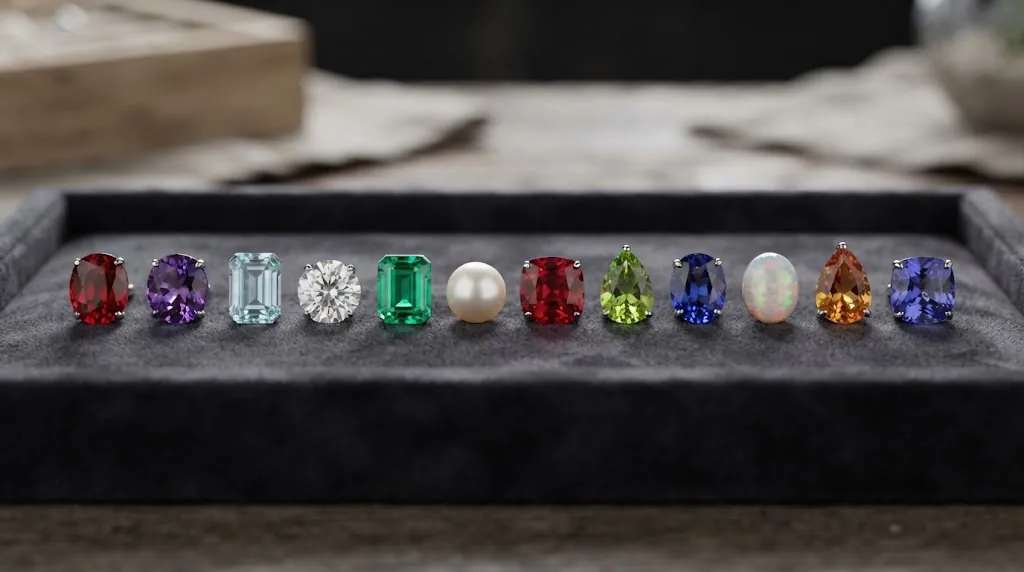
Every month has at least one birthstone. The modern US list was adopted by the National Association of Jewelers (now Jewelers of America) in 1912, and later additions include tanzanite for December in 2002 and spinel for August in 2016 (Wikipedia; International Gem Society). Ruby, sapphire, emerald, spinel and alexandrite are grown in labs (GIA), the same mineral as the mined stone, and April’s diamond comes lab-grown or can be swapped for moissanite. GIA warns that an inexpensive “alexandrite” with a strong red-green colour change is likely a synthetic or simulant. The table gives GIA’s list and what to look for on a listing.
Where the list comes from
In August 1912 the National Association of Jewelers, now Jewelers of America, met in Kansas City and adopted a standard list. The Jewelry Industry Council of America updated it in 1952, adding alexandrite for June, citrine for November and pink tourmaline for October. The American Gem Trade Association added tanzanite for December in 2002, and in 2016 it and Jewelers of America added spinel for August. Several months have more than one stone, so there is usually a choice.
Lab-created vs simulated
Under the US FTC Jewelry Guides, a lab-made stone must carry “laboratory-grown”, “laboratory-created”, “[manufacturer name]-created” or words of like meaning right before the gem’s name, and only if it has essentially the same optical, physical and chemical properties as the mined stone; a look-alike must be called “imitation” or “simulated” (16 CFR 23.25). Sellers may not call a lab-made stone “real”, “genuine” or “natural” (16 CFR 23.27). See lab-created vs simulated.
Cheap alexandrite
GIA says natural alexandrite is rare and valuable, and that an inexpensive gem with a strong red-green colour change is likely to be a synthetic or simulant. It also notes that lab-grown sapphire made with trace elements that give a colour change is sold as “alexandrite sapphire”. A low-priced alexandrite listing should say “lab-created alexandrite” or “simulated alexandrite”, or name the material.
| Month | Birthstone | What to look for | Shop |
|---|---|---|---|
| January | Garnet | Red garnet; any “lab garnet” listing should name the material | Garnet |
| February | Amethyst | Natural amethyst | Amethyst |
| March | Aquamarine, bloodstone | Natural aquamarine; “simulated aquamarine” is a look-alike | Aquamarine |
| April | Diamond | Lab-grown diamond, or moissanite as a look-alike | Moissanite |
| May | Emerald | Lab-created emerald | Lab emerald |
| June | Pearl, moonstone, alexandrite | Cultured pearl or moonstone; a cheap colour-change “alexandrite” is likely lab-made or a simulant (GIA) | Pearl |
| July | Ruby | Lab-created ruby, the same mineral as mined ruby | Lab ruby |
| August | Peridot, spinel | Peridot, or spinel | Peridot |
| September | Sapphire | Lab-created sapphire | Lab sapphire |
| October | Opal, tourmaline | Opal or pink tourmaline | Opal |
| November | Topaz, citrine | Topaz or citrine | Citrine |
| December | Turquoise, tanzanite, zircon | Zircon or turquoise; “simulated tanzanite” is a look-alike | Blue zircon |
Frequently Asked Questions
Is a lab-created birthstone a real birthstone?
It is the same mineral as the mined stone: US rules let a seller call it “laboratory-created” ruby, sapphire, emerald or alexandrite only if it has essentially the same optical, physical and chemical properties as the mined gem (16 CFR 23.25). Sellers may not call it “real” or “genuine” (16 CFR 23.27). Only “simulated” or “imitation” stones are look-alikes.
What is the April birthstone alternative to diamond?
Lab-grown diamond is diamond, grown in a lab. Moissanite is the popular look-alike: GIA gives it a hardness of 9.25 and says it costs much less than comparable diamonds.
Who decides the birthstone list?
Trade groups. The US list was adopted by the National Association of Jewelers (now Jewelers of America) in 1912 and updated in 1952, 2002 and 2016.
Sources
- GIA: Birthstones by month
- International Gem Society: History of birthstones (1912, 1952, 2002, 2016)
- Wikipedia: Birthstone (1912 National Association of Jewelers list; AGTA and Jewelers of America additions)
- GIA: Alexandrite buyer’s guide (inexpensive colour-change gems are likely synthetic or simulant)
- GIA: An introduction to synthetic gem materials (which gems are grown by flame fusion, pulling, flux and hydrothermal methods)
- US FTC Jewelry Guides, 16 CFR 23.25: misuse of the words ruby, sapphire, emerald and others, Cornell LII
- US FTC Jewelry Guides, 16 CFR 23.27: misuse of “real”, “genuine” and “natural”, Cornell LII
Keep reading
Amazon links are affiliate links (tag thegemtray-20): buying through them costs you nothing extra and supports the site. As an Amazon Associate we earn from qualifying purchases.