Lab-grown diamond engagement rings under $1,000
Under $1,000 on Amazon you can buy a 1 carat lab-grown diamond solitaire in 14K gold, listed as IGI certified; each card below shows today’s Amazon price. Put the money into the centre stone and solid metal, then insist on two things before you pay: a report number you type into IGI’s own website yourself, and a return window long enough for an independent appraisal. Most Amazon items can be returned within 30 days of delivery, and Amazon asks for certificates and other inserts to go back with the item.
How we pick: each entry is a kind of piece and the listing details that separate a good one from a bad one, with an Amazon search already narrowed to that spec. We tell you what to look for in each listing. Grades on listings are the seller’s claims.
Amazon prices as of . Prices and availability are accurate as of that date and time and are subject to change; the price shown on Amazon at the time of purchase applies.
1 carat round solitaire in 14K gold
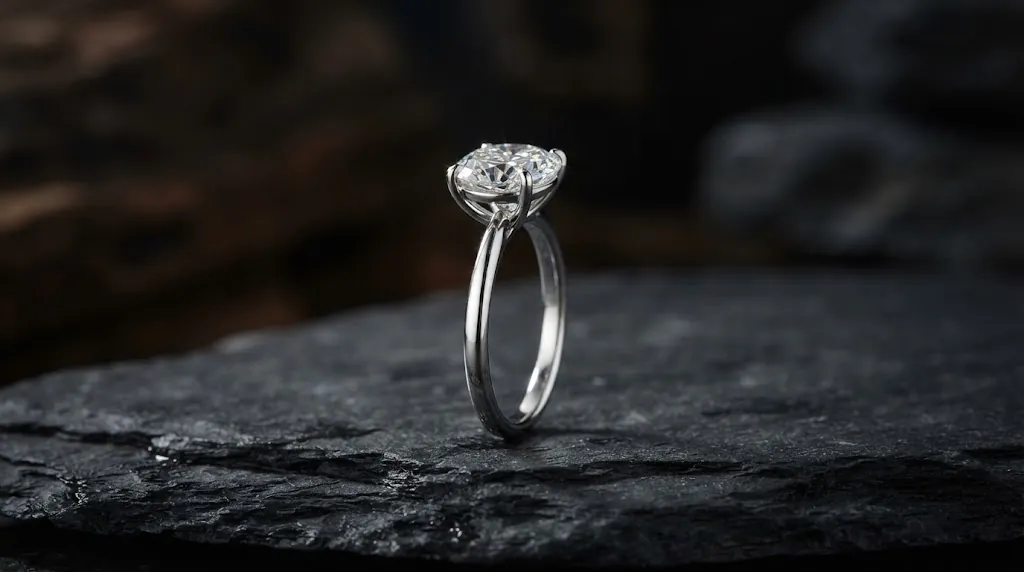
Best for: The classic ring, with the budget in the diamond
A solitaire puts the money into one stone and the metal that holds it, with no small stones to work loose. Lab-grown diamonds of 1.00 to 1.24 ct listed at 19 online retailers had a median asking price of $603 on 16 October 2026 (CaratRadar), which is why a 1 ct ring in 14K gold can come in under $1,000.
Look for
- A 1 ct centre stone: on a solitaire the stone weight and the total weight should be the same number
- IGI named in the title or bullets, and a report number for the stone
- Colour and clarity stated, for example E to F and VS1 to VS2
- Four or six prongs in gold stamped 14K or 585 (18K is 750)

Side stones or a halo
Best for: More sparkle on the hand from a smaller centre
Small stones along the band or round the centre add sparkle, but they count in the total carat weight, and GIA says the size of the centre diamond is the chief driver of price. GIA also says rings with pavé and channel settings cannot be resized easily, so measure the finger before you order.
Look for
- The centre stone’s own weight, not only the total (ctw)
- Side and halo stones that are lab diamond too, not cubic zirconia
- An IGI report number for the centre stone
- Solid 14K gold, in the right size first time: pavé bands are hard to resize
 LynChoe IGI lab diamond with pavé side stones, 14K white goldListing: IGI certified, D to F colour, VVS1 to VS1, pavé lab diamond side stones, four prongs, solid 14K white gold. The title says "1 to 2 Carat" without saying whether that is the centre or the total, so ask.about $670on Amazon →
  LynChoe IGI lab diamond cushion halo with side stones, 14K white goldListing: IGI certified, D to F colour, VS1 to VS2, solid 14K white gold, four prongs, centre stone 0.5, 1 or 2 ct. This link opens the 0.5 ct cushion; check the price of the size you pick.about $750on Amazon →
 Three-stone ring
Best for: A wider look across the finger
Three stones spread the sparkle across the finger. Total weight counts every stone, so a three-stone ring sold as 1 ct total has a centre under 1 ct. GIA’s example: a 1.20 ct centre with a 0.30 ct halo is 1.50 ct total weight.
Look for
- Whether "1 ct" means the centre stone or all three stones together
- A report that covers the centre stone, not only a brand certificate
- Side stones matched in size and colour
- A 14K or 585 stamp

Platinum solitaire
Best for: A stronger metal for the prongs
GIA calls platinum denser and stronger than gold, with prongs less likely to break, and says the rhodium plating on white gold wears away gradually and needs replating now and then.
Look for
- Marked Platinum or 950: under FTC guidance only metal of at least 950 parts per thousand may be called plain Platinum, and 850 to 950 must show its number, as in 850Pt
- An IGI report number, not only "graded to IGI standards"
- A 1 ct round centre, prong set

Matching wedding band
Best for: The band to wear with it
A row of small lab diamonds sits beside the engagement ring. Get the size right first: GIA says eternity rings can be very difficult to resize.
Look for
- The same metal and colour as the engagement ring
- The total weight (ctw) and the stones’ colour and clarity
- A half eternity band if the size might change: full eternity bands are very hard to resize
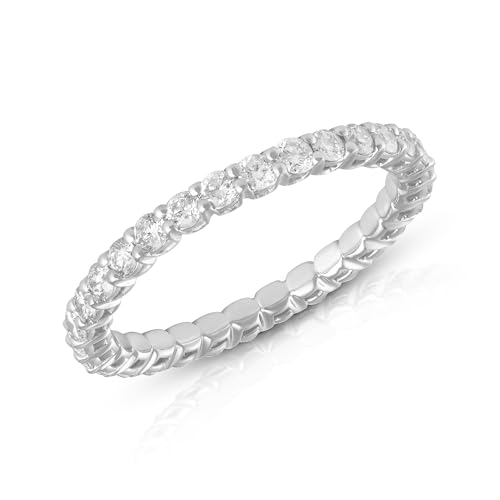 Amazon Essentials IGI lab diamond eternity band, 1 ct total, 14K white goldListing: IGI certified, G to H colour, VS1 to VS2, solid 14K white gold stamped 14k, sizes 5 to 8 including half sizes.about $590on Amazon →
  INDRI lab diamond half eternity band, 0.30 ct total, 10K yellow goldListing: solid 10K gold, 0.30 ct total, D to E colour, VVS1, "certified" diamonds without naming a laboratory.about $200on Amazon →
 Proposal placeholder in sterling silver
Best for: Proposing now and choosing the ring together later
GIA notes that sterling silver is rarely used for engagement rings: it is soft, can scratch and tarnishes. As a stand-in for the proposal it leaves the main budget for the ring you choose together.
Look for
- Read "14K gold plated sterling silver" as silver with a gold coating: the 14K is the coating, not the ring
- "Vermeil" also means sterling silver under the gold, by the FTC’s definition
- IGI named even at 0.3 ct, with a report number you can look up

Before you buy: the listing checklist
- A report number before you pay. If the listing only says "IGI certified", ask the seller for the number, then type it into IGI’s Verify Your Report page yourself rather than following a link or QR code from the seller.
- The report matches the listing: shape, carat weight, colour and clarity, measurements, and "laboratory-grown". A ring may come with an IGI Jewelry Report; where it says "graded as mounting permits", colour and clarity are given as a range such as D-E.
- The centre stone’s weight, not "ctw": total weight adds up every stone in the ring.
- The metal stamp: 14K or 585, 18K or 750, or Platinum or 950. "Gold plated" and "vermeil" mean silver or another metal under the gold.
- A return window long enough for an appraisal. Most Amazon items can be returned within 30 days of delivery; check the return eligibility on the listing and the return-by date in your order.
- Keep the box, the report and every insert: Amazon asks for returns in the original packaging, certificates of authenticity included.
- Book an independent appraiser in the first week. IGI says its report is an opinion, not a guarantee, appraisal or warranty, so have the stone checked against it while you can still return the ring.
- Know the ring size: GIA says most rings can be resized by a size or two, but pavé, channel-set and eternity bands are hard to resize.
Frequently Asked Questions
Can you get a real 1 carat diamond engagement ring for under $1,000?
Yes, if it is lab-grown. The US Federal Trade Commission’s Jewelry Guides define diamond as a mineral of essentially pure carbon crystallised in the isometric system, with nothing about being mined, and treat it as deceptive to sell a lab-grown one without a word such as laboratory-grown or laboratory-created. Lab-grown diamonds of 1.00 to 1.24 ct listed at 19 online retailers had a median asking price of $603 on 16 October 2026 (CaratRadar), which leaves room for a 14K gold setting.
Is "IGI certified" on an Amazon ring the same as having an IGI report?
Only if a report number comes with it. Some listings say "IGI certified" in the title but only "graded as per GIA IGI standards" or "certificate of authenticity" in the details, and those are the seller’s words, not a laboratory report. Ask for the number before you buy and look it up on igi.org.
Why does the listing give a range like E-F or VS1-VS2?
Usually because the stone was graded in its setting. IGI says that when its Jewelry Report carries the comment "graded as mounting permits", colour and clarity are stated as a range, such as D-E or SI1-SI2, with an estimated cut grade. If the stone was graded before it was set, the report says so and gives standard single grades.
How long do I have to return an engagement ring bought on Amazon?
Most items sold on Amazon.com can be returned within 30 days of delivery, and some sellers state their own 30-day policy on the listing. Check the listing before you order and the return-by date in your order afterwards, and send the ring back in its original packaging with the report and any certificate of authenticity.
Can a jeweller match the diamond to its report?
Often, yes. IGI says every lab-grown diamond it grades gets a laser inscription identifying it as laboratory-grown, and that a report number inscribed on the girdle lets the stone be identified quickly under magnification. Ask the appraiser to read the inscription and compare it with the report.
Sources
- CaratRadar, 1 carat lab-grown diamond prices (data 16 October 2026)
- IGI, Verify Your Report
- IGI, Jewelry Reports (graded as mounting permits; Laserscribe report-number inscription)
- IGI, Diamond grading process (laser inscription)
- GIA, Nine Things About Diamond Carat Weight You Need to Know (17 May 2018)
- GIA, How to Determine Ring Size (18 Jan 2018)
- GIA, 10 Tips for Buying a Diamond Engagement Ring (21 Jul 2022)
- GIA, Choosing Between White Gold, Platinum, Palladium, and Silver (29 Jun 2015)
- US FTC Jewelry Guides, 16 CFR 23.12 (definition of diamond)
- US FTC Jewelry Guides, 16 CFR 23.25 (laboratory-grown stones must be qualified)
- US FTC Jewelry Guides, 16 CFR 23.4 (vermeil)
- US FTC Jewelry Guides, 16 CFR 23.6 (platinum)
- UK Hallmarking Act 1973, Schedule 1 (14 carat = 585, 18 carat = 750 parts per thousand)
- Amazon, Returns and refunds policy
Keep reading
Amazon links are affiliate links (tag thegemtray-20): buying through them costs you nothing extra and supports the site. As an Amazon Associate we earn from qualifying purchases.