Real or lab? The loupe test
Nine stones, nine clues, each one something a jeweller or gemologist would actually see. Call it mined, lab-grown, moissanite or can't tell. Most people get the first round wrong: a lab diamond is real diamond, and nobody can tell it from a mined one by eye.
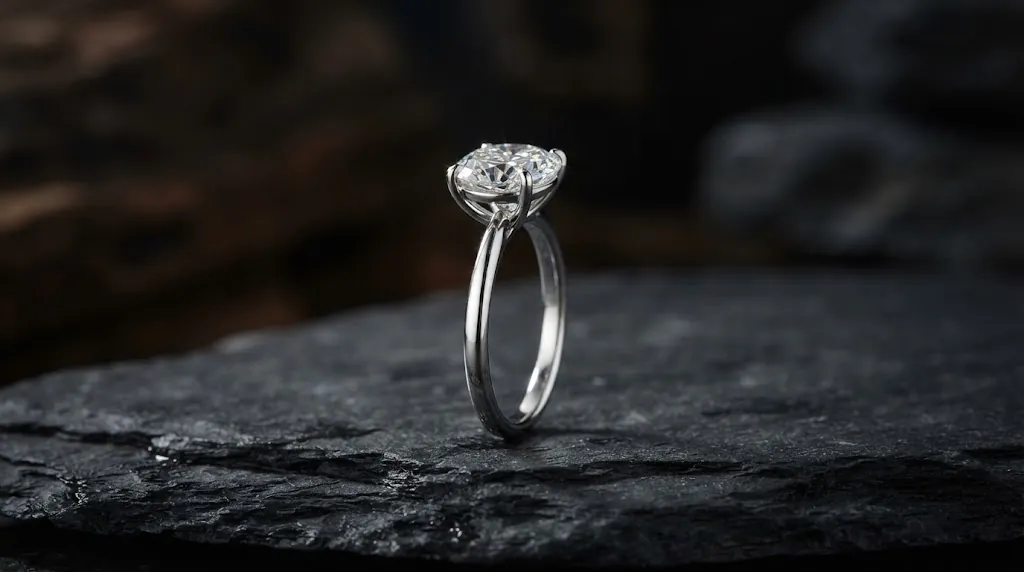
A one-carat round diamond on a ring. It is bright, white and flawless to the naked eye. Mined or lab?
0/9
If a trained eye can't tell them apart and a diamond tester can't either, what a mined stone sells is its origin story. Whether that is worth several times the price is up to you; here is what actually differs.
Link copied.
Keep going
- Lab-grown vs natural: what is actually different
- Moissanite vs lab diamond
- How lab gems are grown: flame fusion, flux, hydrothermal, HPHT and CVD
- Fine diamonds, lab and mined, with reports
Frequently Asked Questions
Can you tell a lab diamond from a mined diamond by eye?
No. A lab-grown diamond is real diamond with the same chemistry, hardness and optics. Jewellers cannot separate them by eye or usually with a loupe; it takes laboratory instruments that read fluorescence patterns, growth structure and trace nitrogen.
Will a diamond tester tell me if a diamond is lab-grown?
No. A thermal diamond tester reads lab diamond as diamond because it is diamond, and it reads moissanite as diamond too. An electrical (conductivity) tester separates moissanite; only a gem lab separates lab from mined diamond.
How do I tell moissanite from diamond at home?
Use a 10x loupe and look into the stone through a side facet: moissanite is doubly refractive, so facet edges appear doubled. Diamond never doubles. Moissanite also throws noticeably more rainbow fire.
How do I prove a diamond is mined?
With a report from a major lab such as GIA that states natural origin, and a matching report number laser-inscribed on the girdle, which an appraiser can read under magnification.